
Homework Answers
Add Answer to:
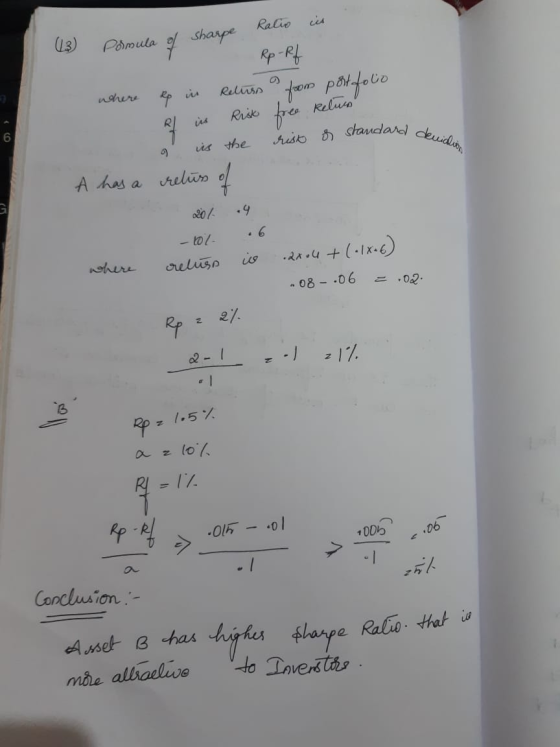
13) An important measure of asset performance is called Sharpe ratio which is defined as ,...
13) An important measure of asset performance is called Sharpe ratio which is defined as SR=***,...
 13) An important measure of asset performance is called Sharpe ratio which is defined as SR=***, where R and o are the asset return and volatility (standard deviation of returns) respectively, and Rf is risk-free return. Asset A has a return of 20% in upside state with probability of 0.4 and -10% in downside state with probability of 0.6 Asset B offers a 1.5% return with a volatility of 10%. Given a risk-free rate of 1%, which asset (A or...
13) An important measure of asset performance is called Sharpe ratio which is defined as SR=...
 13) An important measure of asset performance is called Sharpe ratio which is defined as SR= , where R and o are the asset return and volatility (standard deviation of returns) respectively, and Rf is risk-free return. Asset A has a return of 20% in upside state with probability of 0.4 and -10% in downside state with probability of 0.6 Asset B offers a 1.5% return with a volatility of 10%. Given a risk-free rate of 1%, which asset (A...
8.2 The coefficient of variation is a better measure of stand-alone risk than standard deviation because...
 8.2
The coefficient of variation is a better measure of stand-alone risk than standard deviation because it is a standardized measure of risk per unit; it is calculated as the -Select- divided by the expected return. The coefficient of variation shows the risk per unit of return, so it provides a more meaningful risk measure when the expected returns on two alternatives are not -Select- .. The Sharpe ratio compares the asset's realized excess return to its -Select- over a...
8.2
The coefficient of variation is a better measure of stand-alone risk than standard deviation because it is a standardized measure of risk per unit; it is calculated as the -Select- divided by the expected return. The coefficient of variation shows the risk per unit of return, so it provides a more meaningful risk measure when the expected returns on two alternatives are not -Select- .. The Sharpe ratio compares the asset's realized excess return to its -Select- over a...
29) Which of the following statements is FALSE? A) The Sharpe ratio of the portfolio tells us how much our expected...
 29) Which of the following statements is FALSE? A) The Sharpe ratio of the portfolio tells us how much our expected retun will increase for a given increase in volatility B) We should continue to trade securities until the expected r return of each security equals its required return. Q) The required return is the expected return that is necessary to compensate for the risk that an investment will contribute to the portfolio. D) If security is required retun exceeds...
The Sharpe ratio measure on a portfolio which earns 12 percent, with a standard deviation of...
The Sharpe ratio measure on a portfolio which earns 12 percent, with a standard deviation of 30 percent and beta of 1.27 is: A. 0.40 B. 0.094 C. 0.508 D. There is not enough information. I am leaning towards not having enough information because the Sharpe's ratio also needs the average risk-free rate of return. Am I correct?
2) You want to evaluate three mutual funds using the Sharpe measure for performance evaluation. The...
 2) You want to evaluate three mutual funds using the Sharpe measure for performance evaluation. The risk-free return during the sample period is 5%. The average returns, standard # deviations, and betas for the three funds are given below, as are the data for the S&P 500 Index. Average Return Residual Standard Deviation Beta Fund A 23 % 30 % 1.3 Fund B 20 % 19 % 1.2 Fund C 19 % 17 % 1.1 S&P 500 18 15 %...
CFA Question James Chan is reviewing the performance of the global equity managers of the Jarvis...
CFA Question James Chan is reviewing the performance of the global equity managers of the Jarvis University endowment fund. Williamson Capital is currently the endowment fund’s only large-capitalization global equity manager. Performance data for Williamson Capital are shown in Table 18.10. TABLE 18.10 Williamson Capital performance data, 2007-2018 Average annual rate of return=22.1% Beta=1.2% Standard deviation of returns=16.8% Chan also presents the endowment fund’s investment committee with performance information for Joyner Asset Management, which is another large-capitalization global equity manager....
3. Which of the following statements are true? Please Explain. a. A lower allocation to the...
 3. Which of the following statements are true? Please Explain. a. A lower allocation to the risky portfolio reduces the Sharpe (reward-to-volatility) ratio. b. The higher the borrowing rate, the lower the Sharpe ratios of levered portfolios. c. With a fixed risk-free rate, doubling the expected return and standard deviation of the risky portfolio will double the Sharpe ratio. d. Holding constant the risk premium of the risky portfolio, a higher risk-free rate will increase the Sharpe ratio of investments...
per uhit of risk. The Sharpe ratio is calculated as: performed better, because they generated higher...
 per uhit of risk. The Sharpe ratio is calculated as: performed better, because they generated higher Sharpe ratio(Return - Risk-free rate)/a Quantitative Problem: You are given the following probability distribution for CHC Enterprises: State of Economy Probability Rate of return Strong 0.20 22% Normal 0.50 8% Weak 0.30 -5% What is the stock's expected return? Do not round intermediate calculations. Round your answer to two decimal places. % What is the stock's standard deviation? Do not round intermediate calculations. Round...
Please solve question 1 and 2. The following data are available relating to the performance of...
 Please solve question 1 and 2.
The following data are available relating to the performance of High Variance Stock Fund and the market portfolio High Variance Market Portfolio 19% Average Return Standard Deviation of Returns 12% 35% 15% Beta 1.5 1.0 Residual standard deviation 3.0% 0.0% The risk-free return during the sample period was 6%. (1) Evaluate the performance of the High Variance Stock Fund relative to the market portfolio in terms of the Sharpe measure, the Treynor measure, the...
Please solve question 1 and 2.
The following data are available relating to the performance of High Variance Stock Fund and the market portfolio High Variance Market Portfolio 19% Average Return Standard Deviation of Returns 12% 35% 15% Beta 1.5 1.0 Residual standard deviation 3.0% 0.0% The risk-free return during the sample period was 6%. (1) Evaluate the performance of the High Variance Stock Fund relative to the market portfolio in terms of the Sharpe measure, the Treynor measure, the...
 13) An important measure of asset performance is called Sharpe ratio which is defined as SR=***, where R and o are the asset return and volatility (standard deviation of returns) respectively, and Rf is risk-free return. Asset A has a return of 20% in upside state with probability of 0.4 and -10% in downside state with probability of 0.6 Asset B offers a 1.5% return with a volatility of 10%. Given a risk-free rate of 1%, which asset (A or...
 13) An important measure of asset performance is called Sharpe ratio which is defined as SR= , where R and o are the asset return and volatility (standard deviation of returns) respectively, and Rf is risk-free return. Asset A has a return of 20% in upside state with probability of 0.4 and -10% in downside state with probability of 0.6 Asset B offers a 1.5% return with a volatility of 10%. Given a risk-free rate of 1%, which asset (A...
 8.2
The coefficient of variation is a better measure of stand-alone risk than standard deviation because it is a standardized measure of risk per unit; it is calculated as the -Select- divided by the expected return. The coefficient of variation shows the risk per unit of return, so it provides a more meaningful risk measure when the expected returns on two alternatives are not -Select- .. The Sharpe ratio compares the asset's realized excess return to its -Select- over a...
8.2
The coefficient of variation is a better measure of stand-alone risk than standard deviation because it is a standardized measure of risk per unit; it is calculated as the -Select- divided by the expected return. The coefficient of variation shows the risk per unit of return, so it provides a more meaningful risk measure when the expected returns on two alternatives are not -Select- .. The Sharpe ratio compares the asset's realized excess return to its -Select- over a...
 29) Which of the following statements is FALSE? A) The Sharpe ratio of the portfolio tells us how much our expected retun will increase for a given increase in volatility B) We should continue to trade securities until the expected r return of each security equals its required return. Q) The required return is the expected return that is necessary to compensate for the risk that an investment will contribute to the portfolio. D) If security is required retun exceeds...
 2) You want to evaluate three mutual funds using the Sharpe measure for performance evaluation. The risk-free return during the sample period is 5%. The average returns, standard # deviations, and betas for the three funds are given below, as are the data for the S&P 500 Index. Average Return Residual Standard Deviation Beta Fund A 23 % 30 % 1.3 Fund B 20 % 19 % 1.2 Fund C 19 % 17 % 1.1 S&P 500 18 15 %...
 3. Which of the following statements are true? Please Explain. a. A lower allocation to the risky portfolio reduces the Sharpe (reward-to-volatility) ratio. b. The higher the borrowing rate, the lower the Sharpe ratios of levered portfolios. c. With a fixed risk-free rate, doubling the expected return and standard deviation of the risky portfolio will double the Sharpe ratio. d. Holding constant the risk premium of the risky portfolio, a higher risk-free rate will increase the Sharpe ratio of investments...
 per uhit of risk. The Sharpe ratio is calculated as: performed better, because they generated higher Sharpe ratio(Return - Risk-free rate)/a Quantitative Problem: You are given the following probability distribution for CHC Enterprises: State of Economy Probability Rate of return Strong 0.20 22% Normal 0.50 8% Weak 0.30 -5% What is the stock's expected return? Do not round intermediate calculations. Round your answer to two decimal places. % What is the stock's standard deviation? Do not round intermediate calculations. Round...
 Please solve question 1 and 2.
The following data are available relating to the performance of High Variance Stock Fund and the market portfolio High Variance Market Portfolio 19% Average Return Standard Deviation of Returns 12% 35% 15% Beta 1.5 1.0 Residual standard deviation 3.0% 0.0% The risk-free return during the sample period was 6%. (1) Evaluate the performance of the High Variance Stock Fund relative to the market portfolio in terms of the Sharpe measure, the Treynor measure, the...
Please solve question 1 and 2.
The following data are available relating to the performance of High Variance Stock Fund and the market portfolio High Variance Market Portfolio 19% Average Return Standard Deviation of Returns 12% 35% 15% Beta 1.5 1.0 Residual standard deviation 3.0% 0.0% The risk-free return during the sample period was 6%. (1) Evaluate the performance of the High Variance Stock Fund relative to the market portfolio in terms of the Sharpe measure, the Treynor measure, the...
Most questions answered within 3 hours.
-
Where is the error in this code sequence?
String s1 = "Hello";
String s2 = "ello";...
asked 11 months ago -
Financial data for Joel de Paris, Inc., for last year
follow:
Joel de Paris, Inc.
Balance...
asked 11 months ago -
Consider this reaction:
Al2(SO4)3 (aq)+ BaCl3
(aq) Al2Cl6 (aq)- +
3BaSO4(s) . What is the...
asked 11 months ago -
Suppose that Savneet is considering increasing her
recent random sample from 20 car rentals to 40...
asked 11 months ago -
Trucks arrive at an unloading terminal at an average rate of 120
per hour.
Trucks arrive...
asked 11 months ago -
Why are methanol and ethanol completely soluble in water while
octanol is not very little soluble....
asked 11 months ago -
A facilities manager at a university reads in a research report
that the mean amount of...
asked 11 months ago -
When the CuSO4 is rehydrated by adding water to the anhydrous
compound, is this an endothermic...
asked 11 months ago -
A ray of sunlight is passing from diamond into crown glass; the
angle of incidence is...
asked 11 months ago -
A block of mass 0.249 kg is placed on top of a light, vertical
spring of...
asked 11 months ago -
how do the kidneys compensate in the presences of acidosis
a) trigger hyperventilate
b) reserve acid...
asked 11 months ago -
Question 501 pts
The rental rate of capital to the firm increases. Which of the
following...
asked 11 months ago