No need for more information. This is only vectors I believe.


Homework Answers
(A) Quadrant II
Force due to 2Q is repulsive and is more than the force due to -2Q since it is nearer to Q.
Force due to 2Q is along –x while due to -2Q is along the line joining Q and -2Q; this can be composed into x and y components: x component is along +x and y component is along +y.
So the net force is along –x and +y, so the charge Q moves in second quadrant.
(B) Quadrant IV
Y component of force due to 3Q at the top and at the bottom are cancelled. Their x component is added and along –x.
Force due to -6Q is along +x axis and is more than the previous force.
So, net force horizontally is along +x.
Force dur to 2Q is along –y.
So the force is along +x and –y; so the charge Q moves along fourth quadrant.
Add Answer to:
No need for more information. This is only vectors I
believe.
7: A: The three charges...
5: Three charges of equal mass are arranged as shown. They are suddenly released from rest....
 5: Three charges of equal mass are arranged as shown. They are suddenly released from rest. Describe and explain the subsequent motion of each charge. Make sure you describe what happens to their velocities and accelerations as time passes. 6: Three charges are held in place as shown. Find the magnitude and direction of the net electric force on Q. UseQ2nC. SM -3Q 3 M 7: A: The three charges in the diagram are initially held stationary. If the charge...
B: Five charges are arranged as shown. The charge at the origin is released from rest....
 B: Five charges are arranged as shown. The charge at the origin is released from rest. Which quadrant does it move into? Explain. 30 30 1卫
Identical point charges q1 and q2 each have a positive charge +6.00 μC. Charge q1 is...
Identical point charges q1 and q2 each have a positive charge +6.00 μC. Charge q1 is held fixed on the x-axis at x=+0.400 m, and q2 is held fixed on the x-axis at x=−0.400 m. A small sphere has charge Q=−0.200 μC and mass 12.0 g. The sphere is initially very far from the origin. It is released from rest and moves along the y-axis toward the origin. (a) As the sphere moves from very large y to y=0, how...
Three charges are arranged as shown in the figure below. Find the magnitude and direction of...
 Three charges are arranged as shown in the figure below. Find the magnitude and direction of the electrostatic force on the charge q4.80 nC at the origin. (Let r12 0.260 m.) 6.00 nC 0.100 m -3.00 nC magnitude Use Coulomb's law to find the force that each charge exerts on the charge at the origin and combine the forces to find the net force. N direction Examine the diagram and determine which quadrant contains the angle of the net force....
THE ANSWERS TO BCDE ARE NOT 4344 . I ONLY HAVE ONE MORE TRIES FOR THIS...
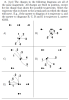 THE ANSWERS TO BCDE ARE NOT 4344 . I ONLY HAVE ONE MORE TRIES
FOR THIS QUESTION, IF YOU ARE UNSURE, ITS BEST IF YOU DO NOT
ANSWER
2. [1pt] The charges in the following diagrams are all of the same magnitude All charges are fixed in position, except for the charge that shows five possible trajectories. Select the trajectory that is closest to the actual path on which the charge will move. E.g., if the answer to diagram A...
THE ANSWERS TO BCDE ARE NOT 4344 . I ONLY HAVE ONE MORE TRIES
FOR THIS QUESTION, IF YOU ARE UNSURE, ITS BEST IF YOU DO NOT
ANSWER
2. [1pt] The charges in the following diagrams are all of the same magnitude All charges are fixed in position, except for the charge that shows five possible trajectories. Select the trajectory that is closest to the actual path on which the charge will move. E.g., if the answer to diagram A...
All I need is 3 and 5. The rest entered are correct. A point charge q2...
 All I need is 3 and 5. The rest entered are correct.
A point charge q2 = -1.6 μC is fixed at the origin of
a co-ordinate system as shown. Another point charge q1 =
-1 μC is is initially located at point P, a distance d1
= 7.1 cm from the origin along the x-axis
1) what is ΔPE, the change in potenial energy of charge q 1 when it is moved from point P to point R, located...
All I need is 3 and 5. The rest entered are correct.
A point charge q2 = -1.6 μC is fixed at the origin of
a co-ordinate system as shown. Another point charge q1 =
-1 μC is is initially located at point P, a distance d1
= 7.1 cm from the origin along the x-axis
1) what is ΔPE, the change in potenial energy of charge q 1 when it is moved from point P to point R, located...
would appreciate a detailed explanation!! thank you :) PHYS208 Week 3 DO NOT WRITE ON THIS...
 would appreciate a detailed explanation!! thank you :)
PHYS208 Week 3 DO NOT WRITE ON THIS FORM RETURN THIS FORM AT THE END OF YOUR CLASS Chapter 23 - Electric Potential 1. Three charges are configured as seen below: a. Find the electric potential at the origin. b. Find the electric potential at the arbitrary point (Xo Yo). You do not need to simplify. -34 (V2a, V2a) + 2. A charge of magnitude +2q is fixed at the origin. A...
would appreciate a detailed explanation!! thank you :)
PHYS208 Week 3 DO NOT WRITE ON THIS FORM RETURN THIS FORM AT THE END OF YOUR CLASS Chapter 23 - Electric Potential 1. Three charges are configured as seen below: a. Find the electric potential at the origin. b. Find the electric potential at the arbitrary point (Xo Yo). You do not need to simplify. -34 (V2a, V2a) + 2. A charge of magnitude +2q is fixed at the origin. A...
I need the answer for PART B Problem 6 a) In the picture below, the 3...
 I need the answer for PART B
Problem 6 a) In the picture below, the 3 charges Q1, Q2 and Q3 are located at positions (-aO), (a 0) and (0,-d) respectively (The origin is the point halfway between Qi and Q2.) 2 Consider the special case where Q1.Q3 greater than zero and Q2-Q Select true or false for each statement True: If Q3 is released from rest, it will initially accelerate to the right False: The external work done to...
I need the answer for PART B
Problem 6 a) In the picture below, the 3 charges Q1, Q2 and Q3 are located at positions (-aO), (a 0) and (0,-d) respectively (The origin is the point halfway between Qi and Q2.) 2 Consider the special case where Q1.Q3 greater than zero and Q2-Q Select true or false for each statement True: If Q3 is released from rest, it will initially accelerate to the right False: The external work done to...
Please help with following questions Three charges are arranged as shown in the figure below. Find...
 Please help with following questions
Three charges are arranged as shown in the figure below. Find the magnitude and direction of the electrostatic force on the charge q = 4.80 nC at the origin. (Let r12-0.230 m.) 100m Need Help? Two small metallic spheres, each of mass m = 0.50 g, are suspended as pendulums by light strings from a common point as shown in the figure below. The spheres are given the same electric charge, and it is found...
Please help with following questions
Three charges are arranged as shown in the figure below. Find the magnitude and direction of the electrostatic force on the charge q = 4.80 nC at the origin. (Let r12-0.230 m.) 100m Need Help? Two small metallic spheres, each of mass m = 0.50 g, are suspended as pendulums by light strings from a common point as shown in the figure below. The spheres are given the same electric charge, and it is found...
 5: Three charges of equal mass are arranged as shown. They are suddenly released from rest. Describe and explain the subsequent motion of each charge. Make sure you describe what happens to their velocities and accelerations as time passes. 6: Three charges are held in place as shown. Find the magnitude and direction of the net electric force on Q. UseQ2nC. SM -3Q 3 M 7: A: The three charges in the diagram are initially held stationary. If the charge...
 B: Five charges are arranged as shown. The charge at the origin is released from rest. Which quadrant does it move into? Explain. 30 30 1卫
 Three charges are arranged as shown in the figure below. Find the magnitude and direction of the electrostatic force on the charge q4.80 nC at the origin. (Let r12 0.260 m.) 6.00 nC 0.100 m -3.00 nC magnitude Use Coulomb's law to find the force that each charge exerts on the charge at the origin and combine the forces to find the net force. N direction Examine the diagram and determine which quadrant contains the angle of the net force....
 THE ANSWERS TO BCDE ARE NOT 4344 . I ONLY HAVE ONE MORE TRIES
FOR THIS QUESTION, IF YOU ARE UNSURE, ITS BEST IF YOU DO NOT
ANSWER
2. [1pt] The charges in the following diagrams are all of the same magnitude All charges are fixed in position, except for the charge that shows five possible trajectories. Select the trajectory that is closest to the actual path on which the charge will move. E.g., if the answer to diagram A...
THE ANSWERS TO BCDE ARE NOT 4344 . I ONLY HAVE ONE MORE TRIES
FOR THIS QUESTION, IF YOU ARE UNSURE, ITS BEST IF YOU DO NOT
ANSWER
2. [1pt] The charges in the following diagrams are all of the same magnitude All charges are fixed in position, except for the charge that shows five possible trajectories. Select the trajectory that is closest to the actual path on which the charge will move. E.g., if the answer to diagram A...
 All I need is 3 and 5. The rest entered are correct.
A point charge q2 = -1.6 μC is fixed at the origin of
a co-ordinate system as shown. Another point charge q1 =
-1 μC is is initially located at point P, a distance d1
= 7.1 cm from the origin along the x-axis
1) what is ΔPE, the change in potenial energy of charge q 1 when it is moved from point P to point R, located...
All I need is 3 and 5. The rest entered are correct.
A point charge q2 = -1.6 μC is fixed at the origin of
a co-ordinate system as shown. Another point charge q1 =
-1 μC is is initially located at point P, a distance d1
= 7.1 cm from the origin along the x-axis
1) what is ΔPE, the change in potenial energy of charge q 1 when it is moved from point P to point R, located...
 would appreciate a detailed explanation!! thank you :)
PHYS208 Week 3 DO NOT WRITE ON THIS FORM RETURN THIS FORM AT THE END OF YOUR CLASS Chapter 23 - Electric Potential 1. Three charges are configured as seen below: a. Find the electric potential at the origin. b. Find the electric potential at the arbitrary point (Xo Yo). You do not need to simplify. -34 (V2a, V2a) + 2. A charge of magnitude +2q is fixed at the origin. A...
would appreciate a detailed explanation!! thank you :)
PHYS208 Week 3 DO NOT WRITE ON THIS FORM RETURN THIS FORM AT THE END OF YOUR CLASS Chapter 23 - Electric Potential 1. Three charges are configured as seen below: a. Find the electric potential at the origin. b. Find the electric potential at the arbitrary point (Xo Yo). You do not need to simplify. -34 (V2a, V2a) + 2. A charge of magnitude +2q is fixed at the origin. A...
 I need the answer for PART B
Problem 6 a) In the picture below, the 3 charges Q1, Q2 and Q3 are located at positions (-aO), (a 0) and (0,-d) respectively (The origin is the point halfway between Qi and Q2.) 2 Consider the special case where Q1.Q3 greater than zero and Q2-Q Select true or false for each statement True: If Q3 is released from rest, it will initially accelerate to the right False: The external work done to...
I need the answer for PART B
Problem 6 a) In the picture below, the 3 charges Q1, Q2 and Q3 are located at positions (-aO), (a 0) and (0,-d) respectively (The origin is the point halfway between Qi and Q2.) 2 Consider the special case where Q1.Q3 greater than zero and Q2-Q Select true or false for each statement True: If Q3 is released from rest, it will initially accelerate to the right False: The external work done to...
 Please help with following questions
Three charges are arranged as shown in the figure below. Find the magnitude and direction of the electrostatic force on the charge q = 4.80 nC at the origin. (Let r12-0.230 m.) 100m Need Help? Two small metallic spheres, each of mass m = 0.50 g, are suspended as pendulums by light strings from a common point as shown in the figure below. The spheres are given the same electric charge, and it is found...
Please help with following questions
Three charges are arranged as shown in the figure below. Find the magnitude and direction of the electrostatic force on the charge q = 4.80 nC at the origin. (Let r12-0.230 m.) 100m Need Help? Two small metallic spheres, each of mass m = 0.50 g, are suspended as pendulums by light strings from a common point as shown in the figure below. The spheres are given the same electric charge, and it is found...
Most questions answered within 3 hours.
-
Where is the error in this code sequence?
String s1 = "Hello";
String s2 = "ello";...
asked 10 months ago -
Financial data for Joel de Paris, Inc., for last year
follow:
Joel de Paris, Inc.
Balance...
asked 10 months ago -
Consider this reaction:
Al2(SO4)3 (aq)+ BaCl3
(aq) Al2Cl6 (aq)- +
3BaSO4(s) . What is the...
asked 10 months ago -
Suppose that Savneet is considering increasing her
recent random sample from 20 car rentals to 40...
asked 10 months ago -
Trucks arrive at an unloading terminal at an average rate of 120
per hour.
Trucks arrive...
asked 10 months ago -
Why are methanol and ethanol completely soluble in water while
octanol is not very little soluble....
asked 10 months ago -
A facilities manager at a university reads in a research report
that the mean amount of...
asked 10 months ago -
When the CuSO4 is rehydrated by adding water to the anhydrous
compound, is this an endothermic...
asked 10 months ago -
A ray of sunlight is passing from diamond into crown glass; the
angle of incidence is...
asked 10 months ago -
A block of mass 0.249 kg is placed on top of a light, vertical
spring of...
asked 10 months ago -
how do the kidneys compensate in the presences of acidosis
a) trigger hyperventilate
b) reserve acid...
asked 10 months ago -
Question 501 pts
The rental rate of capital to the firm increases. Which of the
following...
asked 10 months ago