![xCThe State Of Sone System CanEX+ CBirzeit University [PS] https://ritaj.birzeitedu/bzu msgs/attach/887815/Extra problems ch3.pdf 212 If at time t = 0, the operator Q was measured, and the largest eigenvalue was obtained, write the wavefunction at any later time t. (c) If H was measured at any later time t, what might we get and with what probability 5. Consider a three-level system where the Hamiltonian and observable A are given by the matrix -1 0 1 (a) What are the possible values obtained in a measurement of A (b) Does a state exist in which both the results of a measurement of energy E and observable A can be predicted with certainty? Why or why not? (c Two measurements of A are carried out, separated in time by t. If the s of the first measurement is its largest possible value, determine the expectation value < (t Aw)) > for the second measurement. 6. Consider a two level system, where the matrix representation of the position operator and its eigenvectors are given by 21 and that the Hamiltonian of the system is given by: vate Wind How satisfied are you with Magnifier? O Type here to search 110 AM 14/2019 3](http://img.homeworklib.com/questions/44224150-6e47-11ea-9afc-8bf9665c378a.png?x-oss-process=image/resize,w_560)
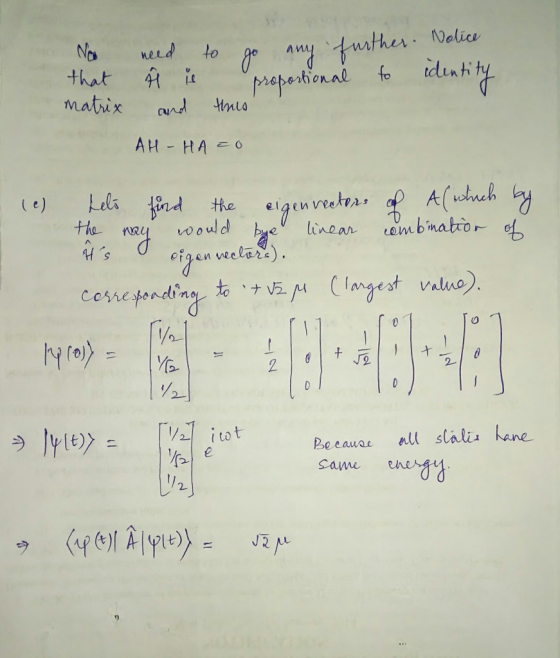
Consider a three-level system where the Hamiltonian and observable A are given by the matrix Aˆ = µ 0 1 0 1 0 1 0 1 0 Hˆ = ¯hω 1 0 0 0 1 0 0 0 1 (a) What are the possible values obtained in a measurement of A (b) Does a state exist in which both the results of a measurement of energy E and observable A can be predicted with certainty? Why or why not? (c) Two measurements of A are carried out, separated in time by t. If the result of the first measurement is its largest possible value, determine the expectation value < ψ(t)|A|ψ)t) > for the second measurement.
Homework Answers

Add Answer to:
Consider a three-level system where the Hamiltonian and
observable A are given by the matrix Aˆ...
Problem 8.3 - A New Two-State System Consider a new two-level system with a Hamiltonian given...
 Problem 8.3 - A New Two-State System Consider a new two-level system with a Hamiltonian given by i = Ti 1461 – 12) (2) (3) Also consider an observable represented by the operator Ŝ = * 11/21 - *12/11: It should (hopefully) be clear that 1) and 2) are eigenkets of the Hamiltonian. Let $1) be an eigenket of S corresponding to the smaller eigenvalue of S and let S2) be an eigenket of S corresponding to the larger eigenvalue....
3) Consider a system whose Hamiltonian H and an operator A are given by the matrices...
 3) Consider a system whose Hamiltonian H and an operator A are given by the matrices 71 H = 60 -1 10 -1 1 0 0 0 -1) A = a 10 4 4 0 10 1 o) 1 0 where εo has the dimensions of energy. a) What are the possible values for the measurement of the energy? (3 marks) b) Suppose that the energy is measured, giving E = - Eo. What values are obtained if we subsequently...
(introduction to quantum mechanics) , the Hamiltonian matrix is H- 3. In the basis |1) - (a) Find the eigenvalues En and eigenfunctions Ion) of H. (b) The system is in state 2) initially (t 0). F...
 (introduction to quantum mechanics)
, the Hamiltonian matrix is H- 3. In the basis |1) - (a) Find the eigenvalues En and eigenfunctions Ion) of H. (b) The system is in state 2) initially (t 0). Find the state of the system at t in the basis n). (c) Calculate the expectation value of H. Briefly explain your result. Does it depend on time? Why?
, the Hamiltonian matrix is H- 3. In the basis |1) - (a) Find the...
(introduction to quantum mechanics)
, the Hamiltonian matrix is H- 3. In the basis |1) - (a) Find the eigenvalues En and eigenfunctions Ion) of H. (b) The system is in state 2) initially (t 0). Find the state of the system at t in the basis n). (c) Calculate the expectation value of H. Briefly explain your result. Does it depend on time? Why?
, the Hamiltonian matrix is H- 3. In the basis |1) - (a) Find the...
A measurement of a spin 1/2 observable described by the operator Sˆ = (Sˆx + Sˆy)...
A measurement of a spin 1/2 observable described by the operator Sˆ = (Sˆx + Sˆy) is made and the system is found in a state corresponding to the largest eigenvalue of Sˆ. Find the probability that at a later time, a measurement of Sˆx will yield the value +ħ/2.
The Hamiltonian of a system in the basis In > is given by H = hw("...
 The Hamiltonian of a system in the basis In > is given by H = hw(" >< 0,1 + il" >< 421-142 >< 0,1 -21°3 >< $3D Here w is a constant. Write the Hamiltonian in the form of a matrix and obtain its eigenvalues and eigenfunctions. Express the eigenfunctions in terms of the basis In > and in its eigenvalues as En = hwe If the system is initially in the state | (0) >= 10 > a. What...
Let 0 E1 0 A 0 E/ Be the matrix representation of the Hamiltonian for a...
 Let 0 E1 0 A 0 E/ Be the matrix representation of the Hamiltonian for a three-state system with basis |1), |2), |3) If the state of the system at time t-0 is lp(0)) 13), what are lp(t)) and c) d) e) If the state of the system at time t-0 is lp(0)) 2), what are lp(t)) and @ct-0)|ψ(t))? In terms of time evolution, explain the difference between them? Why are they different?
Please solve the problem as soon as possible. Problem 1: Consider a two level system with Hamiltonian: Using the first order time-dependent perturbation theory, obtain the probability coefficients cn...
 Please solve the problem as soon as possible.
Problem 1: Consider a two level system with Hamiltonian: Using the first order time-dependent perturbation theory, obtain the probability coefficients cn (t) if the perturbation is applied at t >0 and the system is originally in the ground state. Hint: When solving the problem, first you may need to find the energies and wave functions of the unperturbed Hamiltonian A0.
Problem 1: Consider a two level system with Hamiltonian: Using the first...
Please solve the problem as soon as possible.
Problem 1: Consider a two level system with Hamiltonian: Using the first order time-dependent perturbation theory, obtain the probability coefficients cn (t) if the perturbation is applied at t >0 and the system is originally in the ground state. Hint: When solving the problem, first you may need to find the energies and wave functions of the unperturbed Hamiltonian A0.
Problem 1: Consider a two level system with Hamiltonian: Using the first...
3. Consider a rigid rotor whose Hamiltonian is given by H L2(21) where L is the angular momentum operator and I is the...
 3. Consider a rigid rotor whose Hamiltonian is given by H L2(21) where L is the angular momentum operator and I is the moment of inertia of the rotator. Its rotation is described by a wave function: (0, N{Yo0(0,6)(1 3i) Y1-1(0,6) 2 Y21(0.0) Y20(0.) Find the normalization constant, N. (i) Find the probability to occupy state Yo0- (ii Find the expectation value of L2 of this state (iii Find the expectation value of L2 of this state (iv) Find (L2L2/21...
1. Consider the system described by: *(t) - 6 m (0) + veu(t): y(t) = 01...
 1. Consider the system described by: *(t) - 6 m (0) + veu(t): y(t) = 01 (1) 60 = {1, 1421 a) Find the state transition matrix and the impulse response matrix of the system. b) Determine whether the system is (i) completely state controllable, (ii) differentially control- lable, (iii) instantaneously controllable, (iv) stabilizable at time to = 0. c) Repeat part (b) for to = 1. d) Determine whether the system is (i) observable, (ii) differentially observable, (iii) instanta-...
1. Given a state y(r) expanded on the eigenstates of the Hamiltonian for the electron, H, in a hydrogen atom: where the...
 1. Given a state y(r) expanded on the eigenstates of the Hamiltonian for the electron, H, in a hydrogen atom: where the subscript of E is n, the principal quantum number. The other two numbers are the 1 and m values, find the expectation values of H (you may use the eigenvalue equation to evaluate for H), L-(total angular momentum operator square), Lz (the z-component of the angular momentum operator) and P (parity operator). Draw schematic pictures of 1 and...
 Problem 8.3 - A New Two-State System Consider a new two-level system with a Hamiltonian given by i = Ti 1461 – 12) (2) (3) Also consider an observable represented by the operator Ŝ = * 11/21 - *12/11: It should (hopefully) be clear that 1) and 2) are eigenkets of the Hamiltonian. Let $1) be an eigenket of S corresponding to the smaller eigenvalue of S and let S2) be an eigenket of S corresponding to the larger eigenvalue....
 3) Consider a system whose Hamiltonian H and an operator A are given by the matrices 71 H = 60 -1 10 -1 1 0 0 0 -1) A = a 10 4 4 0 10 1 o) 1 0 where εo has the dimensions of energy. a) What are the possible values for the measurement of the energy? (3 marks) b) Suppose that the energy is measured, giving E = - Eo. What values are obtained if we subsequently...
 (introduction to quantum mechanics)
, the Hamiltonian matrix is H- 3. In the basis |1) - (a) Find the eigenvalues En and eigenfunctions Ion) of H. (b) The system is in state 2) initially (t 0). Find the state of the system at t in the basis n). (c) Calculate the expectation value of H. Briefly explain your result. Does it depend on time? Why?
, the Hamiltonian matrix is H- 3. In the basis |1) - (a) Find the...
(introduction to quantum mechanics)
, the Hamiltonian matrix is H- 3. In the basis |1) - (a) Find the eigenvalues En and eigenfunctions Ion) of H. (b) The system is in state 2) initially (t 0). Find the state of the system at t in the basis n). (c) Calculate the expectation value of H. Briefly explain your result. Does it depend on time? Why?
, the Hamiltonian matrix is H- 3. In the basis |1) - (a) Find the...
 The Hamiltonian of a system in the basis In > is given by H = hw(" >< 0,1 + il" >< 421-142 >< 0,1 -21°3 >< $3D Here w is a constant. Write the Hamiltonian in the form of a matrix and obtain its eigenvalues and eigenfunctions. Express the eigenfunctions in terms of the basis In > and in its eigenvalues as En = hwe If the system is initially in the state | (0) >= 10 > a. What...
 Let 0 E1 0 A 0 E/ Be the matrix representation of the Hamiltonian for a three-state system with basis |1), |2), |3) If the state of the system at time t-0 is lp(0)) 13), what are lp(t)) and c) d) e) If the state of the system at time t-0 is lp(0)) 2), what are lp(t)) and @ct-0)|ψ(t))? In terms of time evolution, explain the difference between them? Why are they different?
 Please solve the problem as soon as possible.
Problem 1: Consider a two level system with Hamiltonian: Using the first order time-dependent perturbation theory, obtain the probability coefficients cn (t) if the perturbation is applied at t >0 and the system is originally in the ground state. Hint: When solving the problem, first you may need to find the energies and wave functions of the unperturbed Hamiltonian A0.
Problem 1: Consider a two level system with Hamiltonian: Using the first...
Please solve the problem as soon as possible.
Problem 1: Consider a two level system with Hamiltonian: Using the first order time-dependent perturbation theory, obtain the probability coefficients cn (t) if the perturbation is applied at t >0 and the system is originally in the ground state. Hint: When solving the problem, first you may need to find the energies and wave functions of the unperturbed Hamiltonian A0.
Problem 1: Consider a two level system with Hamiltonian: Using the first...
 3. Consider a rigid rotor whose Hamiltonian is given by H L2(21) where L is the angular momentum operator and I is the moment of inertia of the rotator. Its rotation is described by a wave function: (0, N{Yo0(0,6)(1 3i) Y1-1(0,6) 2 Y21(0.0) Y20(0.) Find the normalization constant, N. (i) Find the probability to occupy state Yo0- (ii Find the expectation value of L2 of this state (iii Find the expectation value of L2 of this state (iv) Find (L2L2/21...
 1. Consider the system described by: *(t) - 6 m (0) + veu(t): y(t) = 01 (1) 60 = {1, 1421 a) Find the state transition matrix and the impulse response matrix of the system. b) Determine whether the system is (i) completely state controllable, (ii) differentially control- lable, (iii) instantaneously controllable, (iv) stabilizable at time to = 0. c) Repeat part (b) for to = 1. d) Determine whether the system is (i) observable, (ii) differentially observable, (iii) instanta-...
 1. Given a state y(r) expanded on the eigenstates of the Hamiltonian for the electron, H, in a hydrogen atom: where the subscript of E is n, the principal quantum number. The other two numbers are the 1 and m values, find the expectation values of H (you may use the eigenvalue equation to evaluate for H), L-(total angular momentum operator square), Lz (the z-component of the angular momentum operator) and P (parity operator). Draw schematic pictures of 1 and...
Most questions answered within 3 hours.
-
Where is the error in this code sequence?
String s1 = "Hello";
String s2 = "ello";...
asked 10 months ago -
Financial data for Joel de Paris, Inc., for last year
follow:
Joel de Paris, Inc.
Balance...
asked 10 months ago -
Consider this reaction:
Al2(SO4)3 (aq)+ BaCl3
(aq) Al2Cl6 (aq)- +
3BaSO4(s) . What is the...
asked 10 months ago -
Suppose that Savneet is considering increasing her
recent random sample from 20 car rentals to 40...
asked 10 months ago -
Trucks arrive at an unloading terminal at an average rate of 120
per hour.
Trucks arrive...
asked 10 months ago -
Why are methanol and ethanol completely soluble in water while
octanol is not very little soluble....
asked 10 months ago -
A facilities manager at a university reads in a research report
that the mean amount of...
asked 10 months ago -
When the CuSO4 is rehydrated by adding water to the anhydrous
compound, is this an endothermic...
asked 10 months ago -
A ray of sunlight is passing from diamond into crown glass; the
angle of incidence is...
asked 10 months ago -
A block of mass 0.249 kg is placed on top of a light, vertical
spring of...
asked 10 months ago -
how do the kidneys compensate in the presences of acidosis
a) trigger hyperventilate
b) reserve acid...
asked 10 months ago -
Question 501 pts
The rental rate of capital to the firm increases. Which of the
following...
asked 10 months ago