
Homework Answers

Add Answer to:
Problem 3: Show that for the symmetric laminate as shown below, the coupling stiffnesses, B must...
4. Determine the , , and E G x xy xy ν for a [ ± 45]s (subscript s means symmetric laminate) angle-ply laminate with the lamina properties given in Problem 1. Using values gained from problem 1 4. D...
 4. Determine the , , and E G x xy xy ν for a [ ± 45]s (subscript
s means symmetric laminate) angle-ply laminate with the lamina
properties given in Problem 1.
Using values gained from problem 1
4. Determine the Er, Gr , and vry for a [ ±45], (subscript s means symmetric laminate) ompute all t lamina properties E1 145 GPa E2 10.5 GPa G12 7.0 GPa V12 0.28 t 0.25 mmm
4. Determine the Er, Gr ,...
4. Determine the , , and E G x xy xy ν for a [ ± 45]s (subscript
s means symmetric laminate) angle-ply laminate with the lamina
properties given in Problem 1.
Using values gained from problem 1
4. Determine the Er, Gr , and vry for a [ ±45], (subscript s means symmetric laminate) ompute all t lamina properties E1 145 GPa E2 10.5 GPa G12 7.0 GPa V12 0.28 t 0.25 mmm
4. Determine the Er, Gr ,...
1. a) What is the fundamental difference between symmetric and anti-symmetric matrix? b) Given th...
 1. a) What is the fundamental difference between symmetric and anti-symmetric matrix? b) Given the laminate shown below compute A2, Bn, and Dis. Given that E, 155 GPa; Ep 12.1 GPa; V12-0.248; G12-4.4 GPa. Z3-15 0-30° -5 0-90 0-0° z1-5 mm All dimensions are in Zo-15
1. a) What is the fundamental difference between symmetric and anti-symmetric matrix? b) Given the laminate shown below compute A2, Bn, and Dis. Given that E, 155 GPa; Ep 12.1 GPa; V12-0.248; G12-4.4 GPa....
1. a) What is the fundamental difference between symmetric and anti-symmetric matrix? b) Given the laminate shown below compute A2, Bn, and Dis. Given that E, 155 GPa; Ep 12.1 GPa; V12-0.248; G12-4.4 GPa. Z3-15 0-30° -5 0-90 0-0° z1-5 mm All dimensions are in Zo-15
1. a) What is the fundamental difference between symmetric and anti-symmetric matrix? b) Given the laminate shown below compute A2, Bn, and Dis. Given that E, 155 GPa; Ep 12.1 GPa; V12-0.248; G12-4.4 GPa....
Macromechanics 215 N, 1000 N/m; all remaining components are equal to zero b) Mry 1 Nm/m; all rem...
 I need help with question 6.18
Macromechanics 215 N, 1000 N/m; all remaining components are equal to zero b) Mry 1 Nm/m; all remaining components are equal to sero ) Comment on the coupling efects obsereed 6.12 Compute the strains ( (y, and ry at the interface between the 459 and laminae above the middle surface by using the results of case (b) of Ezercise 6.11 and -45 /a.e3 6.23). cise 6.13 Compute the stresses ơz and σ1 in the...
I need help with question 6.18
Macromechanics 215 N, 1000 N/m; all remaining components are equal to zero b) Mry 1 Nm/m; all remaining components are equal to sero ) Comment on the coupling efects obsereed 6.12 Compute the strains ( (y, and ry at the interface between the 459 and laminae above the middle surface by using the results of case (b) of Ezercise 6.11 and -45 /a.e3 6.23). cise 6.13 Compute the stresses ơz and σ1 in the...
Problem 5.2 (10 points) For the simple symmetric random walk (Sn)n=0.12 that with So = 0, show for all n>0 and all -n<k<n Problem 5.2 (10 points) For the simple symmetric random walk (S...
 Problem 5.2 (10 points) For the simple symmetric random walk (Sn)n=0.12 that with So = 0, show for all n>0 and all -n<k<n
Problem 5.2 (10 points) For the simple symmetric random walk (Sn)n=0.12 that with So = 0, show for all n>0 and all -n
Problem 5.2 (10 points) For the simple symmetric random walk (Sn)n=0.12 that with So = 0, show for all n>0 and all -n<k<n
Problem 5.2 (10 points) For the simple symmetric random walk (Sn)n=0.12 that with So = 0, show for all n>0 and all -n
Please show work Answer shown below Problem 2: Consider the three-spring structure given below. It is...
 Please show work
Answer shown below
Problem 2: Consider the three-spring structure given below. It is fixed at the far right end (node 4) and is subject to nodal forces as given below. из 144 lu 142 Pi Kj Ki P2 The element (spring) stiffnesses are: Ki- K2- 200 k/in and Ks-250 k/in The forces applied at the nodes are: P 150 k, P--50 k, Ps 150 k E.g. the stiffness a) Write the stiffness equilibrium equations for nodes 1,...
Please show work
Answer shown below
Problem 2: Consider the three-spring structure given below. It is fixed at the far right end (node 4) and is subject to nodal forces as given below. из 144 lu 142 Pi Kj Ki P2 The element (spring) stiffnesses are: Ki- K2- 200 k/in and Ks-250 k/in The forces applied at the nodes are: P 150 k, P--50 k, Ps 150 k E.g. the stiffness a) Write the stiffness equilibrium equations for nodes 1,...
show the working and resoning Test Problem 3.6 [10 pt(s) field, B, as shown below. The...
 show the working and resoning
Test Problem 3.6 [10 pt(s) field, B, as shown below. The length of one of the sides of the square, ((t), is increasing with time as the function (e)- Is a current induced in the loop; if so, in what direction? A square loop of wire with N turns is growing in a constant uniform magnetic Select One of the Following (a) clockwise (b) counterclockwise (c) There is no induced current Earlier Time Later Time...
show the working and resoning
Test Problem 3.6 [10 pt(s) field, B, as shown below. The length of one of the sides of the square, ((t), is increasing with time as the function (e)- Is a current induced in the loop; if so, in what direction? A square loop of wire with N turns is growing in a constant uniform magnetic Select One of the Following (a) clockwise (b) counterclockwise (c) There is no induced current Earlier Time Later Time...
Linear Algebra Problem Problem #3 Prove each of the following. Show ALL steps. (a) If A...
 Linear Algebra Problem
Problem #3 Prove each of the following. Show ALL steps. (a) If A and C are symmetric n x n matrices, then (A+ BIC)T = A +CB. (b) tr(cA+dB) = c tr(A) + d • tr(B).
Linear Algebra Problem
Problem #3 Prove each of the following. Show ALL steps. (a) If A and C are symmetric n x n matrices, then (A+ BIC)T = A +CB. (b) tr(cA+dB) = c tr(A) + d • tr(B).
True or False? (a) An n x n matrix that is diagonalizable must be symmetric. (b)...
 True or False? (a) An n x n matrix that is diagonalizable must be symmetric. (b) If AT = A and if vectors u and v satisfy Au = 3u and Av = 40, then u: v=0. (c) An n x n symmetric matrix has n distinct real eigenvalues. (d) For a nonzero v in R", the matrix vv7 is a rank-1 matrix.
Problem 3: In a certain region, a charge distribution exists that is spherically symmetric but nonuniform....
 Problem 3: In a certain region, a charge distribution exists that is spherically symmetric but nonuniform. That is, the volume charge density p(r) depends on the distancer from the center of the distribution but not on the spherical polar angles and . The electric potential V(r) due to this charge distribution is V(r) = Pop (1-3(E)? +2(3) forrsa; and V(r) = 0 for r > a, where po is a constant having units of C/m' and a is a constant...
The EPR spectrum of a cyclo-tetrasilane radical anion is shown below. a) Explain the observed coupling....
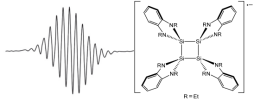 The EPR spectrum of a cyclo-tetrasilane radical anion is shown
below. a) Explain the observed coupling. (Hint: 1H:
I=1/2, 99% abundant; 13C: I=1/2, 1.0% abundant;
14N: I=1. 99.9% abundant; 29Si: I=1/2, 5.0%
abundant; not all the expected lines may be observed.)
b) Based on your explanation of the observed coupling in part
a), explain the relative intensities of the lines in this spectrum
(Hint: You may need to construct a Pascal's triangle for a nucleus
with I>1/2).
The EPR spectrum of a cyclo-tetrasilane radical anion is shown
below. a) Explain the observed coupling. (Hint: 1H:
I=1/2, 99% abundant; 13C: I=1/2, 1.0% abundant;
14N: I=1. 99.9% abundant; 29Si: I=1/2, 5.0%
abundant; not all the expected lines may be observed.)
b) Based on your explanation of the observed coupling in part
a), explain the relative intensities of the lines in this spectrum
(Hint: You may need to construct a Pascal's triangle for a nucleus
with I>1/2).
 4. Determine the , , and E G x xy xy ν for a [ ± 45]s (subscript
s means symmetric laminate) angle-ply laminate with the lamina
properties given in Problem 1.
Using values gained from problem 1
4. Determine the Er, Gr , and vry for a [ ±45], (subscript s means symmetric laminate) ompute all t lamina properties E1 145 GPa E2 10.5 GPa G12 7.0 GPa V12 0.28 t 0.25 mmm
4. Determine the Er, Gr ,...
4. Determine the , , and E G x xy xy ν for a [ ± 45]s (subscript
s means symmetric laminate) angle-ply laminate with the lamina
properties given in Problem 1.
Using values gained from problem 1
4. Determine the Er, Gr , and vry for a [ ±45], (subscript s means symmetric laminate) ompute all t lamina properties E1 145 GPa E2 10.5 GPa G12 7.0 GPa V12 0.28 t 0.25 mmm
4. Determine the Er, Gr ,...
 1. a) What is the fundamental difference between symmetric and anti-symmetric matrix? b) Given the laminate shown below compute A2, Bn, and Dis. Given that E, 155 GPa; Ep 12.1 GPa; V12-0.248; G12-4.4 GPa. Z3-15 0-30° -5 0-90 0-0° z1-5 mm All dimensions are in Zo-15
1. a) What is the fundamental difference between symmetric and anti-symmetric matrix? b) Given the laminate shown below compute A2, Bn, and Dis. Given that E, 155 GPa; Ep 12.1 GPa; V12-0.248; G12-4.4 GPa....
1. a) What is the fundamental difference between symmetric and anti-symmetric matrix? b) Given the laminate shown below compute A2, Bn, and Dis. Given that E, 155 GPa; Ep 12.1 GPa; V12-0.248; G12-4.4 GPa. Z3-15 0-30° -5 0-90 0-0° z1-5 mm All dimensions are in Zo-15
1. a) What is the fundamental difference between symmetric and anti-symmetric matrix? b) Given the laminate shown below compute A2, Bn, and Dis. Given that E, 155 GPa; Ep 12.1 GPa; V12-0.248; G12-4.4 GPa....
 I need help with question 6.18
Macromechanics 215 N, 1000 N/m; all remaining components are equal to zero b) Mry 1 Nm/m; all remaining components are equal to sero ) Comment on the coupling efects obsereed 6.12 Compute the strains ( (y, and ry at the interface between the 459 and laminae above the middle surface by using the results of case (b) of Ezercise 6.11 and -45 /a.e3 6.23). cise 6.13 Compute the stresses ơz and σ1 in the...
I need help with question 6.18
Macromechanics 215 N, 1000 N/m; all remaining components are equal to zero b) Mry 1 Nm/m; all remaining components are equal to sero ) Comment on the coupling efects obsereed 6.12 Compute the strains ( (y, and ry at the interface between the 459 and laminae above the middle surface by using the results of case (b) of Ezercise 6.11 and -45 /a.e3 6.23). cise 6.13 Compute the stresses ơz and σ1 in the...
 Problem 5.2 (10 points) For the simple symmetric random walk (Sn)n=0.12 that with So = 0, show for all n>0 and all -n<k<n
Problem 5.2 (10 points) For the simple symmetric random walk (Sn)n=0.12 that with So = 0, show for all n>0 and all -n
Problem 5.2 (10 points) For the simple symmetric random walk (Sn)n=0.12 that with So = 0, show for all n>0 and all -n<k<n
Problem 5.2 (10 points) For the simple symmetric random walk (Sn)n=0.12 that with So = 0, show for all n>0 and all -n
 Please show work
Answer shown below
Problem 2: Consider the three-spring structure given below. It is fixed at the far right end (node 4) and is subject to nodal forces as given below. из 144 lu 142 Pi Kj Ki P2 The element (spring) stiffnesses are: Ki- K2- 200 k/in and Ks-250 k/in The forces applied at the nodes are: P 150 k, P--50 k, Ps 150 k E.g. the stiffness a) Write the stiffness equilibrium equations for nodes 1,...
Please show work
Answer shown below
Problem 2: Consider the three-spring structure given below. It is fixed at the far right end (node 4) and is subject to nodal forces as given below. из 144 lu 142 Pi Kj Ki P2 The element (spring) stiffnesses are: Ki- K2- 200 k/in and Ks-250 k/in The forces applied at the nodes are: P 150 k, P--50 k, Ps 150 k E.g. the stiffness a) Write the stiffness equilibrium equations for nodes 1,...
 show the working and resoning
Test Problem 3.6 [10 pt(s) field, B, as shown below. The length of one of the sides of the square, ((t), is increasing with time as the function (e)- Is a current induced in the loop; if so, in what direction? A square loop of wire with N turns is growing in a constant uniform magnetic Select One of the Following (a) clockwise (b) counterclockwise (c) There is no induced current Earlier Time Later Time...
show the working and resoning
Test Problem 3.6 [10 pt(s) field, B, as shown below. The length of one of the sides of the square, ((t), is increasing with time as the function (e)- Is a current induced in the loop; if so, in what direction? A square loop of wire with N turns is growing in a constant uniform magnetic Select One of the Following (a) clockwise (b) counterclockwise (c) There is no induced current Earlier Time Later Time...
 Linear Algebra Problem
Problem #3 Prove each of the following. Show ALL steps. (a) If A and C are symmetric n x n matrices, then (A+ BIC)T = A +CB. (b) tr(cA+dB) = c tr(A) + d • tr(B).
Linear Algebra Problem
Problem #3 Prove each of the following. Show ALL steps. (a) If A and C are symmetric n x n matrices, then (A+ BIC)T = A +CB. (b) tr(cA+dB) = c tr(A) + d • tr(B).
 True or False? (a) An n x n matrix that is diagonalizable must be symmetric. (b) If AT = A and if vectors u and v satisfy Au = 3u and Av = 40, then u: v=0. (c) An n x n symmetric matrix has n distinct real eigenvalues. (d) For a nonzero v in R", the matrix vv7 is a rank-1 matrix.
 Problem 3: In a certain region, a charge distribution exists that is spherically symmetric but nonuniform. That is, the volume charge density p(r) depends on the distancer from the center of the distribution but not on the spherical polar angles and . The electric potential V(r) due to this charge distribution is V(r) = Pop (1-3(E)? +2(3) forrsa; and V(r) = 0 for r > a, where po is a constant having units of C/m' and a is a constant...
 The EPR spectrum of a cyclo-tetrasilane radical anion is shown
below. a) Explain the observed coupling. (Hint: 1H:
I=1/2, 99% abundant; 13C: I=1/2, 1.0% abundant;
14N: I=1. 99.9% abundant; 29Si: I=1/2, 5.0%
abundant; not all the expected lines may be observed.)
b) Based on your explanation of the observed coupling in part
a), explain the relative intensities of the lines in this spectrum
(Hint: You may need to construct a Pascal's triangle for a nucleus
with I>1/2).
The EPR spectrum of a cyclo-tetrasilane radical anion is shown
below. a) Explain the observed coupling. (Hint: 1H:
I=1/2, 99% abundant; 13C: I=1/2, 1.0% abundant;
14N: I=1. 99.9% abundant; 29Si: I=1/2, 5.0%
abundant; not all the expected lines may be observed.)
b) Based on your explanation of the observed coupling in part
a), explain the relative intensities of the lines in this spectrum
(Hint: You may need to construct a Pascal's triangle for a nucleus
with I>1/2).
Most questions answered within 3 hours.
-
Where is the error in this code sequence?
String s1 = "Hello";
String s2 = "ello";...
asked 10 months ago -
Financial data for Joel de Paris, Inc., for last year
follow:
Joel de Paris, Inc.
Balance...
asked 10 months ago -
Consider this reaction:
Al2(SO4)3 (aq)+ BaCl3
(aq) Al2Cl6 (aq)- +
3BaSO4(s) . What is the...
asked 10 months ago -
Suppose that Savneet is considering increasing her
recent random sample from 20 car rentals to 40...
asked 10 months ago -
Trucks arrive at an unloading terminal at an average rate of 120
per hour.
Trucks arrive...
asked 10 months ago -
Why are methanol and ethanol completely soluble in water while
octanol is not very little soluble....
asked 10 months ago -
A facilities manager at a university reads in a research report
that the mean amount of...
asked 10 months ago -
When the CuSO4 is rehydrated by adding water to the anhydrous
compound, is this an endothermic...
asked 10 months ago -
A ray of sunlight is passing from diamond into crown glass; the
angle of incidence is...
asked 10 months ago -
A block of mass 0.249 kg is placed on top of a light, vertical
spring of...
asked 10 months ago -
how do the kidneys compensate in the presences of acidosis
a) trigger hyperventilate
b) reserve acid...
asked 10 months ago -
Question 501 pts
The rental rate of capital to the firm increases. Which of the
following...
asked 10 months ago