
Homework Answers
Add Answer to:
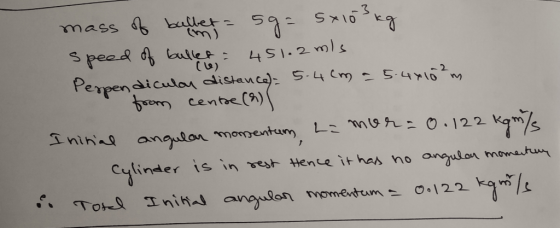
BRUN CAPUT RRRRRR BBBBB axis ORD cylinder A 5 g bullet is fired at 451.2 m/s...
A 7 g bullet is fired at 470.4 m/s into a solid cylinder of mass 15.6...
A 7 g bullet is fired at 470.4 m/s into a solid cylinder of mass 15.6 kg and a radius 0.49 m. The cylinder is initially at rest and is mounted on fixed vertical axis that runs through it's center of mass. The line of motion of the bullet is perpendicular to the axle and at a distance 5.1 cm from the center. What is the initial angular momentum of the system?
A 14 g bullet is fired at 436.9 m/s into a solid cylinder of mass 26.5...
A 14 g bullet is fired at 436.9 m/s into a solid cylinder of mass 26.5 kg and a radius 0.28 m. The cylinder is initially at rest and is mounted on fixed vertical axis that runs through it's center of mass. The line of motion of the bullet is perpendicular to the axle and at a distance 8.3 cm from the center. What is the initial angular momentum of the system? Find the angular velocity of the system after...
Ballistic Cylinder A 0.17-kg bullet is fired with a velocity of 85.9 m/s into a solid...
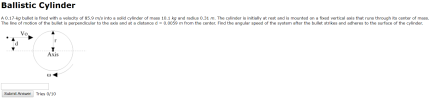 Ballistic Cylinder A 0.17-kg bullet is fired with a velocity of 85.9 m/s into a solid cylinder of mass 10.1 kg and radius 0.31 m. The cylinder is initially at rest and is mounted on a fixed vertical axis that runs through its center of mass. The line of motion of the bullet is perpendicular to the axis and at a distance d 0.0059 m from the center. Find the angular speed of the system after the bullet strikes and...
A 12.0g bullet is fired at 452.1m/s into a solid disk of mass 15.1kg and a...
A 12.0g bullet is fired at 452.1m/s into a solid disk of mass 15.1kg and a radius 0.310m. The disk is initially at rest and is mounted on fixed vertical axis that runs through it's center of mass. The line of motion of the bullet is perpendicular to the axis and at a distance 6.20cm from the center. Find the angular velocity of the system after the bullet strikes and adheres to the surface of the disk.
A wad of sticky clay of mass m and velocity ; is fired at a solid...
 A wad of sticky clay of mass m and velocity ; is fired at a solid cylinder of mass M and radius R (see figure). The cylinder is initially at rest and is mounted on a fixed horizontal axle that runs through its center of mass. The line of motion of the projectile is perpendicular to the axle and at a distance d<R from the center. (a) Find the angular speed of the system just after the clay strikes and...
A wad of sticky clay of mass m and velocity vector v i is fired at...
A wad of sticky clay of mass m and velocity vector v i is fired at a solid cylinder of mass M and radius R (see figure). The cylinder is initially at rest and is mounted on a fixed horizontal axle that runs through its center of mass. The line of motion of the projectile is perpendicular to the axle and at a distance d < R from the center. (a) Find the angular speed of the system just after...
A wad of sticky clay of mass m and velocity vector Vis fired at a solid...
 A wad of sticky clay of mass m and velocity vector Vis fired at a solid cylinder of mass M and radius R (see figure). The cylinder is initially at rest and is mounted on a fixed horizontal axle that runs through its center of mass. The line of motion of the projectile is perpendicular to the axle and at a distance d < R from the center. (a) Find the angular speed of the system just after the clay...
A 15.0-g bullet is fired at a muzzle velocity of 3250 m/s from a high-powered rifle...
A 15.0-g bullet is fired at a muzzle velocity of 3250 m/s from a high-powered rifle with a mass of 4.75 kg and barrel of length 75.0 cm. (a) How long is the bullet in the barrel? (b) What is the force on the bullet while it is in the barrel? (c) Find the impulse exerted on the bullet while it is in the barrel. (d) Find the bullet’s momentum as it leaves the barrel. I've seen this question a...
A 0.1 kg bullet initially travels at 200 m/s before striking the edge of a uniform...
 A 0.1 kg bullet initially travels at 200 m/s before striking the
edge of a uniform horizontal cylinder supported by a frictionless
axle through its center. The cylinder has a mass of 3 kg, a radiuis
of 0.5 m and is initially at rest. The bullet becomes lodged inside
the outer edge of the cylinder. PLEASE SHOW THE STEPS
(numbers 10-) A0.1 kg bullet initially travels at 200 m/s before striking the edge of a uniform horizontal cylinder supported by...
A 0.1 kg bullet initially travels at 200 m/s before striking the
edge of a uniform horizontal cylinder supported by a frictionless
axle through its center. The cylinder has a mass of 3 kg, a radiuis
of 0.5 m and is initially at rest. The bullet becomes lodged inside
the outer edge of the cylinder. PLEASE SHOW THE STEPS
(numbers 10-) A0.1 kg bullet initially travels at 200 m/s before striking the edge of a uniform horizontal cylinder supported by...
with good explanation. 1. Twad of sticky clay of mass m and velocity vector v is...
 with good explanation.
1. Twad of sticky clay of mass m and velocity vector v is fired at a solid cylinder of mass M and radius R (see figure). The cylinder is initially at rest and is mounted on a fixed horizontal axle that runs through its center of mass. The line of motion of the projectile is perpendicular to the axle and at a distance d < R from the center (a) Find the angular speed of the system...
with good explanation.
1. Twad of sticky clay of mass m and velocity vector v is fired at a solid cylinder of mass M and radius R (see figure). The cylinder is initially at rest and is mounted on a fixed horizontal axle that runs through its center of mass. The line of motion of the projectile is perpendicular to the axle and at a distance d < R from the center (a) Find the angular speed of the system...
 Ballistic Cylinder A 0.17-kg bullet is fired with a velocity of 85.9 m/s into a solid cylinder of mass 10.1 kg and radius 0.31 m. The cylinder is initially at rest and is mounted on a fixed vertical axis that runs through its center of mass. The line of motion of the bullet is perpendicular to the axis and at a distance d 0.0059 m from the center. Find the angular speed of the system after the bullet strikes and...
 A wad of sticky clay of mass m and velocity ; is fired at a solid cylinder of mass M and radius R (see figure). The cylinder is initially at rest and is mounted on a fixed horizontal axle that runs through its center of mass. The line of motion of the projectile is perpendicular to the axle and at a distance d<R from the center. (a) Find the angular speed of the system just after the clay strikes and...
 A wad of sticky clay of mass m and velocity vector Vis fired at a solid cylinder of mass M and radius R (see figure). The cylinder is initially at rest and is mounted on a fixed horizontal axle that runs through its center of mass. The line of motion of the projectile is perpendicular to the axle and at a distance d < R from the center. (a) Find the angular speed of the system just after the clay...
 A 0.1 kg bullet initially travels at 200 m/s before striking the
edge of a uniform horizontal cylinder supported by a frictionless
axle through its center. The cylinder has a mass of 3 kg, a radiuis
of 0.5 m and is initially at rest. The bullet becomes lodged inside
the outer edge of the cylinder. PLEASE SHOW THE STEPS
(numbers 10-) A0.1 kg bullet initially travels at 200 m/s before striking the edge of a uniform horizontal cylinder supported by...
A 0.1 kg bullet initially travels at 200 m/s before striking the
edge of a uniform horizontal cylinder supported by a frictionless
axle through its center. The cylinder has a mass of 3 kg, a radiuis
of 0.5 m and is initially at rest. The bullet becomes lodged inside
the outer edge of the cylinder. PLEASE SHOW THE STEPS
(numbers 10-) A0.1 kg bullet initially travels at 200 m/s before striking the edge of a uniform horizontal cylinder supported by...
 with good explanation.
1. Twad of sticky clay of mass m and velocity vector v is fired at a solid cylinder of mass M and radius R (see figure). The cylinder is initially at rest and is mounted on a fixed horizontal axle that runs through its center of mass. The line of motion of the projectile is perpendicular to the axle and at a distance d < R from the center (a) Find the angular speed of the system...
with good explanation.
1. Twad of sticky clay of mass m and velocity vector v is fired at a solid cylinder of mass M and radius R (see figure). The cylinder is initially at rest and is mounted on a fixed horizontal axle that runs through its center of mass. The line of motion of the projectile is perpendicular to the axle and at a distance d < R from the center (a) Find the angular speed of the system...
Most questions answered within 3 hours.
-
Where is the error in this code sequence?
String s1 = "Hello";
String s2 = "ello";...
asked 10 months ago -
Financial data for Joel de Paris, Inc., for last year
follow:
Joel de Paris, Inc.
Balance...
asked 10 months ago -
Consider this reaction:
Al2(SO4)3 (aq)+ BaCl3
(aq) Al2Cl6 (aq)- +
3BaSO4(s) . What is the...
asked 10 months ago -
Suppose that Savneet is considering increasing her
recent random sample from 20 car rentals to 40...
asked 10 months ago -
Trucks arrive at an unloading terminal at an average rate of 120
per hour.
Trucks arrive...
asked 10 months ago -
Why are methanol and ethanol completely soluble in water while
octanol is not very little soluble....
asked 10 months ago -
A facilities manager at a university reads in a research report
that the mean amount of...
asked 10 months ago -
When the CuSO4 is rehydrated by adding water to the anhydrous
compound, is this an endothermic...
asked 10 months ago -
A ray of sunlight is passing from diamond into crown glass; the
angle of incidence is...
asked 10 months ago -
A block of mass 0.249 kg is placed on top of a light, vertical
spring of...
asked 10 months ago -
how do the kidneys compensate in the presences of acidosis
a) trigger hyperventilate
b) reserve acid...
asked 10 months ago -
Question 501 pts
The rental rate of capital to the firm increases. Which of the
following...
asked 10 months ago