![] In the apparatus shown, water (density ρ) runs through the large section of the horizontal pipe at speed vi. The horizontal pipe has radius R and ends with a constriction of radius R/3 into atmosphere (pressure po). a) Find the speed v2 of the water coming out of the constriction. Find the pressure pi inside the large portion of the horizontal pipe. c) Find the height of the water in the vertical pipe connected to the horizontal pipe (marked open to air). Write your results in terms of R, p, Po, and v 2 with in the picture - notice that the pipe is Show your work! Open with](http://img.homeworklib.com/questions/7e6a3990-6e4f-11ea-bbd9-11cf883ff6c2.png?x-oss-process=image/resize,w_560)
Homework Answers


Add Answer to:
] In the apparatus shown, water (density ρ) runs through the large section of the horizontal...
In the figure, water flows through a horizontal pipe and then out into the atmosphere at...
 In the figure, water flows through a horizontal pipe and then
out into the atmosphere at a speed v1 = 16.0
m/s. The diameters of the left and right sections of the pipe are
5.20 cm and 3.00 cm. (a) What volume of water
flows into the atmosphere during a 10 min period? In the left
section of the pipe, what are (b) the speed
v2 and (c) the gauge
pressure?
Question 1 In the figure, water flows through a...
In the figure, water flows through a horizontal pipe and then
out into the atmosphere at a speed v1 = 16.0
m/s. The diameters of the left and right sections of the pipe are
5.20 cm and 3.00 cm. (a) What volume of water
flows into the atmosphere during a 10 min period? In the left
section of the pipe, what are (b) the speed
v2 and (c) the gauge
pressure?
Question 1 In the figure, water flows through a...
In the figure, water flows through a horizontal pipe and then out into the atmosphere at...
 In the figure, water flows through a horizontal pipe and then out into the atmosphere at a speed vi-14.0 m/s. The diameters of the left and right sections of the pipe are 4.80 cm and 2.70 cm. (a) What volume of water flows into the atmosphere during a 10 min period? In the left section of the pipe, what are (b) the speed v2 and (c) the gauge pressure? da
V2 4.(17 points) In figure, water flows through a horizontal pipe and then out into the...
 V2 4.(17 points) In figure, water flows through a horizontal pipe and then out into the atmosphere at a speed vi=15 m/s. The diameters of the left and right section of the pipe are dz=0.05 m and d;=0.03 m. (a) What volume of water flows into the atmosphere during a 10 min period? In the left section of the pipe, what are (b) the speed v2 and (c) what is the pressure difference in the left and right parts of...
In the figure, water flows through a horizontal pipe and then out into the atmosphere at...
In the figure, water flows through a horizontal pipe and then out into the atmosphere at a speed v1 = 14.0 m/s. The diameters of the left and right sections of the pipe are 4.90 cm and 3.20 cm. (a) What volume of water flows into the atmosphere during a 10 min period? In the left section of the pipe, what are (b) the speed v2 and (c) the gauge pressure?
Question 1 In the figure, water flows through a horizontal pipe and then out into the...
 Question 1 In the figure, water flows through a horizontal pipe and then out into the atmosphere at a speed v1 = 13.0 m/s. The diameters of the left and right sections of the pipe are 5.10 cm and 3.00 cm. (a) What volume of water flows into the atmosphere during a 10 min period? In the left section of the pipe, what are (b) the speed v2 and (c) the gauge pressure? V2 (a) Number Units (b) Number Units...
Water at 60 °F flows through the elbow as shown below and is then injected to...
 Water at 60 °F flows through the elbow as shown below and is then injected to the atmosphere through a nozzle (on a horizontal plane). The pipe diameter is Di = 4 in. while the diameter of the exit of the nozzle is D2 = 1 in. At a flow rate of Q = 245 gpm, the gage pressure at the section (1) where the flange locates is Pi = 34 psig. Neglect the weight of the water and elbow,...
9. Water (density 1.0 X 10 kolm flows through a horizontal tapered pipe. At the wide...
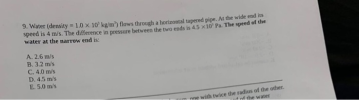 9. Water (density 1.0 X 10 kolm flows through a horizontal tapered pipe. At the wide ends speed is 4 m/s. The difference in pressure between the two ends is 4.5 x 10' Pa. The speed of the water at the narrow end is: A. 2.6 m/s B.3.2 m/s C. 4.0 m/s D. 4.5 m/s E.5.0 m/s - nne with twice the radius of the other. of the water
Problem 4. Water flows through a large tank having a diameter of 8 ft. The velocity...
 Problem 4. Water flows through a large tank having a diameter of 8 ft. The velocity of the water relative to the tank is given as Vi 16-r f/s. Water then leaves through two pipes. A 3ft pipe whose velocity of the water relative to the radius of the pipe can be expressed as V2-2.25- ts and a third pipe. Draw the control volume for this system What must be the average velocity of the third pipe if the diameter...
Water moves through a constricted pipe in steady, ideal flow. At the lower point shown in...
 Water moves through a constricted pipe in steady, ideal flow. At
the lower point shown in the figure below, the pressure is 1.85 ✕
105 Pa and the pipe radius is 2.50 cm. At the higher
point located at
y = 2.50 m,
the pressure is 1.30 ✕ 105 Pa and the pipe radius is
1.20 cm.
A pipe is open at both its left and right ends. The pipe starts
at the left end, extends horizontally to the right,...
Water moves through a constricted pipe in steady, ideal flow. At
the lower point shown in the figure below, the pressure is 1.85 ✕
105 Pa and the pipe radius is 2.50 cm. At the higher
point located at
y = 2.50 m,
the pressure is 1.30 ✕ 105 Pa and the pipe radius is
1.20 cm.
A pipe is open at both its left and right ends. The pipe starts
at the left end, extends horizontally to the right,...
Water moves through a constricted pipe in steady, ideal flow. At the lower point shown in...
Water moves through a constricted pipe in steady, ideal flow. At the lower point shown in the figure below, the pressure is 1.70 ✕ 105 Pa and the pipe radius is 2.70 cm. At the higher point located at y = 2.50 m, the pressure is 1.30 ✕ 105 Pa and the pipe radius is 1.60 cm. A pipe is open at both its left and right ends. The pipe starts at the left end, extends horizontally to the right,...
 In the figure, water flows through a horizontal pipe and then
out into the atmosphere at a speed v1 = 16.0
m/s. The diameters of the left and right sections of the pipe are
5.20 cm and 3.00 cm. (a) What volume of water
flows into the atmosphere during a 10 min period? In the left
section of the pipe, what are (b) the speed
v2 and (c) the gauge
pressure?
Question 1 In the figure, water flows through a...
In the figure, water flows through a horizontal pipe and then
out into the atmosphere at a speed v1 = 16.0
m/s. The diameters of the left and right sections of the pipe are
5.20 cm and 3.00 cm. (a) What volume of water
flows into the atmosphere during a 10 min period? In the left
section of the pipe, what are (b) the speed
v2 and (c) the gauge
pressure?
Question 1 In the figure, water flows through a...
 In the figure, water flows through a horizontal pipe and then out into the atmosphere at a speed vi-14.0 m/s. The diameters of the left and right sections of the pipe are 4.80 cm and 2.70 cm. (a) What volume of water flows into the atmosphere during a 10 min period? In the left section of the pipe, what are (b) the speed v2 and (c) the gauge pressure? da
 V2 4.(17 points) In figure, water flows through a horizontal pipe and then out into the atmosphere at a speed vi=15 m/s. The diameters of the left and right section of the pipe are dz=0.05 m and d;=0.03 m. (a) What volume of water flows into the atmosphere during a 10 min period? In the left section of the pipe, what are (b) the speed v2 and (c) what is the pressure difference in the left and right parts of...
 Question 1 In the figure, water flows through a horizontal pipe and then out into the atmosphere at a speed v1 = 13.0 m/s. The diameters of the left and right sections of the pipe are 5.10 cm and 3.00 cm. (a) What volume of water flows into the atmosphere during a 10 min period? In the left section of the pipe, what are (b) the speed v2 and (c) the gauge pressure? V2 (a) Number Units (b) Number Units...
 Water at 60 °F flows through the elbow as shown below and is then injected to the atmosphere through a nozzle (on a horizontal plane). The pipe diameter is Di = 4 in. while the diameter of the exit of the nozzle is D2 = 1 in. At a flow rate of Q = 245 gpm, the gage pressure at the section (1) where the flange locates is Pi = 34 psig. Neglect the weight of the water and elbow,...
 9. Water (density 1.0 X 10 kolm flows through a horizontal tapered pipe. At the wide ends speed is 4 m/s. The difference in pressure between the two ends is 4.5 x 10' Pa. The speed of the water at the narrow end is: A. 2.6 m/s B.3.2 m/s C. 4.0 m/s D. 4.5 m/s E.5.0 m/s - nne with twice the radius of the other. of the water
 Problem 4. Water flows through a large tank having a diameter of 8 ft. The velocity of the water relative to the tank is given as Vi 16-r f/s. Water then leaves through two pipes. A 3ft pipe whose velocity of the water relative to the radius of the pipe can be expressed as V2-2.25- ts and a third pipe. Draw the control volume for this system What must be the average velocity of the third pipe if the diameter...
 Water moves through a constricted pipe in steady, ideal flow. At
the lower point shown in the figure below, the pressure is 1.85 ✕
105 Pa and the pipe radius is 2.50 cm. At the higher
point located at
y = 2.50 m,
the pressure is 1.30 ✕ 105 Pa and the pipe radius is
1.20 cm.
A pipe is open at both its left and right ends. The pipe starts
at the left end, extends horizontally to the right,...
Water moves through a constricted pipe in steady, ideal flow. At
the lower point shown in the figure below, the pressure is 1.85 ✕
105 Pa and the pipe radius is 2.50 cm. At the higher
point located at
y = 2.50 m,
the pressure is 1.30 ✕ 105 Pa and the pipe radius is
1.20 cm.
A pipe is open at both its left and right ends. The pipe starts
at the left end, extends horizontally to the right,...
Most questions answered within 3 hours.
-
Where is the error in this code sequence?
String s1 = "Hello";
String s2 = "ello";...
asked 10 months ago -
Financial data for Joel de Paris, Inc., for last year
follow:
Joel de Paris, Inc.
Balance...
asked 10 months ago -
Consider this reaction:
Al2(SO4)3 (aq)+ BaCl3
(aq) Al2Cl6 (aq)- +
3BaSO4(s) . What is the...
asked 10 months ago -
Suppose that Savneet is considering increasing her
recent random sample from 20 car rentals to 40...
asked 10 months ago -
Trucks arrive at an unloading terminal at an average rate of 120
per hour.
Trucks arrive...
asked 10 months ago -
Why are methanol and ethanol completely soluble in water while
octanol is not very little soluble....
asked 10 months ago -
A facilities manager at a university reads in a research report
that the mean amount of...
asked 10 months ago -
When the CuSO4 is rehydrated by adding water to the anhydrous
compound, is this an endothermic...
asked 10 months ago -
A ray of sunlight is passing from diamond into crown glass; the
angle of incidence is...
asked 10 months ago -
A block of mass 0.249 kg is placed on top of a light, vertical
spring of...
asked 10 months ago -
how do the kidneys compensate in the presences of acidosis
a) trigger hyperventilate
b) reserve acid...
asked 10 months ago -
Question 501 pts
The rental rate of capital to the firm increases. Which of the
following...
asked 10 months ago