
Homework Answers

Add Answer to:
Problem 2: Wave function Which of these functions describes a wave moving in -r direction'? (i)...
Problem 2: Wave function Which of these functions describes a wave moving in -x direction? (i)...
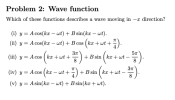 Problem 2: Wave function Which of these functions describes a wave moving in -x direction? (i) y = A cos(kx-at) + B sin(kz-wt). (ii) y = Acos(kz-wt) + B cos (kx +wt + π) B sin[kx + wt - 37T (v) yAsin(kx -wt) +B sin(kx +wt)
At the position r = 0 A (meters) 30 t (seconds) 10 Which wave function corresponds best to the diagram? 2. y= A si...
 At the position r = 0 A (meters) 30 t (seconds) 10 Which wave function corresponds best to the diagram? 2. y= A sin ko- 1. y = A sin ko - (25) -- () 2. y = A sin(kx - (39) +- (63) sin (er - () - ()] [62-(19) --() [63-(3) --() sin ka - ()--(*) 7., = Asin ka- (19) :-()] – A sin kr- () :-(-) 9. y = A sin k=-()- () 10. y =...
PrOBleM: SoLuTiONS To THE WAvE EQuATION a) By direct substitution determine which of the following functions...
 PrOBleM: SoLuTiONS To THE WAvE EQuATION a) By direct substitution determine which of the following functions satisfy the wave equation 1. g(z, t)-A cos(kr - wt) where A, k, w are positive constants 2. h(z,t)-Ae-(kz-wt)2 where A, k, ω are positive constants 3. p(x, t) A sinh(kx-wt) where A, k,w are positive constants 4. q(z, t) - Ae(atut) where A,a, w are positive constants 5. An arbitrary function: f(x, t) - f(kx -wt) where k and w are positive constants....
check whether the function E(x,t)= Asin(kx^2-wt^2) satisfies the wave equation. if so, find the wave speed....
check whether the function E(x,t)= Asin(kx^2-wt^2) satisfies the wave equation. if so, find the wave speed. if not explain
Paragraph Styles Problem 5-The following figure represents a traveling wave. The distance the wave has traveled...
 Paragraph Styles Problem 5-The following figure represents a traveling wave. The distance the wave has traveled is 50 meters during a 10 second. w Formulas: F=1/T, V=f1, w = 271, K=27/A, Y= Asin(kx - w t) The wave Y-5 sin (k x-wt) travels in the rope. • "5" in the formula is in cm. a)What is the amplitude (A) of the wave? b)What is the frequency (f) (-in Hertz) of the wave? (see the above figure) c) What is the...
Chapter 16, Problem 009 A sinusoidal wave moving along a string is shown twice in the...
 Chapter 16, Problem 009 A sinusoidal wave moving along a string is shown twice in the figure, as crest A travels in the positive direction of an x axis by distance d" 6.0 cm in 4,2 ms. The tick marks along the axis are separated by 14 cm; height H 6.20 mm. If the wave equation is of the form y(x, t) Ym sin(kx wt), what are (a) yme (b) k, (c) , and (d) the correct choice of sign...
2. Derivation of the Kronig-Penney result: Write the solution for the wave function in the region...
 2. Derivation of the Kronig-Penney result: Write the solution for the wave function in the region 0 < r < a as a linear combi nation of sin and cos functions and in the region-b< 0 as a linear combination of the hvperbolic sin and cos functions: ψ(z) Asin Kr +Bcos Kx (0<x <a) = By invoking the continuity and differentiability conditions at a- 0, show that B D and AK - CQ, so essentially two constants, say A and...
a) By direct substitution determine which of the following functions satisfy the wave equation. 1. g(x,...
a) By direct substitution determine which of the following functions satisfy the wave equation. 1. g(x, t) = Acos(kx − t) where A, k, are positive constants. 2. h(x, t) = Ae where A, k, are positive constants. 3. p(x, t) = Asinh(kx − t) where A, k, are positive constants. 4. q(x, t) = Ae where A, a, are positive constants. 5. An arbitrary function: f(x, t) = f(kx−t) where k and are positive constants. (Hint: Be careful with...
7. (Problem 7.1) A string is oscillating with the wave function y(x,t) A sin(kx-wt) with A-3...
 7. (Problem 7.1) A string is oscillating with the wave function y(x,t) A sin(kx-wt) with A-3 cm, k=0.2π rad/cm, and ω = 10π rad/cm. For both t = 0.05s and 0.07s sketch the string for 0 s xS 10 cm
transverse sinusoidal wave is moving along a string in the positive direction of an x axis...
transverse sinusoidal wave is moving along a string in the positive direction of an x axis with a speed of 93 m/s. At t= 0, the string particle at x = 0 has a transverse displacement of 4.1 cm from its equilibrium position and is not moving. The maximum transverse speed of the string particle at x = 0 is 19 m/s. (a) What is the frequency of the wave? (b) What is the wavelength of the wave? If the...
 Problem 2: Wave function Which of these functions describes a wave moving in -x direction? (i) y = A cos(kx-at) + B sin(kz-wt). (ii) y = Acos(kz-wt) + B cos (kx +wt + π) B sin[kx + wt - 37T (v) yAsin(kx -wt) +B sin(kx +wt)
 At the position r = 0 A (meters) 30 t (seconds) 10 Which wave function corresponds best to the diagram? 2. y= A sin ko- 1. y = A sin ko - (25) -- () 2. y = A sin(kx - (39) +- (63) sin (er - () - ()] [62-(19) --() [63-(3) --() sin ka - ()--(*) 7., = Asin ka- (19) :-()] – A sin kr- () :-(-) 9. y = A sin k=-()- () 10. y =...
 PrOBleM: SoLuTiONS To THE WAvE EQuATION a) By direct substitution determine which of the following functions satisfy the wave equation 1. g(z, t)-A cos(kr - wt) where A, k, w are positive constants 2. h(z,t)-Ae-(kz-wt)2 where A, k, ω are positive constants 3. p(x, t) A sinh(kx-wt) where A, k,w are positive constants 4. q(z, t) - Ae(atut) where A,a, w are positive constants 5. An arbitrary function: f(x, t) - f(kx -wt) where k and w are positive constants....
 Paragraph Styles Problem 5-The following figure represents a traveling wave. The distance the wave has traveled is 50 meters during a 10 second. w Formulas: F=1/T, V=f1, w = 271, K=27/A, Y= Asin(kx - w t) The wave Y-5 sin (k x-wt) travels in the rope. • "5" in the formula is in cm. a)What is the amplitude (A) of the wave? b)What is the frequency (f) (-in Hertz) of the wave? (see the above figure) c) What is the...
 Chapter 16, Problem 009 A sinusoidal wave moving along a string is shown twice in the figure, as crest A travels in the positive direction of an x axis by distance d" 6.0 cm in 4,2 ms. The tick marks along the axis are separated by 14 cm; height H 6.20 mm. If the wave equation is of the form y(x, t) Ym sin(kx wt), what are (a) yme (b) k, (c) , and (d) the correct choice of sign...
 2. Derivation of the Kronig-Penney result: Write the solution for the wave function in the region 0 < r < a as a linear combi nation of sin and cos functions and in the region-b< 0 as a linear combination of the hvperbolic sin and cos functions: ψ(z) Asin Kr +Bcos Kx (0<x <a) = By invoking the continuity and differentiability conditions at a- 0, show that B D and AK - CQ, so essentially two constants, say A and...
 7. (Problem 7.1) A string is oscillating with the wave function y(x,t) A sin(kx-wt) with A-3 cm, k=0.2π rad/cm, and ω = 10π rad/cm. For both t = 0.05s and 0.07s sketch the string for 0 s xS 10 cm
Most questions answered within 3 hours.
-
Where is the error in this code sequence?
String s1 = "Hello";
String s2 = "ello";...
asked 10 months ago -
Financial data for Joel de Paris, Inc., for last year
follow:
Joel de Paris, Inc.
Balance...
asked 10 months ago -
Consider this reaction:
Al2(SO4)3 (aq)+ BaCl3
(aq) Al2Cl6 (aq)- +
3BaSO4(s) . What is the...
asked 10 months ago -
Suppose that Savneet is considering increasing her
recent random sample from 20 car rentals to 40...
asked 10 months ago -
Trucks arrive at an unloading terminal at an average rate of 120
per hour.
Trucks arrive...
asked 10 months ago -
Why are methanol and ethanol completely soluble in water while
octanol is not very little soluble....
asked 10 months ago -
A facilities manager at a university reads in a research report
that the mean amount of...
asked 10 months ago -
When the CuSO4 is rehydrated by adding water to the anhydrous
compound, is this an endothermic...
asked 10 months ago -
A ray of sunlight is passing from diamond into crown glass; the
angle of incidence is...
asked 10 months ago -
A block of mass 0.249 kg is placed on top of a light, vertical
spring of...
asked 10 months ago -
how do the kidneys compensate in the presences of acidosis
a) trigger hyperventilate
b) reserve acid...
asked 10 months ago -
Question 501 pts
The rental rate of capital to the firm increases. Which of the
following...
asked 10 months ago