The drawing shows two surfaces that have the same area. A uniform magnetic field vector B...
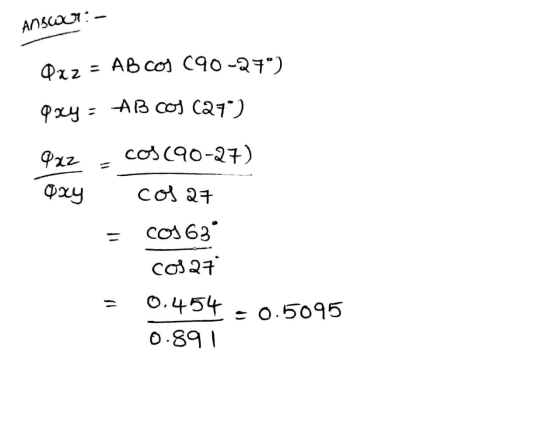
The drawing shows two surfaces that have the same area. A uniform magnetic field vector B fills the space occupied by these surfaces and is oriented parallel to the yz plane as shown. If θ = 27°, find the ratio Φxz/Φxy of the magnetic fluxes that pass through the surfaces.
Homework Answers
Add Answer to:
The drawing shows two surfaces that have the same area. A
uniform magnetic field vector B...
The drawing shows two surfaces that have the same area. A uniform magnetic field fills the...
 The drawing shows two surfaces that have the same area. A
uniform magnetic field
fills the space occupied by these surfaces and is oriented
parallel to the yz plane as shown. Find the ratio
xz/xy
of the magnetic fluxes that pass through the surfaces.
The drawing shows two surfaces that have the same area. A
uniform magnetic field
fills the space occupied by these surfaces and is oriented
parallel to the yz plane as shown. Find the ratio
xz/xy
of the magnetic fluxes that pass through the surfaces.
Two flat surfaces are exposed to a uniform, horizontal magnetic field of magnitude 0.20 T. When...
Two flat surfaces are exposed to a uniform, horizontal magnetic field of magnitude 0.20 T. When viewed edge-on, the first surface is tilted at an angle of 27° from the horizontal, and a net magnetic flux of 7.0 x 10⁻⁴ Wb passes through it. The same net magnetic flux passes through the second surface. (a) Determine the area of the first surface. (b) Find the smallest possible value of the area of the second surface.
A circular loop of radius r is rotating in a uniform external magnetic field of B....
A circular loop of radius r is rotating in a uniform external magnetic field of B. Find the magnetic flux through the loop due to the external field when the plane of the loop and the magnetic field vectors are oriented at 3 different angles, θ. The coil in an ac generator of frequency f has N turns, each having an area A and is rotated in a uniform magnetic field B. What is the peak output voltage of this...
Two flat surfaces are exposed to a uniform, horizontal magnetic field of magnitude 0.47 T. When...
Two flat surfaces are exposed to a uniform, horizontal magnetic field of magnitude 0.47 T. When viewed edge-on, the first surface is tilted at an angle of 23° from the horizontal, and a net magnetic flux of 9.2 x 10⁻⁴ Wb passes through it. The same net magnetic flux passes through the second surface. (a) Determine the area of the first surface. (b) Find the smallest possible value of the area of the second surface.
Two flat surfaces are exposed to a uniform, horizontal magnetic field of magnitude 0.46 T. When...
 Two flat surfaces are exposed to a uniform, horizontal magnetic field of magnitude 0.46 T. When viewed edge-on, the first surface is tilted at an angle of 14° from the horizontal, and a net magnetic flux of 8.50 x 10⁻³ Wb passes through it. The same net magnetic flux passes through the second surface. (a) Determine the area of the first surface. m2 (b) Find the smallest possible value for the area of the second surface. m2
Please solve! Thanks Two flat surfaces are exposed to a uniform, horizontal magnetic field of magnitude...
Please solve! Thanks Two flat surfaces are exposed to a uniform, horizontal magnetic field of magnitude 0.35 T. When viewed edge-on, the first surface is tilted at an angle of 11° from the horizontal, and a net magnetic flux of 6.7 x 10⁻⁴ Wb passes through it. The same net magnetic flux passes through the second surface. (a) Determine the area of the first surface. (b) Find the smallest possible value of the area of the second surface.
The drawing shows an edge-on view of two planar surfaces that intersect and are mutually perpendicular....
 The drawing shows an edge-on
view of two planar surfaces that intersect and are mutually
perpendicular. Surface 1 has an area of 1.7 m2, while surface 2 has
an area of 4.3 m2. The electric field E in the drawing is uniform
and has a magnitude of 320 N/C. It is directed towards the two
perpendicular surfaces, making an angle 35o with the bottom
surface. Find the electric flux through (a) surface 1 and (b)
surface 2.
The drawing shows an edge-on
view of two planar surfaces that intersect and are mutually
perpendicular. Surface 1 has an area of 1.7 m2, while surface 2 has
an area of 4.3 m2. The electric field E in the drawing is uniform
and has a magnitude of 320 N/C. It is directed towards the two
perpendicular surfaces, making an angle 35o with the bottom
surface. Find the electric flux through (a) surface 1 and (b)
surface 2.
The drawing shows an edge-on view of two planar surfaces that intersect and are mutually perpendicular....
 The drawing shows an edge-on view of two planar surfaces that intersect and are mutually perpendicular. Surface 1 has an area of 1.9 m^2, while surface 2 has an area of 3.5 m^2. The electric field E in the drawing is uniform and has a magnitude of 245 N/C. (a) Find the electric flux through surface 1. N middot m^2/C (b) Find the electric flux through surface 2. N middot m^2/C
The drawing shows an edge-on view of two planar surfaces that intersect and are mutually perpendicular....
 The drawing shows an edge-on view of two planar surfaces that
intersect and are mutually perpendicular. Surface (1) has an area
of 1.90 m², while surface (2) has an area of 3.40 m². The electric
field in the drawing is uniform and has a magnitude of 275 N/C.
Find the magnitude of the electric flux through surface (1) if the
angle ? made between the electric field with surface (2) is
36.0°.
Put answer in Nm^2/C
https://general.physics.rutgers.edu/gifs/CJ/18-81.jpg
The drawing shows an edge-on view of two planar surfaces that
intersect and are mutually perpendicular. Surface (1) has an area
of 1.90 m², while surface (2) has an area of 3.40 m². The electric
field in the drawing is uniform and has a magnitude of 275 N/C.
Find the magnitude of the electric flux through surface (1) if the
angle ? made between the electric field with surface (2) is
36.0°.
Put answer in Nm^2/C
https://general.physics.rutgers.edu/gifs/CJ/18-81.jpg
a) Two flat surfaces are exposed to a uniform, horizontal magnetic field of magnitude 0.22 T....
a) Two flat surfaces are exposed to a uniform, horizontal magnetic field of magnitude 0.22 T. When viewed edge-on, the first surface is tilted at an angle of 21° from the horizontal, and a net magnetic flux of 6.6 x 10⁻⁴ Wb passes through it. The same net magnetic flux passes through the second surface. (a) Determine the area of the first surface. (b) Find the smallest possible value of the area of the second surface. b) Near San Francisco,...
 Two flat surfaces are exposed to a uniform, horizontal magnetic field of magnitude 0.46 T. When viewed edge-on, the first surface is tilted at an angle of 14° from the horizontal, and a net magnetic flux of 8.50 x 10⁻³ Wb passes through it. The same net magnetic flux passes through the second surface. (a) Determine the area of the first surface. m2 (b) Find the smallest possible value for the area of the second surface. m2
 The drawing shows an edge-on
view of two planar surfaces that intersect and are mutually
perpendicular. Surface 1 has an area of 1.7 m2, while surface 2 has
an area of 4.3 m2. The electric field E in the drawing is uniform
and has a magnitude of 320 N/C. It is directed towards the two
perpendicular surfaces, making an angle 35o with the bottom
surface. Find the electric flux through (a) surface 1 and (b)
surface 2.
The drawing shows an edge-on
view of two planar surfaces that intersect and are mutually
perpendicular. Surface 1 has an area of 1.7 m2, while surface 2 has
an area of 4.3 m2. The electric field E in the drawing is uniform
and has a magnitude of 320 N/C. It is directed towards the two
perpendicular surfaces, making an angle 35o with the bottom
surface. Find the electric flux through (a) surface 1 and (b)
surface 2.
 The drawing shows an edge-on view of two planar surfaces that intersect and are mutually perpendicular. Surface 1 has an area of 1.9 m^2, while surface 2 has an area of 3.5 m^2. The electric field E in the drawing is uniform and has a magnitude of 245 N/C. (a) Find the electric flux through surface 1. N middot m^2/C (b) Find the electric flux through surface 2. N middot m^2/C
Most questions answered within 3 hours.
-
Where is the error in this code sequence?
String s1 = "Hello";
String s2 = "ello";...
asked 10 months ago -
Financial data for Joel de Paris, Inc., for last year
follow:
Joel de Paris, Inc.
Balance...
asked 10 months ago -
Consider this reaction:
Al2(SO4)3 (aq)+ BaCl3
(aq) Al2Cl6 (aq)- +
3BaSO4(s) . What is the...
asked 10 months ago -
Suppose that Savneet is considering increasing her
recent random sample from 20 car rentals to 40...
asked 10 months ago -
Trucks arrive at an unloading terminal at an average rate of 120
per hour.
Trucks arrive...
asked 10 months ago -
Why are methanol and ethanol completely soluble in water while
octanol is not very little soluble....
asked 10 months ago -
A facilities manager at a university reads in a research report
that the mean amount of...
asked 10 months ago -
When the CuSO4 is rehydrated by adding water to the anhydrous
compound, is this an endothermic...
asked 10 months ago -
A ray of sunlight is passing from diamond into crown glass; the
angle of incidence is...
asked 10 months ago -
A block of mass 0.249 kg is placed on top of a light, vertical
spring of...
asked 10 months ago -
how do the kidneys compensate in the presences of acidosis
a) trigger hyperventilate
b) reserve acid...
asked 10 months ago -
Question 501 pts
The rental rate of capital to the firm increases. Which of the
following...
asked 10 months ago