
Homework Answers
Add Answer to:
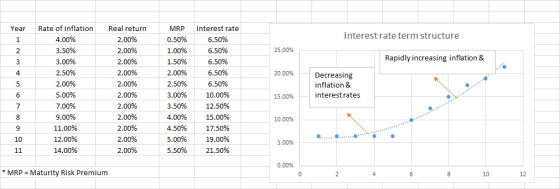
Over the next three years, you expect the rate of inflation to decrease, but yet remain...
You expect inflation over the next year to be 4.6%. Actual inflation over the last year...
You expect inflation over the next year to be 4.6%. Actual inflation over the last year was 0.78%, and the current nominal interest rate is 0.51%. What is your expected real rate of interest (in %)? Round to 0.01%. E.g., if your answer is 3.145%, record it as 3.15.
Inflation is expected to increase steadily over the next 10 years, there is a positive maturity...
Inflation is expected to increase steadily over the next 10 years, there is a positive maturity risk premium on both Treasury and corporate bonds, and the real risk-free rate of interest is expected to remain constant. Which of the following statements is CORRECT? a. The yield on 7-year corporate bonds must exceed the yield on 10-year Treasury bonds. b. The stated conditions cannot all be true – they are internally inconsistent. c. The yield on any corporate bond must exceed...
Suppose you and other investors expect that inflation will be 4% next year, to rise to...
Suppose you and other investors expect that inflation will be 4% next year, to rise to 5% during the following year and then to remain at 4.9% thereafter. Further you expect that the real risk free rate of interest will remain at 2% and the maturity risk premium on treasury securities will rise from .2% for one year bonds. Maturity risk premiums are expected to increase 0.2% for each year to maturity up to a limit of 1.0 percentage point on 5-year...
Question 22 (0.9 points) Over the next three years, the expected path of 1-year interest rates...
 Question 22 (0.9 points) Over the next three years, the expected path of 1-year interest rates is 1, 2, and 1 percent, and the 1-year, 2-year, and 3-year term premia are 0, 0.2, and 0.5 percent, respectively. Using the information, if the expectations theory of the term structure is true, then the current interest rate on 2-year bond must be % (round to one decimal place x.x). Question 23 (0.9 points) Over the next three years, the expected path of...
An economist expects short-term rates to remain unchanged over the next several years. The economist would...
 An economist expects short-term rates to remain unchanged over the next several years. The economist would most likely predict an upward sloping yield curve if he believes which term structure theory applies? a) Local expectations theory. b) Liquidity preference theory. c) Unbiased expectations theory. ОА OB OC QUESTION 41 If the spot rate curve is upward sloping, then: a) The forward curve lies above the spot curve and the yield to maturity will be lower than the spot rate with...
You expect the annual real rate of interest to remain constant for the indefinite future at...
You expect the annual real rate of interest to remain constant for the indefinite future at 2.2%. You expect the upcoming year’s inflation to be 3%. What current one-year spot rate should you observe in the market? Please use the exact formula. Enter in percent form without the percentage sign. Enter to three decimal places.
determine the net income for the following years. did the net income increase, decrease, or remain...
 determine the net income for the following years. did the net
income increase, decrease, or remain unchanged in this three-year
period.
Exercise 13-5 Determining income effects from common-size and trend percents LO P1, P2 Common-size and trend percents for Rustynail Company's sales, cost of goods sold, and expenses follow. Sales Cost of goods sold Total expenses Common-Size Percents Current Yr 1 Yr Ago 2 Yrs Ago 100.0% 100.0% 100. 63.4 61.9 59.1 15.3 14.8 15.1 Trend Percents Current Yr 1...
determine the net income for the following years. did the net
income increase, decrease, or remain unchanged in this three-year
period.
Exercise 13-5 Determining income effects from common-size and trend percents LO P1, P2 Common-size and trend percents for Rustynail Company's sales, cost of goods sold, and expenses follow. Sales Cost of goods sold Total expenses Common-Size Percents Current Yr 1 Yr Ago 2 Yrs Ago 100.0% 100.0% 100. 63.4 61.9 59.1 15.3 14.8 15.1 Trend Percents Current Yr 1...
The first blank options are (a downward-sloping, a humped, and an upward-sloping) 5. Drawing a yield...
 The
first blank options are (a downward-sloping, a humped, and an
upward-sloping)
5. Drawing a yield curve Given the indicated maturities listed in the following table, assume the following yields for U.S. Treasury securities: Maturity (Years) Yield (%) 1 2.0 5 3.1 10 3.8 20 4.6 30 5.5 On the following graph, plot the yield curve implied by these interest rates. Place a blue point (circle symbol) at each maturity and interest rate in the table, and the yield curve...
The
first blank options are (a downward-sloping, a humped, and an
upward-sloping)
5. Drawing a yield curve Given the indicated maturities listed in the following table, assume the following yields for U.S. Treasury securities: Maturity (Years) Yield (%) 1 2.0 5 3.1 10 3.8 20 4.6 30 5.5 On the following graph, plot the yield curve implied by these interest rates. Place a blue point (circle symbol) at each maturity and interest rate in the table, and the yield curve...
3. Assume that the current 1-year interest rate is 3%, the expected 1-year rate next year...
 3. Assume that the current 1-year interest rate is 3%, the expected 1-year rate next year is 2%, and the expected 1-year rate in the following year (3rd year) is 4%. a. Calculate the 2-year interest rate and the 3-year interest rate based on the expectations theory. (Show calculations) b. Draw the yield curve based on your data above. Label your axis and mark the numbers along the axis, so you can read the actual interest rates in your graph....
e. Suppose most investors expect the inflation rate to be 5% next year, 6% the following...
 e. Suppose most investors expect the inflation rate to be 5% next year, 6% the following year, and 8% thereafter. The real risk-free rate is 3%. The maturity risk premium is zero for bonds that mature in 1 year or less and 0.1% for 2-year bonds; then the MRP increases by 0.1% per year thereafter for 20 years, after which it is stable. What is the interest rate on 1-, 10-, and 20-year Treasury bonds? Draw a yield curve with...
 Question 22 (0.9 points) Over the next three years, the expected path of 1-year interest rates is 1, 2, and 1 percent, and the 1-year, 2-year, and 3-year term premia are 0, 0.2, and 0.5 percent, respectively. Using the information, if the expectations theory of the term structure is true, then the current interest rate on 2-year bond must be % (round to one decimal place x.x). Question 23 (0.9 points) Over the next three years, the expected path of...
 An economist expects short-term rates to remain unchanged over the next several years. The economist would most likely predict an upward sloping yield curve if he believes which term structure theory applies? a) Local expectations theory. b) Liquidity preference theory. c) Unbiased expectations theory. ОА OB OC QUESTION 41 If the spot rate curve is upward sloping, then: a) The forward curve lies above the spot curve and the yield to maturity will be lower than the spot rate with...
 determine the net income for the following years. did the net
income increase, decrease, or remain unchanged in this three-year
period.
Exercise 13-5 Determining income effects from common-size and trend percents LO P1, P2 Common-size and trend percents for Rustynail Company's sales, cost of goods sold, and expenses follow. Sales Cost of goods sold Total expenses Common-Size Percents Current Yr 1 Yr Ago 2 Yrs Ago 100.0% 100.0% 100. 63.4 61.9 59.1 15.3 14.8 15.1 Trend Percents Current Yr 1...
determine the net income for the following years. did the net
income increase, decrease, or remain unchanged in this three-year
period.
Exercise 13-5 Determining income effects from common-size and trend percents LO P1, P2 Common-size and trend percents for Rustynail Company's sales, cost of goods sold, and expenses follow. Sales Cost of goods sold Total expenses Common-Size Percents Current Yr 1 Yr Ago 2 Yrs Ago 100.0% 100.0% 100. 63.4 61.9 59.1 15.3 14.8 15.1 Trend Percents Current Yr 1...
 The
first blank options are (a downward-sloping, a humped, and an
upward-sloping)
5. Drawing a yield curve Given the indicated maturities listed in the following table, assume the following yields for U.S. Treasury securities: Maturity (Years) Yield (%) 1 2.0 5 3.1 10 3.8 20 4.6 30 5.5 On the following graph, plot the yield curve implied by these interest rates. Place a blue point (circle symbol) at each maturity and interest rate in the table, and the yield curve...
The
first blank options are (a downward-sloping, a humped, and an
upward-sloping)
5. Drawing a yield curve Given the indicated maturities listed in the following table, assume the following yields for U.S. Treasury securities: Maturity (Years) Yield (%) 1 2.0 5 3.1 10 3.8 20 4.6 30 5.5 On the following graph, plot the yield curve implied by these interest rates. Place a blue point (circle symbol) at each maturity and interest rate in the table, and the yield curve...
 3. Assume that the current 1-year interest rate is 3%, the expected 1-year rate next year is 2%, and the expected 1-year rate in the following year (3rd year) is 4%. a. Calculate the 2-year interest rate and the 3-year interest rate based on the expectations theory. (Show calculations) b. Draw the yield curve based on your data above. Label your axis and mark the numbers along the axis, so you can read the actual interest rates in your graph....
 e. Suppose most investors expect the inflation rate to be 5% next year, 6% the following year, and 8% thereafter. The real risk-free rate is 3%. The maturity risk premium is zero for bonds that mature in 1 year or less and 0.1% for 2-year bonds; then the MRP increases by 0.1% per year thereafter for 20 years, after which it is stable. What is the interest rate on 1-, 10-, and 20-year Treasury bonds? Draw a yield curve with...
Most questions answered within 3 hours.
-
Where is the error in this code sequence?
String s1 = "Hello";
String s2 = "ello";...
asked 10 months ago -
Financial data for Joel de Paris, Inc., for last year
follow:
Joel de Paris, Inc.
Balance...
asked 10 months ago -
Consider this reaction:
Al2(SO4)3 (aq)+ BaCl3
(aq) Al2Cl6 (aq)- +
3BaSO4(s) . What is the...
asked 10 months ago -
Suppose that Savneet is considering increasing her
recent random sample from 20 car rentals to 40...
asked 10 months ago -
Trucks arrive at an unloading terminal at an average rate of 120
per hour.
Trucks arrive...
asked 10 months ago -
Why are methanol and ethanol completely soluble in water while
octanol is not very little soluble....
asked 10 months ago -
A facilities manager at a university reads in a research report
that the mean amount of...
asked 10 months ago -
When the CuSO4 is rehydrated by adding water to the anhydrous
compound, is this an endothermic...
asked 10 months ago -
A ray of sunlight is passing from diamond into crown glass; the
angle of incidence is...
asked 10 months ago -
A block of mass 0.249 kg is placed on top of a light, vertical
spring of...
asked 10 months ago -
how do the kidneys compensate in the presences of acidosis
a) trigger hyperventilate
b) reserve acid...
asked 10 months ago -
Question 501 pts
The rental rate of capital to the firm increases. Which of the
following...
asked 10 months ago