A machine costing $99,375 with a 5-year life and $6,000 residual value was purchased January 2....
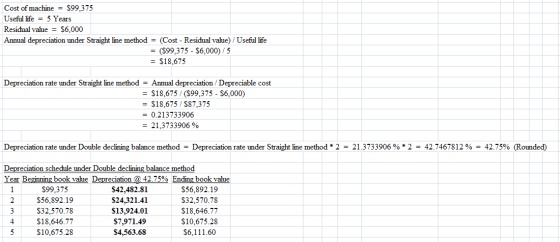
A machine costing $99,375 with a 5-year life and $6,000 residual value was purchased January 2. Compute depreciation for each of the five years, using the double-declining-balance method.
Year 1: $ ?
Year 2: $?
Year 3: $?
Year 4: $?
Year 5: $?
Homework Answers
Add Answer to:
A machine costing $99,375 with a 5-year life and $6,000 residual
value was purchased January 2....
A machine costing $40,625 with a five-year life and $2,400 residual value was purchased January 2....
A machine costing $40,625 with a five-year life and $2,400 residual value was purchased January 2. Compute depreciation for each of the five years, using the double-declining-balance method. Year 1 $ Year 2 $ Year 3 $ Year 4 $ Year 5 $
A machine costing $185,000 with a five-year life and $20,000residual value was purchased January 2....
A machine costing $185,000 with a five-year life and $20,000 residual value was purchased January 2. Compute depreciation for each of the five years, using the double-declining-balance method.1. Year 1$2. Year 2$3. Year 3$4. Year 4$5. Year 5$
12) BONUS QUESTION (5 PTS.) A machine costing $185,000 with a 5-year life and $20,000 residual...
 12)
BONUS QUESTION (5 PTS.) A machine costing $185,000 with a 5-year life and $20,000 residual value was purchased January 2. Compute depreciation for each of the five years, using the double-declining-balance method. (SHOW WORK) YEAR: 1.
12)
BONUS QUESTION (5 PTS.) A machine costing $185,000 with a 5-year life and $20,000 residual value was purchased January 2. Compute depreciation for each of the five years, using the double-declining-balance method. (SHOW WORK) YEAR: 1.
On January 1, a machine with a useful life of five years and a residual value...
On January 1, a machine with a useful life of five years and a residual value of $30,000 was purchased for $90,000. What is the depreciation expense for year 1 under the double-declining-balance method of depreciation?
machine 1: cost 76,000 salvage value 6,000 useful life 10 years purchased 7/1/16 machine 2: cost...
 machine 1:
cost 76,000
salvage value 6,000
useful life 10 years
purchased 7/1/16
machine 2:
cost 80,000
salvage value 10,000
useful life 8 years
purchased 1/1/13
machine 3:
cost 78,000
salvage value 6,000
useful life 6 years = 24,000 hours
purchased 1/1/18
Problem: In recent years, Hrubeck Company purchased three machines. Because of heavy turnover in the accounting department, a different accountant was in charge of selecting the depreciation method for each machine, and various methods were selected. Information concerning...
machine 1:
cost 76,000
salvage value 6,000
useful life 10 years
purchased 7/1/16
machine 2:
cost 80,000
salvage value 10,000
useful life 8 years
purchased 1/1/13
machine 3:
cost 78,000
salvage value 6,000
useful life 6 years = 24,000 hours
purchased 1/1/18
Problem: In recent years, Hrubeck Company purchased three machines. Because of heavy turnover in the accounting department, a different accountant was in charge of selecting the depreciation method for each machine, and various methods were selected. Information concerning...
1. A machine costing $59,375 with a 5-year life and $3,600 residual value was purchased January...
1. A machine costing $59,375 with a 5-year life and $3,600 residual value was purchased January 2. Compute depreciation for each of the five years, using the double-declining-balance method. Year Depreciation Year 1 $ Year 2 $ Year 3 $ Year 4 $ Year 5 $ 2. An asset was purchased for $71,000 and originally estimated to have a useful life of 10 years with a residual value of $3,400. After two years of straight-line depreciation, it was determined that...
On January 1. 2014. a machine was purchased for $90,000.
On January 1. 2014. a machine was purchased for $90,000. The machine has an estimated salvage value of $6,000 and an estimated useful life of 5 years. The machine can operate for 100.000 hours before it needs to be replaced. The company closed its books on December 31 of each year. Instructions (a) Compute the annual depreciation charges over the machine' s life assuming a December 31 year-end for each of the following depreciation rnethods. (l) Straight-line method. (2) Sum-of-the-years'-digits method. ....
QUESTION 2 A machine with a four-year estimated useful life and an estimated residual value of...
 QUESTION 2 A machine with a four-year estimated useful life and an estimated residual value of $10,000 was acquired on January 1, 2011 for $40,000. Would depreciation expense using sum-of-the-years-digits be higher or lower than depreciation expense using double-declining balance in the first year? Higher Lower Cannot answer based on only this information QUESTION 3 On January 1, 2011, New Company purchased a new copier for $22.000. The asset has an estimated life of four years and an estimated residual...
On June 1, a machine costing $660,000 with a 5-year life and an estimated $50,000 salvage...
 On June 1, a machine costing $660,000 with a 5-year life and an
estimated $50,000 salvage value was purchased. It was also
estimated that the machine would produce 200,000 units during its
life. Actual production would be 40,000 units per year for all five
years.
Using the depreciation template provided, determine the amount
of depreciation expense for the third year under each of the
following assumption
The company uses the double-declining-balance method of
depreciation.
50 Cast Salvage value Depreciable cost...
On June 1, a machine costing $660,000 with a 5-year life and an
estimated $50,000 salvage value was purchased. It was also
estimated that the machine would produce 200,000 units during its
life. Actual production would be 40,000 units per year for all five
years.
Using the depreciation template provided, determine the amount
of depreciation expense for the third year under each of the
following assumption
The company uses the double-declining-balance method of
depreciation.
50 Cast Salvage value Depreciable cost...
Part 1. A machine costing $22,000 with a five-year life and an estimated $2,000 salvage value...
 Part 1. A machine costing $22,000 with a five-year life and an estimated $2,000 salvage value is installed on January 1. The factory manager estimates the machine will produce 1,000 units of product during its life. It actually produces the following units: Year 1, 200; Year 2, 400; Year 3, 300; Year 4, 80; and Year 5, 30. The total number of units produced by the end of Year 5 exceeds the original estimate this difference was not predicted. (The...
 12)
BONUS QUESTION (5 PTS.) A machine costing $185,000 with a 5-year life and $20,000 residual value was purchased January 2. Compute depreciation for each of the five years, using the double-declining-balance method. (SHOW WORK) YEAR: 1.
12)
BONUS QUESTION (5 PTS.) A machine costing $185,000 with a 5-year life and $20,000 residual value was purchased January 2. Compute depreciation for each of the five years, using the double-declining-balance method. (SHOW WORK) YEAR: 1.
 machine 1:
cost 76,000
salvage value 6,000
useful life 10 years
purchased 7/1/16
machine 2:
cost 80,000
salvage value 10,000
useful life 8 years
purchased 1/1/13
machine 3:
cost 78,000
salvage value 6,000
useful life 6 years = 24,000 hours
purchased 1/1/18
Problem: In recent years, Hrubeck Company purchased three machines. Because of heavy turnover in the accounting department, a different accountant was in charge of selecting the depreciation method for each machine, and various methods were selected. Information concerning...
machine 1:
cost 76,000
salvage value 6,000
useful life 10 years
purchased 7/1/16
machine 2:
cost 80,000
salvage value 10,000
useful life 8 years
purchased 1/1/13
machine 3:
cost 78,000
salvage value 6,000
useful life 6 years = 24,000 hours
purchased 1/1/18
Problem: In recent years, Hrubeck Company purchased three machines. Because of heavy turnover in the accounting department, a different accountant was in charge of selecting the depreciation method for each machine, and various methods were selected. Information concerning...
 QUESTION 2 A machine with a four-year estimated useful life and an estimated residual value of $10,000 was acquired on January 1, 2011 for $40,000. Would depreciation expense using sum-of-the-years-digits be higher or lower than depreciation expense using double-declining balance in the first year? Higher Lower Cannot answer based on only this information QUESTION 3 On January 1, 2011, New Company purchased a new copier for $22.000. The asset has an estimated life of four years and an estimated residual...
 On June 1, a machine costing $660,000 with a 5-year life and an
estimated $50,000 salvage value was purchased. It was also
estimated that the machine would produce 200,000 units during its
life. Actual production would be 40,000 units per year for all five
years.
Using the depreciation template provided, determine the amount
of depreciation expense for the third year under each of the
following assumption
The company uses the double-declining-balance method of
depreciation.
50 Cast Salvage value Depreciable cost...
On June 1, a machine costing $660,000 with a 5-year life and an
estimated $50,000 salvage value was purchased. It was also
estimated that the machine would produce 200,000 units during its
life. Actual production would be 40,000 units per year for all five
years.
Using the depreciation template provided, determine the amount
of depreciation expense for the third year under each of the
following assumption
The company uses the double-declining-balance method of
depreciation.
50 Cast Salvage value Depreciable cost...
 Part 1. A machine costing $22,000 with a five-year life and an estimated $2,000 salvage value is installed on January 1. The factory manager estimates the machine will produce 1,000 units of product during its life. It actually produces the following units: Year 1, 200; Year 2, 400; Year 3, 300; Year 4, 80; and Year 5, 30. The total number of units produced by the end of Year 5 exceeds the original estimate this difference was not predicted. (The...
Most questions answered within 3 hours.
-
Where is the error in this code sequence?
String s1 = "Hello";
String s2 = "ello";...
asked 10 months ago -
Financial data for Joel de Paris, Inc., for last year
follow:
Joel de Paris, Inc.
Balance...
asked 10 months ago -
Consider this reaction:
Al2(SO4)3 (aq)+ BaCl3
(aq) Al2Cl6 (aq)- +
3BaSO4(s) . What is the...
asked 10 months ago -
Suppose that Savneet is considering increasing her
recent random sample from 20 car rentals to 40...
asked 10 months ago -
Trucks arrive at an unloading terminal at an average rate of 120
per hour.
Trucks arrive...
asked 10 months ago -
Why are methanol and ethanol completely soluble in water while
octanol is not very little soluble....
asked 10 months ago -
A facilities manager at a university reads in a research report
that the mean amount of...
asked 10 months ago -
When the CuSO4 is rehydrated by adding water to the anhydrous
compound, is this an endothermic...
asked 10 months ago -
A ray of sunlight is passing from diamond into crown glass; the
angle of incidence is...
asked 10 months ago -
A block of mass 0.249 kg is placed on top of a light, vertical
spring of...
asked 10 months ago -
how do the kidneys compensate in the presences of acidosis
a) trigger hyperventilate
b) reserve acid...
asked 10 months ago -
Question 501 pts
The rental rate of capital to the firm increases. Which of the
following...
asked 10 months ago