
Homework Answers
Add Answer to:
Pre-Laboratory Questions 1. In a normal hydrogen atom, when the electron occupies its lowest aval is...
4. When a hydrogen atom is bombarded, the atom may be raised into a higher energy state. As the excited electron f...
 4. When a hydrogen atom is bombarded, the atom may be raised into a higher energy state. As the excited electron falls back to the lower energy levels, light is emitted. What are the three longest-wavelength spectral lines emitted by the hydrogen atom as it returns to the n = 1 state from higher energy states? Give your answers to three significant figures. The lowest possible state, n = 1, corresponds to the electron in its smallest possible orbit; it...
What is wavelength of a photon that would be emitted when a hydrogen atom makes a...
 What is wavelength of a photon that would be emitted when a hydrogen atom makes a transition from the n = 3 to the n = 2 energy level? What is the longest wavelength photon that could ionize a hydrogen atom originally in its ground state? What processes might occur if an electron of energy 12.2 eV collides with a hydrogen atom at rest and in its ground state?
EXPERIMENT #9: SPECTRUM OF THE HYDROGEN ATOM ADDITIONAL QUESTIONS 1. What does the energy of the...
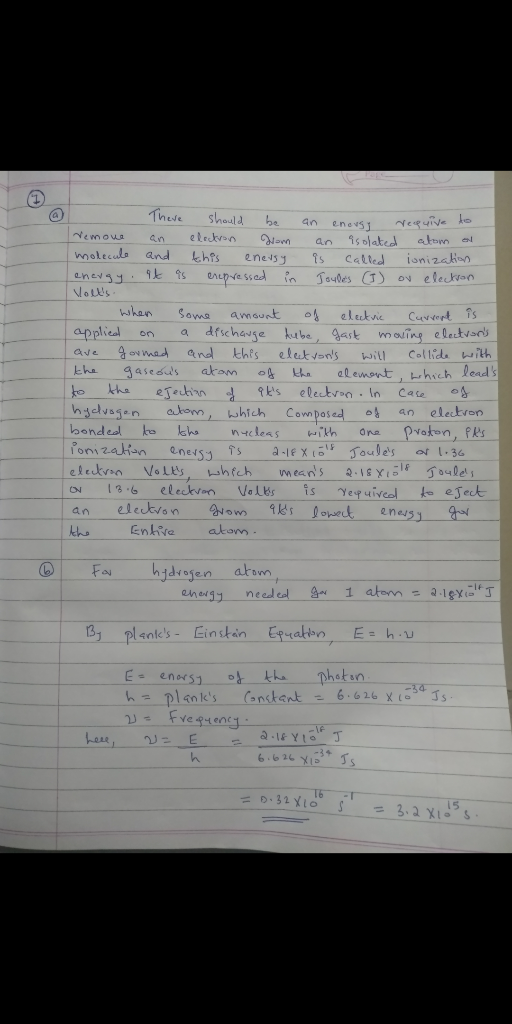
 EXPERIMENT #9: SPECTRUM OF THE HYDROGEN ATOM ADDITIONAL QUESTIONS 1. What does the energy of the electron from the hydrogen atom become when n is a very large number, or approaching infinity? We say an electron with this energy has separated from the nucleus, which is now an ion. Determine the quantity of energy (AE) required to ionize an electron from its ground state in the hydrogen atom
1. The energy of the electron in the lowest level of the hydrogen atom (n=1) is...
1. The energy of the electron in the lowest level of the hydrogen atom (n=1) is -2.179×10⁻¹⁸ J. What is the energy of the electron in level n=5? -8.716×10⁻²⁰ J (Answer is correct) 2. The electron in a hydrogen atom moves from level n=4 to level n=1. Is a photon emitted or absorbed? What is the wavelength of the photon? 3. An excited hydrogen atom emits a photon with a wavelength of 102.6 nm. In what region of the spectrum...
In the simple Bohr model of the hydrogen atom, an electron moves in a circular orbit...
In the simple Bohr model of the hydrogen atom, an electron moves in a circular orbit of radius r = 5.30 × 10⁻¹¹ m around a fixed proton. (a) What is the potential energy of the electron? (b) What is the kinetic energy of the electron? (c) Calculate the total energy when it is in its ground state. (d) How much energy is required to ionize the atom from its ground state?
EXPERIMENT #9: SPECTRUM OF THE HYDROGEN ATOM ADDITIONAL QUESTIONS 1, What does the energy of the...
 EXPERIMENT #9: SPECTRUM OF THE HYDROGEN ATOM ADDITIONAL QUESTIONS 1, What does the energy of the electron from the hydrogen atom become when n is a very large number, or approaching infinity? We say an electron with this energy has separated from the nucleus, which is now an ion. Determine the quantity of energy (AE) required to ionize an electron from its ground state in the hydrogen atom. 2. The Bohr model holds for any one-electron atom. Calculate the lowest...
P3. In a hydrogen atom in its lowest energy state (known as the ground state), the...
 P3. In a hydrogen atom in its lowest energy state (known as the ground state), the electron forms a spherically-symmetric "cloud" around the nucleus, with a charge density given by ρ-A exp(-2r a ), where a,-0.529 Â-0.529 × 10⁻¹⁰ m is the Bohr radius. (a) Determine the constant A. (b) What is the electric field at the Bohr radius?
05 Question (4 points) When a hydrogen atom absorbs a photon of electromagnetic radiation (EMR), the...
 05 Question (4 points) When a hydrogen atom absorbs a photon of electromagnetic radiation (EMR), the internal energy of the atom increases and one or more electrons may be energized into an excited state. The release of this extra energy as the excited state electron transitions back to a lower energy state results in the emission of a photon. These energy changes are responsible for the emission spectrum of hydrogen (shown below) and are described by the Bohr equation. AE...
How does the DeBroglie wavelength of the electron in the ground state of a hydrogen atom...
 How does the DeBroglie wavelength of the electron in the ground state of a hydrogen atom compare to the DeBroglie wavelength of the electron when it's in a 2p state? The DeBroglie wavelengths of the two electrons are equal. The DeBroglie wavelength of the electron in the ground state is greater than that of the electron in a 2p state. The DeBroglie wavelength of the electron in the ground state is less than that of the electron in a 2p...
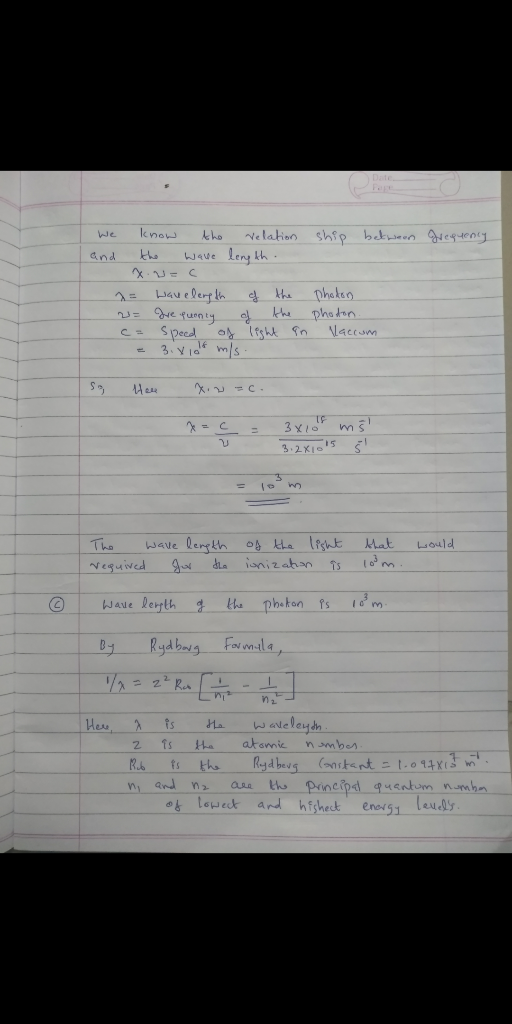
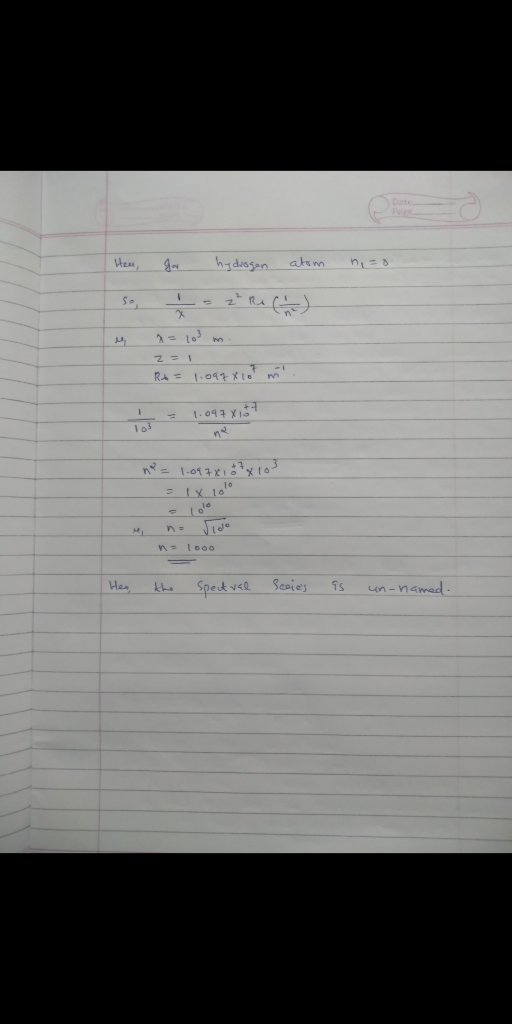
What wavelength of light would ionize hydrogen when its electron is in its ground state (n=1)?
What wavelength of light would ionize hydrogen when its electron is in its ground state (n=1)?
 4. When a hydrogen atom is bombarded, the atom may be raised into a higher energy state. As the excited electron falls back to the lower energy levels, light is emitted. What are the three longest-wavelength spectral lines emitted by the hydrogen atom as it returns to the n = 1 state from higher energy states? Give your answers to three significant figures. The lowest possible state, n = 1, corresponds to the electron in its smallest possible orbit; it...
 What is wavelength of a photon that would be emitted when a hydrogen atom makes a transition from the n = 3 to the n = 2 energy level? What is the longest wavelength photon that could ionize a hydrogen atom originally in its ground state? What processes might occur if an electron of energy 12.2 eV collides with a hydrogen atom at rest and in its ground state?
 EXPERIMENT #9: SPECTRUM OF THE HYDROGEN ATOM ADDITIONAL QUESTIONS 1. What does the energy of the electron from the hydrogen atom become when n is a very large number, or approaching infinity? We say an electron with this energy has separated from the nucleus, which is now an ion. Determine the quantity of energy (AE) required to ionize an electron from its ground state in the hydrogen atom
 EXPERIMENT #9: SPECTRUM OF THE HYDROGEN ATOM ADDITIONAL QUESTIONS 1, What does the energy of the electron from the hydrogen atom become when n is a very large number, or approaching infinity? We say an electron with this energy has separated from the nucleus, which is now an ion. Determine the quantity of energy (AE) required to ionize an electron from its ground state in the hydrogen atom. 2. The Bohr model holds for any one-electron atom. Calculate the lowest...
 P3. In a hydrogen atom in its lowest energy state (known as the ground state), the electron forms a spherically-symmetric "cloud" around the nucleus, with a charge density given by ρ-A exp(-2r a ), where a,-0.529 Â-0.529 × 10⁻¹⁰ m is the Bohr radius. (a) Determine the constant A. (b) What is the electric field at the Bohr radius?
 05 Question (4 points) When a hydrogen atom absorbs a photon of electromagnetic radiation (EMR), the internal energy of the atom increases and one or more electrons may be energized into an excited state. The release of this extra energy as the excited state electron transitions back to a lower energy state results in the emission of a photon. These energy changes are responsible for the emission spectrum of hydrogen (shown below) and are described by the Bohr equation. AE...
 How does the DeBroglie wavelength of the electron in the ground state of a hydrogen atom compare to the DeBroglie wavelength of the electron when it's in a 2p state? The DeBroglie wavelengths of the two electrons are equal. The DeBroglie wavelength of the electron in the ground state is greater than that of the electron in a 2p state. The DeBroglie wavelength of the electron in the ground state is less than that of the electron in a 2p...
Most questions answered within 3 hours.
-
Where is the error in this code sequence?
String s1 = "Hello";
String s2 = "ello";...
asked 10 months ago -
Financial data for Joel de Paris, Inc., for last year
follow:
Joel de Paris, Inc.
Balance...
asked 10 months ago -
Consider this reaction:
Al2(SO4)3 (aq)+ BaCl3
(aq) Al2Cl6 (aq)- +
3BaSO4(s) . What is the...
asked 10 months ago -
Suppose that Savneet is considering increasing her
recent random sample from 20 car rentals to 40...
asked 10 months ago -
Trucks arrive at an unloading terminal at an average rate of 120
per hour.
Trucks arrive...
asked 10 months ago -
Why are methanol and ethanol completely soluble in water while
octanol is not very little soluble....
asked 10 months ago -
A facilities manager at a university reads in a research report
that the mean amount of...
asked 10 months ago -
When the CuSO4 is rehydrated by adding water to the anhydrous
compound, is this an endothermic...
asked 10 months ago -
A ray of sunlight is passing from diamond into crown glass; the
angle of incidence is...
asked 10 months ago -
A block of mass 0.249 kg is placed on top of a light, vertical
spring of...
asked 10 months ago -
how do the kidneys compensate in the presences of acidosis
a) trigger hyperventilate
b) reserve acid...
asked 10 months ago -
Question 501 pts
The rental rate of capital to the firm increases. Which of the
following...
asked 10 months ago