![1. [Ni(H20)] + 6NH3 = [Ni(NH3);]+ 6H20 K= 2. [Ni(H2O).] + 3en = [Ni(en)]2+ + 6H20 K= 3. [Ni(H2O).)** + 2dien = [Ni(dien)]2+ +](http://img.homeworklib.com/questions/19f92aa0-6e5b-11ea-b5c6-49d9398b5e37.png?x-oss-process=image/resize,w_560)
Homework Answers
![0 [Nilike)s]*+6N113 = [Ni(913),]2+ 6H2O (wi@wms)e]*CHhoje Ka ** [wiltheya)* * [wn] ® (Nilite)o 394 3en = {wilem);]$ 6 the - 3](http://img.homeworklib.com/questions/1a665d60-6e5b-11ea-97a4-dd01c3c92521.png?x-oss-process=image/resize,w_560)
Add Answer to:
1. [Ni(H20)] + 6NH3 = [Ni(NH3);]+ 6H20 K= 2. [Ni(H2O).] + 3en = [Ni(en)]2+ + 6H20...
6. [Ni(en)]2+ + 6NH3 = [Ni(NH3).]2+ + 3en Show calculation for this and all following K's!...
 6. [Ni(en)]2+ + 6NH3 = [Ni(NH3).]2+ + 3en Show calculation for this and all following K's! K = 7. [Ni(dien) P* + 6NH = [Ni(NH3)4]* + 2dien KE
The spectrochemical series is < Br<< Cl<F-<OH" <H2O <NH3 <en <NO2- < CN- The complex [Ni(Cl)c]...
 The spectrochemical series is < Br<< Cl<F-<OH" <H2O <NH3 <en <NO2- < CN- The complex [Ni(Cl)c] is green and the complex [Ni(en)]2+ is violet, where en corresponds to the ethylenediamine ligand. The reason for the difference in the color of these complexes is: Select one: A. The chloride ligand is green, and the ethylenediamine ligand is violet. B. The difference in the coordination numbers of the chloride complex and the en complex. C. The difference in the oxidation states of...
23. A solution is prepared by adding 0.10 mole of Ni(NH3). Cl2 to 0.50 L of 3.2 M NH3. Calculate (Ni (NH3)&2+) and...
 23.
A solution is prepared by adding 0.10 mole of Ni(NH3). Cl2 to 0.50 L of 3.2 M NH3. Calculate (Ni (NH3)&2+) and (Ni2+in this solution. Koveralt for Ni (NH3)22+ is 5.5 x 10⁸. That is, 5.5 x 108 = Ni (NH3) 2+1 [Ni2+] [NH3] for the overall reaction Ni2+ (aq) + 6NH3(aq) = Ni (NH3). 2+ (aq) (Ni (NH3), 2+] = 0 [Ni2+] = C M
23.
A solution is prepared by adding 0.10 mole of Ni(NH3). Cl2 to 0.50 L of 3.2 M NH3. Calculate (Ni (NH3)&2+) and (Ni2+in this solution. Koveralt for Ni (NH3)22+ is 5.5 x 10⁸. That is, 5.5 x 108 = Ni (NH3) 2+1 [Ni2+] [NH3] for the overall reaction Ni2+ (aq) + 6NH3(aq) = Ni (NH3). 2+ (aq) (Ni (NH3), 2+] = 0 [Ni2+] = C M
Determine the percent yield of each of the nickel (II) compounds Part A Step 1:6.107 g...
Determine the percent yield of each of the nickel (II) compounds Part A Step 1:6.107 g (weight of starting material) [Ni(H2O)6]Cl2 Step 7: 5.292 g (weight of product) Part B Step 8: 6.115 g (weight of starting material) Step 11: 10.892 g (Weight of product) i dont know if this equation goes any further but it is- [Ni(H2O)6]Cl2(aq)+6NH3(aq)-----> [Ni(NH3)6]Cl2(aq)+6H2O(l) coordination compound cooled then precipitated by 95% ethanol [Ni(H2O)6]Cl2(aq)+3en(aq)-----> [Ni(en)3]Cl2*2H20(aq)+4H2O(l) The compound is precipitated with 95% ethanol solution.
calculuate valence electrons for each complex (a) [Mn(H20)]3+ (d) [Fe(H20).]3+ (b) [Cr(H2O)6]2+ (e) [Co(NH3)4] * (h)...
 calculuate valence electrons for each complex
(a) [Mn(H20)]3+ (d) [Fe(H20).]3+ (b) [Cr(H2O)6]2+ (e) [Co(NH3)4] * (h) [Pd(NH3).]4+ (c) [V(H2O).]2+ (1) [Ni(H2O)]2+ (1) [Re(CN).]3- (g) MoF6
calculuate valence electrons for each complex
(a) [Mn(H20)]3+ (d) [Fe(H20).]3+ (b) [Cr(H2O)6]2+ (e) [Co(NH3)4] * (h) [Pd(NH3).]4+ (c) [V(H2O).]2+ (1) [Ni(H2O)]2+ (1) [Re(CN).]3- (g) MoF6
Which of the following complex ions will most likely be colorless? O [Zn(en)3]2+ O [Ni(H20)612+ O...
 Which of the following complex ions will most likely be colorless? O [Zn(en)3]2+ O [Ni(H20)612+ O [Cr(NH3)6]3+ O [Fe(CN)614- O [Fe(NH3)6]2+
Part B: Calculate the formation constant for the formation of [Cu(NH3)4(H2O)2]2+ from [Cu(H2O)6]2+, given that ΔG∘...
Part B: Calculate the formation constant for the formation of [Cu(NH3)4(H2O)2]2+ from [Cu(H2O)6]2+, given that ΔG∘ is −74.2kJ⋅mol−1 at 298 K. Express your answer numerically to three significant figures. Part C: Consider the formation of [Ni(en)3]2+ from [Ni(H2O)6]2+. The stepwise ΔG∘ values at 298 Kare ΔG∘1 for first step=−42.9 kJ⋅mol−1 ΔG∘2 for second step=−35.8 kJ⋅mol−1 ΔG∘3 for third step=−24.3 kJ⋅mol−1Calculate the overall formation constant (Kf) for the complex [Ni(en)3]2+. Express your answer numerically to three significant figures.
9. Which is more stable: Ni(NH3)2+ or Ni(en)37+? Explain your reasoning.
 9. Which is more stable: Ni(NH3)2+ or Ni(en)37+? Explain your reasoning.
Problems about reaction n 4) The rate law for the substitution of NH3 for H20 in...
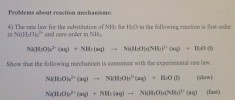 Problems about reaction n 4) The rate law for the substitution of NH3 for H20 in the following reaction is first order in Ni(H2O and zero order in NH3 Ni(H2O)62 + (aq) + NH3(aq) → Ni(H2O)s(NH3)2+ (aq) + H2O (1) Show that the following mechanism is consistent with the experimental rate law. Ni(H2O)62+ (aq) → Ni(H2O)S2+ (aq) +H2O(l) (slow) Ni(H2O),» (aq) + NH3 (aq) → Ni(H2O)5(NH3)2+(aq) (fast)
Consider the reaction: NiCl2·6H2O + 3en → [Ni(en)3]Cl2 + 6H2O You start with 2.19 mol of...
Consider the reaction: NiCl2·6H2O + 3en → [Ni(en)3]Cl2 + 6H2O You start with 2.19 mol of NiCl2·6H2O and 5.80 mol of en (en = H2NCH2CH2NH2). What is the theoretical yield of [Ni(en)3]Cl2
 6. [Ni(en)]2+ + 6NH3 = [Ni(NH3).]2+ + 3en Show calculation for this and all following K's! K = 7. [Ni(dien) P* + 6NH = [Ni(NH3)4]* + 2dien KE
 The spectrochemical series is < Br<< Cl<F-<OH" <H2O <NH3 <en <NO2- < CN- The complex [Ni(Cl)c] is green and the complex [Ni(en)]2+ is violet, where en corresponds to the ethylenediamine ligand. The reason for the difference in the color of these complexes is: Select one: A. The chloride ligand is green, and the ethylenediamine ligand is violet. B. The difference in the coordination numbers of the chloride complex and the en complex. C. The difference in the oxidation states of...
 23.
A solution is prepared by adding 0.10 mole of Ni(NH3). Cl2 to 0.50 L of 3.2 M NH3. Calculate (Ni (NH3)&2+) and (Ni2+in this solution. Koveralt for Ni (NH3)22+ is 5.5 x 10⁸. That is, 5.5 x 108 = Ni (NH3) 2+1 [Ni2+] [NH3] for the overall reaction Ni2+ (aq) + 6NH3(aq) = Ni (NH3). 2+ (aq) (Ni (NH3), 2+] = 0 [Ni2+] = C M
23.
A solution is prepared by adding 0.10 mole of Ni(NH3). Cl2 to 0.50 L of 3.2 M NH3. Calculate (Ni (NH3)&2+) and (Ni2+in this solution. Koveralt for Ni (NH3)22+ is 5.5 x 10⁸. That is, 5.5 x 108 = Ni (NH3) 2+1 [Ni2+] [NH3] for the overall reaction Ni2+ (aq) + 6NH3(aq) = Ni (NH3). 2+ (aq) (Ni (NH3), 2+] = 0 [Ni2+] = C M
 calculuate valence electrons for each complex
(a) [Mn(H20)]3+ (d) [Fe(H20).]3+ (b) [Cr(H2O)6]2+ (e) [Co(NH3)4] * (h) [Pd(NH3).]4+ (c) [V(H2O).]2+ (1) [Ni(H2O)]2+ (1) [Re(CN).]3- (g) MoF6
calculuate valence electrons for each complex
(a) [Mn(H20)]3+ (d) [Fe(H20).]3+ (b) [Cr(H2O)6]2+ (e) [Co(NH3)4] * (h) [Pd(NH3).]4+ (c) [V(H2O).]2+ (1) [Ni(H2O)]2+ (1) [Re(CN).]3- (g) MoF6
 Which of the following complex ions will most likely be colorless? O [Zn(en)3]2+ O [Ni(H20)612+ O [Cr(NH3)6]3+ O [Fe(CN)614- O [Fe(NH3)6]2+
 9. Which is more stable: Ni(NH3)2+ or Ni(en)37+? Explain your reasoning.
 Problems about reaction n 4) The rate law for the substitution of NH3 for H20 in the following reaction is first order in Ni(H2O and zero order in NH3 Ni(H2O)62 + (aq) + NH3(aq) → Ni(H2O)s(NH3)2+ (aq) + H2O (1) Show that the following mechanism is consistent with the experimental rate law. Ni(H2O)62+ (aq) → Ni(H2O)S2+ (aq) +H2O(l) (slow) Ni(H2O),» (aq) + NH3 (aq) → Ni(H2O)5(NH3)2+(aq) (fast)
Most questions answered within 3 hours.
-
Where is the error in this code sequence?
String s1 = "Hello";
String s2 = "ello";...
asked 11 months ago -
Financial data for Joel de Paris, Inc., for last year
follow:
Joel de Paris, Inc.
Balance...
asked 11 months ago -
Consider this reaction:
Al2(SO4)3 (aq)+ BaCl3
(aq) Al2Cl6 (aq)- +
3BaSO4(s) . What is the...
asked 11 months ago -
Suppose that Savneet is considering increasing her
recent random sample from 20 car rentals to 40...
asked 11 months ago -
Trucks arrive at an unloading terminal at an average rate of 120
per hour.
Trucks arrive...
asked 11 months ago -
Why are methanol and ethanol completely soluble in water while
octanol is not very little soluble....
asked 11 months ago -
A facilities manager at a university reads in a research report
that the mean amount of...
asked 11 months ago -
When the CuSO4 is rehydrated by adding water to the anhydrous
compound, is this an endothermic...
asked 11 months ago -
A ray of sunlight is passing from diamond into crown glass; the
angle of incidence is...
asked 11 months ago -
A block of mass 0.249 kg is placed on top of a light, vertical
spring of...
asked 11 months ago -
how do the kidneys compensate in the presences of acidosis
a) trigger hyperventilate
b) reserve acid...
asked 11 months ago -
Question 501 pts
The rental rate of capital to the firm increases. Which of the
following...
asked 11 months ago