Hello, I need the full workings and reasoning for the entire question below. Thank you!
Homework Answers
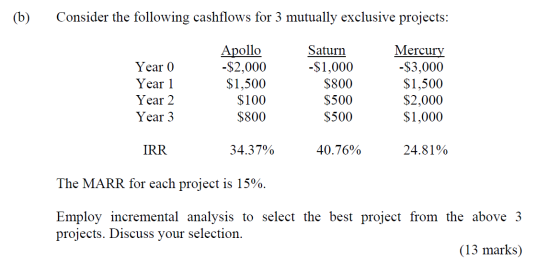
| Apollo | Saturn | Mercury | discount factor | ||||||||||
| Y0 | -2000 | -1000 | -3000 | ||||||||||
| Y1 | 1500 | 800 | 1500 | 0.869565 | |||||||||
| Y2 | 100 | 500 | 2000 | 0.756144 | |||||||||
| Y3 | 800 | 500 | 1000 | 0.657516 | |||||||||
| IRR % | 15.95 | 40.76 | 24.81 | ||||||||||
| Apollo | Mercury | M-A | Saturn | Mercury | M-S | Saturn | Apollo | A-S | |||||
| Y0 | -2000 | -3000 | -1000 | Y0 | -1000 | -3000 | -2000 | Y0 | -1000 | -2000 | -1000 | ||
| Y1 | 1500 | 1500 | 0 | Y1 | 800 | 1500 | 700 | Y1 | 800 | 1500 | 700 | ||
| Y2 | 100 | 2000 | 1900 | Y2 | 500 | 2000 | 1500 | Y2 | 500 | 100 | -400 | ||
| Y3 | 800 | 1000 | 200 | Y3 | 500 | 1000 | 500 | Y3 | 500 | 800 | 300 | ||
| IRR | 15.95 | 24.81 | 0.4283 | 40.76 | 24.81 | 0.172 | 40.76 | 15.95 | 1 | ||||
| NAV= | -0.0070023 | NAV= | -0.1069 | NAV= | -712.5 | ||||||||
| Since IRR of M-A if higher and in that IRR of M is higher so we should choose Mercury project | |||||||||||||
Add Answer to:
Hello, I need the full workings and reasoning for the entire
question below. Thank you!
(b)...
Hello, I need the full workings for the entire question below. Thank you! (a) Two alternative...
 Hello, I need the full workings for the entire question below.
Thank you!
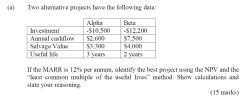
(a) Two alternative projects have the following data Investment Annual cashflow Salvage Value Useful life Alpha -$10,500 $2,600 $3,300 3 years Beta -$12,200 $7,500 $4,000 2 years If the MARR is 12% per annum, identify the best project using the NPV and the “least common multiple of the useful lives” method. Show calculations and state your reasoning. (15 marks)
Hello, I need the full workings for the entire question below.
Thank you!
(a) Two alternative projects have the following data Investment Annual cashflow Salvage Value Useful life Alpha -$10,500 $2,600 $3,300 3 years Beta -$12,200 $7,500 $4,000 2 years If the MARR is 12% per annum, identify the best project using the NPV and the “least common multiple of the useful lives” method. Show calculations and state your reasoning. (15 marks)
Question 3 (10 marks) a) Six mutually exclusive projects A-F are being considered by a company....
 Question 3 (10 marks) a) Six mutually exclusive projects A-F are being considered by a company. They have been ordered by first costs so that project A has the lowest first cost, and F the highest. The table below provides information on the IRR and incremental IRR of each investment. For example, the IRR of C is 11 % ; the incremental IRR going from A to C is 13 % and the incremental IRR from B to C is...
please show full work step by step for full points and not excel workings. thank you!! 10. Consider the following two mu...
 please show full work step by
step for full points and not excel workings. thank you!!
10. Consider the following two mutually exclusive projects: Year Cash Flow (A) - $175,000 10,000 25,000 25,000 375,000 Cash Flow (B) - $20,000 10,000 5,000 3,000 1,000 Whichever project you choose, if any, you require a 15 percent return on your investment. a. If you apply the payback criterion, which investment will you choose? b. If you apply the NPV criterion, which investment will...
please show full work step by
step for full points and not excel workings. thank you!!
10. Consider the following two mutually exclusive projects: Year Cash Flow (A) - $175,000 10,000 25,000 25,000 375,000 Cash Flow (B) - $20,000 10,000 5,000 3,000 1,000 Whichever project you choose, if any, you require a 15 percent return on your investment. a. If you apply the payback criterion, which investment will you choose? b. If you apply the NPV criterion, which investment will...
MIRR and NPV Your company is considering two mutually exclusiveprojects, X and Y, whose costs...
MIRR and NPV Your company is considering two mutually exclusive projects, X and Y, whose costs and cash flows are shown below: YearXY0-$5,000-$5,00011,0004,50021,5001,50032,0001,00044,000500The projects are equally risky, and their cost of capital is 12%. You must make a recommendation, and you must base it on the modified IRR (MIRR). Calculate the two projects' MIRRs. Round your answers to two decimal places. Project X % Project Y % Which project has the higher MIRR?
Projects A and B are mutually exclusive. The minimum attractive rate of return (MARR) is 5%....
 Projects A and B are mutually exclusive. The minimum attractive rate of return (MARR) is 5%. Using rate of return analysis, which project should be selected? Year B-A $1,000 $200 $200 $300 $400 3.47% $1,500 $350 $400 $450 $500 4.90% $500 150 $200 $150 $100 8.28% 0 3 4 ROR
Your company is considering two mutually exclusive projects, X and Y, whose costs and cash flows...
Your company is considering two mutually exclusive projects, X and Y, whose costs and cash flows are shown below: Year X Y 0 -$5,000 -$5,000 1 1,000 4,500 2 1,500 1,500 3 2,000 1,000 4 4,000 500 The projects are equally risky, and their cost of capital is 11%. You must make a recommendation, and you must base it on the modified IRR (MIRR). Calculate the two projects' MIRRs. Do not round intermediate calculations. Round your answers to two decimal...
MIRR and NPV Your company is considering two mutually exclusive projects, X and Y, whose costs...
MIRR and NPV Your company is considering two mutually exclusive projects, X and Y, whose costs and cash flows are shown below: Year X Y 0 -$5,000 -$5,000 1 1,000 4,500 2 1,500 1,500 3 2,000 1,000 4 4,000 500 The projects are equally risky, and their cost of capital is 13%. You must make a recommendation, and you must base it on the modified IRR (MIRR). Calculate the two projects' MIRRs. Do not round intermediate calculations. Round your answers...
MIRR and NPV Your company is considering two mutually exclusive projects, X and Y, whose costs and cash flows are shown...
MIRR and NPV Your company is considering two mutually exclusive projects, X and Y, whose costs and cash flows are shown below: Year X Y 0 -$5,000 -$5,000 1 1,000 4,500 2 1,500 1,500 3 2,000 1,000 4 4,000 500 The projects are equally risky, and their cost of capital is 15%. You must make a recommendation, and you must base it on the modified IRR (MIRR). Calculate the two projects' MIRRs. Do not round intermediate calculations. Round your answers...
MIRR and NPV Your company is considering two mutually exclusive projects, X and Y, whose costs...
MIRR and NPV Your company is considering two mutually exclusive projects, X and Y, whose costs and cash flows are shown below: Year X Y 0 -$5,000 -$5,000 1 1,000 4,500 2 1,500 1,500 3 2,000 1,000 4 4,000 500 The projects are equally risky, and their cost of capital is 14%. You must make a recommendation, and you must base it on the modified IRR (MIRR). Calculate the two projects' MIRRs. Do not round intermediate calculations. Round your answers...
Projects A and B are mutually exclusive and both have an initial cost of $3,000. Annual...
Projects A and B are mutually exclusive and both have an initial cost of $3,000. Annual Cash flows are following the table. What is the crossover rate (i.e. At what discount rate would the company be indifferent between these two projects)? CFs CFs Year Project A Project B 0 -3,000 -3,000 1 500 2,000 2 500 1,000 3 1,500 600 4 2,000 500 A. 6.33 percent B. 14.25 percent C. 18.82 percent D. 7.99 percent E. 9.17 percent
 Hello, I need the full workings for the entire question below.
Thank you!
(a) Two alternative projects have the following data Investment Annual cashflow Salvage Value Useful life Alpha -$10,500 $2,600 $3,300 3 years Beta -$12,200 $7,500 $4,000 2 years If the MARR is 12% per annum, identify the best project using the NPV and the “least common multiple of the useful lives” method. Show calculations and state your reasoning. (15 marks)
Hello, I need the full workings for the entire question below.
Thank you!
(a) Two alternative projects have the following data Investment Annual cashflow Salvage Value Useful life Alpha -$10,500 $2,600 $3,300 3 years Beta -$12,200 $7,500 $4,000 2 years If the MARR is 12% per annum, identify the best project using the NPV and the “least common multiple of the useful lives” method. Show calculations and state your reasoning. (15 marks)
 Question 3 (10 marks) a) Six mutually exclusive projects A-F are being considered by a company. They have been ordered by first costs so that project A has the lowest first cost, and F the highest. The table below provides information on the IRR and incremental IRR of each investment. For example, the IRR of C is 11 % ; the incremental IRR going from A to C is 13 % and the incremental IRR from B to C is...
 please show full work step by
step for full points and not excel workings. thank you!!
10. Consider the following two mutually exclusive projects: Year Cash Flow (A) - $175,000 10,000 25,000 25,000 375,000 Cash Flow (B) - $20,000 10,000 5,000 3,000 1,000 Whichever project you choose, if any, you require a 15 percent return on your investment. a. If you apply the payback criterion, which investment will you choose? b. If you apply the NPV criterion, which investment will...
please show full work step by
step for full points and not excel workings. thank you!!
10. Consider the following two mutually exclusive projects: Year Cash Flow (A) - $175,000 10,000 25,000 25,000 375,000 Cash Flow (B) - $20,000 10,000 5,000 3,000 1,000 Whichever project you choose, if any, you require a 15 percent return on your investment. a. If you apply the payback criterion, which investment will you choose? b. If you apply the NPV criterion, which investment will...
 Projects A and B are mutually exclusive. The minimum attractive rate of return (MARR) is 5%. Using rate of return analysis, which project should be selected? Year B-A $1,000 $200 $200 $300 $400 3.47% $1,500 $350 $400 $450 $500 4.90% $500 150 $200 $150 $100 8.28% 0 3 4 ROR
Most questions answered within 3 hours.
-
Where is the error in this code sequence?
String s1 = "Hello";
String s2 = "ello";...
asked 10 months ago -
Financial data for Joel de Paris, Inc., for last year
follow:
Joel de Paris, Inc.
Balance...
asked 10 months ago -
Consider this reaction:
Al2(SO4)3 (aq)+ BaCl3
(aq) Al2Cl6 (aq)- +
3BaSO4(s) . What is the...
asked 10 months ago -
Suppose that Savneet is considering increasing her
recent random sample from 20 car rentals to 40...
asked 10 months ago -
Trucks arrive at an unloading terminal at an average rate of 120
per hour.
Trucks arrive...
asked 10 months ago -
Why are methanol and ethanol completely soluble in water while
octanol is not very little soluble....
asked 10 months ago -
A facilities manager at a university reads in a research report
that the mean amount of...
asked 10 months ago -
When the CuSO4 is rehydrated by adding water to the anhydrous
compound, is this an endothermic...
asked 10 months ago -
A ray of sunlight is passing from diamond into crown glass; the
angle of incidence is...
asked 10 months ago -
A block of mass 0.249 kg is placed on top of a light, vertical
spring of...
asked 10 months ago -
how do the kidneys compensate in the presences of acidosis
a) trigger hyperventilate
b) reserve acid...
asked 10 months ago -
Question 501 pts
The rental rate of capital to the firm increases. Which of the
following...
asked 10 months ago