
Homework Answers
Add Answer to:
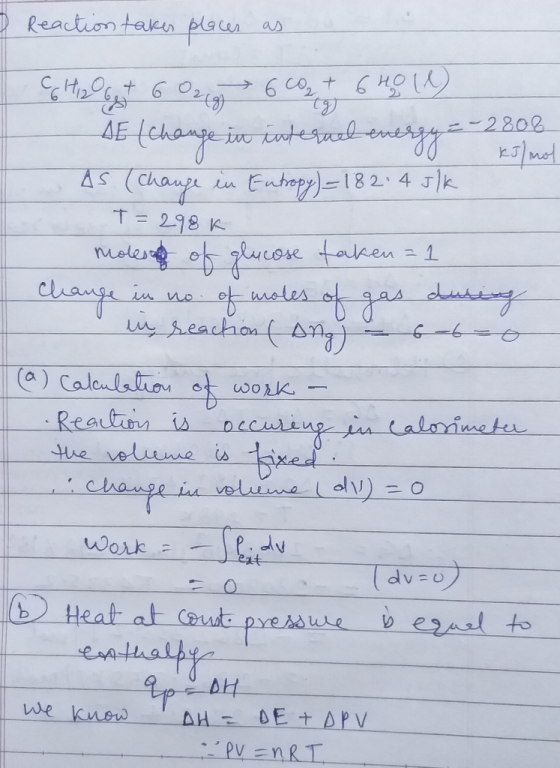
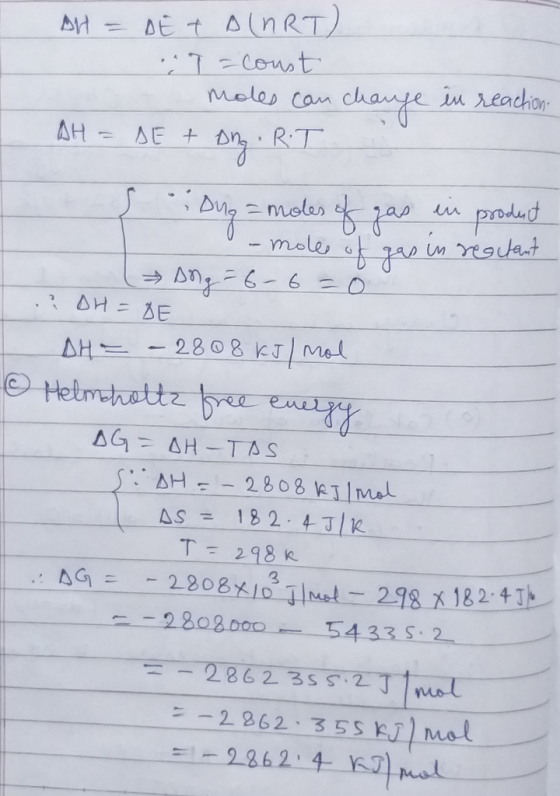
6. When 1.000 mol of CsH12O6 (glucose) is oxidized to carbon dioxide and water at 298...
change in Helmholtz free energy for this process? (-2862 kJ/mol) 7. Calculate the entropy change when...
 change in Helmholtz free energy for this process? (-2862 kJ/mol) 7. Calculate the entropy change when 0.7760 moles of oxygen gas, a perfect gas, expands isothermally from a volume of 36.80 mL to 84.90 mLs. (ANS: 5.394 J/K) 8. The standard reaction enthalpy for the hydrogenation of propene, CH2=CHCH + 5O2 →
The standard enthalpies of formation, at 25.00 oC, of methanol (CH4O(l)), water (H2O(l)), and carbon dioxide...
The standard enthalpies of formation, at 25.00 oC, of methanol (CH4O(l)), water (H2O(l)), and carbon dioxide (CO2(g)) are, respectively, -238.7 kJ/mol, -285.8 kJ/mol, and -393.5 kJ/mol. Calculate the change in the entropy of the surroundings (in J/K) upon the combustion of 16.9 g of methanol under a constant pressure of 1.000 atm and a temperature of 25.00 oC. N.B. combustion is the reaction of this substance with molecular oxygen to produce water and carbon dioxide.
Assume that the complete combustion of one mole of glucose to carbon dioxide and water liberates...
 Assume that the complete combustion of one mole of glucose to carbon dioxide and water liberates 2870 kJ/mol (AG' = -2870 kJ/mol). If one contraction cycle in muscle requires 63 kJ, and the energy from the combustion of glucose is converted with an efficiency of 43% to contraction, how many contraction cycles could theoretically be fueled by the complete combustion of one mole of glucose? Round your answer to the nearest whole number. cycles per mole glucose =
Assume that the complete combustion of one mole of glucose to carbon dioxide and water liberates...
Assume that the complete combustion of one mole of glucose to carbon dioxide and water liberates 2870 kJ/mol (ΔG°′=−2870 kJ/mol). If one contraction cycle in muscle requires 61 kJ, and the energy from the combustion of glucose is converted with an efficiency of 37% to contraction, how many contraction cycles could theoretically be fueled by the complete combustion of one mole of glucose? Round your answer to the nearest whole number. CYCLE PER MOLE GLUCOSE =
Assume that the complete combustion of one mole of glucose to carbon dioxide and water liberates...
Assume that the complete combustion of one mole of glucose to carbon dioxide and water liberates 2870 kJ/mol ( Δ?°′=−2870 kJ/mol ). If one contraction cycle in muscle requires 67 kJ , and the energy from the combustion of glucose is converted with an efficiency of 43% to contraction, how many contraction cycles could theoretically be fueled by the complete combustion of one mole of glucose? Round your answer to the nearest whole number. Cycles per mole glucose = ___________...
Attempt 6 Assume that the complete combustion of one mole of glucose to carbon dioxide and...
 Attempt 6 Assume that the complete combustion of one mole of glucose to carbon dioxide and water liberates 2870 kJ/mol (AG"' = -2870 kJ/mol). If one contraction cycle in muscle requires 57 kJ, and the energy from the combustion of glucose is converted with an efficiency of 45% to contraction, how many contraction cycles could theoretically be fueled by the complete combustion of one mole of glucose? Round your answer to the nearest whole number. cycles per mole glucose =
Calcium carbonate can decompose into calcium oxide and carbon dioxide gas with the (c) reaction: CaCO3...
 Calcium carbonate can decompose into calcium oxide and carbon dioxide gas with the (c) reaction: CaCO3 СаО + СО2 The change in enthalpy for this reaction is AH = +178 kJ/mol and the change in entropy is AS = +0.16 kJ/(K. mol) (i) Describe the concept of the Gibbs energy and how it is related to the enthalpy and entropy (ii Hence calculate the minimum temperature for the decomposition of calcium carbonate to proceed spontaneously An Einstein solid consists of...
4. Glucose (CaHi2 is metabolized by a combustion reaction to form carbon dioxide and water. (glucose...
 4. Glucose (CaHi2 is metabolized by a combustion reaction to form carbon dioxide and water. (glucose has 5 C-C, 7 C-O, 5 0-H, 7 CH) a) Write a balanced reaction C6 H,,06(s) +60,(リーウ.coz(S) t 6H20,9 н-о Determine the enthalpy for the reaction using the bond enthalpies listed in the table. Is the reaction endothermic or exothermic? b) Bond Enthalpy (kJ/mol) Bond C-C C-O O-H C-H O-O 347 351 460 414 498.7 799 c) How much glucose (in g) must be...
A 1.75 mole sample of carbon dioxide, for which CP,m=37.1 J K−1 mol−1 at 298 K,...
A 1.75 mole sample of carbon dioxide, for which CP,m=37.1 J K−1 mol−1 at 298 K, is expanded reversibly and adiabatically from a volume of 3.25 L and a temperature of 298 K to a final volume of 40.0 L. Calculate the final temperature, q, w, ∆U, and ∆H. Assume that carbon dioxide is an ideal gas and its CP,m is constant over the temperature interval.
The combustion of glucose (C6H12O6) with oxygen gas produces carbon dioxide and water. This process releases...
The combustion of glucose (C6H12O6) with oxygen gas produces carbon dioxide and water. This process releases 2,668 kJ per mole of glucose. When 2.670 mol of oxygen react in this way with glucose, what is the energy released in Calories (big C calories). Input your answer as a number without units.
 change in Helmholtz free energy for this process? (-2862 kJ/mol) 7. Calculate the entropy change when 0.7760 moles of oxygen gas, a perfect gas, expands isothermally from a volume of 36.80 mL to 84.90 mLs. (ANS: 5.394 J/K) 8. The standard reaction enthalpy for the hydrogenation of propene, CH2=CHCH + 5O2 →
 Assume that the complete combustion of one mole of glucose to carbon dioxide and water liberates 2870 kJ/mol (AG' = -2870 kJ/mol). If one contraction cycle in muscle requires 63 kJ, and the energy from the combustion of glucose is converted with an efficiency of 43% to contraction, how many contraction cycles could theoretically be fueled by the complete combustion of one mole of glucose? Round your answer to the nearest whole number. cycles per mole glucose =
 Attempt 6 Assume that the complete combustion of one mole of glucose to carbon dioxide and water liberates 2870 kJ/mol (AG"' = -2870 kJ/mol). If one contraction cycle in muscle requires 57 kJ, and the energy from the combustion of glucose is converted with an efficiency of 45% to contraction, how many contraction cycles could theoretically be fueled by the complete combustion of one mole of glucose? Round your answer to the nearest whole number. cycles per mole glucose =
 Calcium carbonate can decompose into calcium oxide and carbon dioxide gas with the (c) reaction: CaCO3 СаО + СО2 The change in enthalpy for this reaction is AH = +178 kJ/mol and the change in entropy is AS = +0.16 kJ/(K. mol) (i) Describe the concept of the Gibbs energy and how it is related to the enthalpy and entropy (ii Hence calculate the minimum temperature for the decomposition of calcium carbonate to proceed spontaneously An Einstein solid consists of...
 4. Glucose (CaHi2 is metabolized by a combustion reaction to form carbon dioxide and water. (glucose has 5 C-C, 7 C-O, 5 0-H, 7 CH) a) Write a balanced reaction C6 H,,06(s) +60,(リーウ.coz(S) t 6H20,9 н-о Determine the enthalpy for the reaction using the bond enthalpies listed in the table. Is the reaction endothermic or exothermic? b) Bond Enthalpy (kJ/mol) Bond C-C C-O O-H C-H O-O 347 351 460 414 498.7 799 c) How much glucose (in g) must be...
Most questions answered within 3 hours.
-
Where is the error in this code sequence?
String s1 = "Hello";
String s2 = "ello";...
asked 11 months ago -
Financial data for Joel de Paris, Inc., for last year
follow:
Joel de Paris, Inc.
Balance...
asked 11 months ago -
Consider this reaction:
Al2(SO4)3 (aq)+ BaCl3
(aq) Al2Cl6 (aq)- +
3BaSO4(s) . What is the...
asked 11 months ago -
Suppose that Savneet is considering increasing her
recent random sample from 20 car rentals to 40...
asked 11 months ago -
Trucks arrive at an unloading terminal at an average rate of 120
per hour.
Trucks arrive...
asked 11 months ago -
Why are methanol and ethanol completely soluble in water while
octanol is not very little soluble....
asked 11 months ago -
A facilities manager at a university reads in a research report
that the mean amount of...
asked 11 months ago -
When the CuSO4 is rehydrated by adding water to the anhydrous
compound, is this an endothermic...
asked 11 months ago -
A ray of sunlight is passing from diamond into crown glass; the
angle of incidence is...
asked 11 months ago -
A block of mass 0.249 kg is placed on top of a light, vertical
spring of...
asked 11 months ago -
how do the kidneys compensate in the presences of acidosis
a) trigger hyperventilate
b) reserve acid...
asked 11 months ago -
Question 501 pts
The rental rate of capital to the firm increases. Which of the
following...
asked 11 months ago