
Homework Answers
Add Answer to:
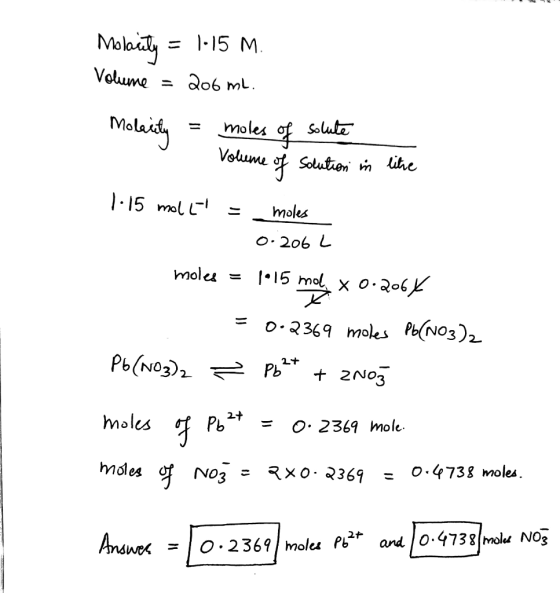
Question 2 0.4 pts A sample contains 206 mL of 1.15M Pb(NO3)2. The sample contains moles...
Calculate the number of moles of Pb2+ in 2.5 mL of 0.0025 M Pb(NO3)2 and the...
Calculate the number of moles of Pb2+ in 2.5 mL of 0.0025 M Pb(NO3)2 and the number of moles of I – in 7.5 mL of 0.0050 M NaI.
Question 4 1.2 pts Fifty five (55.00) mL of 0.456 M aqueous RbOH solution is mixed...
 Question 4 1.2 pts Fifty five (55.00) mL of 0.456 M aqueous RbOH solution is mixed with 45.00 mL of 0.302 M aqueous solution of Pb(NO3)2 The number of moles of RbOH available is The number of moles of Pb(NO3)2 available is The amount in grams of the precipitate formed is (MM (g/mole) RbOH = 102.478; Pb(OH)2 = 241.216; Pb(NO3)2=331.21; RbNO3=147.47) (Express your answer with 4 decimal figures or 4 prd's and do NOT include the units). (Hint: this problem...
A student mixes 41.0 mL of 2.84 M Pb(NO3)2(aq) with 20.0 mL of 0.00235 M Nal(aq). How many moles of Pbla(s) precipi...
 A student mixes 41.0 mL of 2.84 M Pb(NO3)2(aq) with 20.0 mL of 0.00235 M Nal(aq). How many moles of Pbla(s) precipitate from the resulting solution? Number K,,[Pb12()] – 9810 mol What are the values of [Pb2+), [1]. [NO3-), and [Na*) after the solution has reached equilibrium at 25 °C? Number Number [Pb?*] = Number Number [no; ]- 0 M [nat)-
EXPERIMENT 1: List the measured potential for Cell 3: Zn|Zn(NO3)2 || Pb(NO3)2|Pb. Based on your observations,...
EXPERIMENT 1: List the measured potential for Cell 3: Zn|Zn(NO3)2 || Pb(NO3)2|Pb. Based on your observations, do you expect given electrochemical cell to be spontaneous or nonspontaneous? Explain your answer. Pb|Pb(NO3)2||Zn|Zn(NO3)2 EXPERIMENT 1: What would happen to the measured cell potentials if 30 mL solution was used in each half-cell instead of 25 mL? EXPERIMENT 1: Calculate the theoretical standard cell potential for the electrochemical cell that includes the reaction. Mn+Pb2+⟶Mn2++Pb The standard reduction potentials for each half reaction are...
A student mixes 39.0 mL of 2.88 M Pb(NO3)2(aq) with 20.0 mL of 0.00197 M Na2C2O4(aq)....
 A student mixes 39.0 mL of 2.88
M Pb(NO3)2(aq) with 20.0 mL of 0.00197 M Na2C2O4(aq). How many
moles of PbC2O4(s) precipitate from the resulting solution? What
are the values of [Pb2 ], [C2O42–], [NO3–], and [Na ] after the
solution has reached equilibrium at 25 °C?
A student mixes 39.0 mL of 2.88
M Pb(NO3)2(aq) with 20.0 mL of 0.00197 M Na2C2O4(aq). How many
moles of PbC2O4(s) precipitate from the resulting solution? What
are the values of [Pb2 ], [C2O42–], [NO3–], and [Na ] after the
solution has reached equilibrium at 25 °C?
I need help plotting the mass of precipitate versus moles of Pb(NO3)2 . Reaction Equation: Pb(NO3)2...
 I need help plotting the mass of precipitate versus moles of
Pb(NO3)2 .
Reaction Equation: Pb(NO3)2 + 2KBr →
PbBr2 + 2KNO3
Volume (mL) Solution Mixture 0.50 M Pb(NO3)2 0.50 M KBT 2.00 18.00 4.00 16.00 6.00 14.00 8.00 12.00 10.00 10.00 12.00 8.00 14.00 6.00 16.00 4.00 18.00 2.00 Data Collection | Experimental Data Assignment Number Volume Pb(NO3)2 16m Moles Pb(NO3)2 Volume KBr 114 mL Moles KBT Mass of watchglass and filer paper (g) 28.7455 | 1st heating: Mass...
I need help plotting the mass of precipitate versus moles of
Pb(NO3)2 .
Reaction Equation: Pb(NO3)2 + 2KBr →
PbBr2 + 2KNO3
Volume (mL) Solution Mixture 0.50 M Pb(NO3)2 0.50 M KBT 2.00 18.00 4.00 16.00 6.00 14.00 8.00 12.00 10.00 10.00 12.00 8.00 14.00 6.00 16.00 4.00 18.00 2.00 Data Collection | Experimental Data Assignment Number Volume Pb(NO3)2 16m Moles Pb(NO3)2 Volume KBr 114 mL Moles KBT Mass of watchglass and filer paper (g) 28.7455 | 1st heating: Mass...
Question 3 2 pts 35.5 mL of 0.375 M Pb(NO3)2 (aq) is poured into excess Nal...
 Question 3 2 pts 35.5 mL of 0.375 M Pb(NO3)2 (aq) is poured into excess Nal (aq). How many g of Pblz (s) will form? Pb(NO3)2 (aq) + 2 Nal (aq) - --> Pblz (s) + 2 NaNO3(aq) g Pbl2
Question 6 1.5 pts Given the partial equation: NO3 + Pb2 - NO2+ Pb, balance the...
 Question 6 1.5 pts Given the partial equation: NO3 + Pb2 - NO2+ Pb, balance the reaction in acidic solution using thod and fill in the coefficients. The missing blanks represent H20. H. or OH, as required to balance the reaction. Enter the coefficients as integers, using the lowest whole numbers. If the coefficient for something is "1", make sure to type that in and not leave it blank. Enter only the coefficients Pb2+ + NO2+ NO3 + Pb++ +...
44.1 mL of aqueous 0.255 M Pb(NO3)2 is mixed with 38.5 mL of 0.415 M NaCl....
44.1 mL of aqueous 0.255 M Pb(NO3)2 is mixed with 38.5 mL of 0.415 M NaCl. The equation for the precipitate reaction is: Pb(NO3)2 (aq) + 2 NaCl (aq) --> PbCl2 (s) + 2 NaNO3 (aq) The concentration of Pb2+ ion in the solution is _____ M after the reaction is complete.
Question 3 1.2 pts When 0.385 M RbOH solution is mixed with an aqueous solution of...
 Question 3 1.2 pts When 0.385 M RbOH solution is mixed with an aqueous solution of Pb(NO3)2, 15.656 g of precipitate is formed (precipitate should be identified first - see question #1). The number of moles of precipitate formed is The number of moles of RbOH that has reacted is and the volume of the 0.385 M ROOH solution mixed is (MM (g/mole) RbOH = 102.478; Pb(OH)2 = 241.216; Pb(NO3)2=331.21; RbNO3=147.47) (Express your answer with 4 decimal figures or 4...
 Question 4 1.2 pts Fifty five (55.00) mL of 0.456 M aqueous RbOH solution is mixed with 45.00 mL of 0.302 M aqueous solution of Pb(NO3)2 The number of moles of RbOH available is The number of moles of Pb(NO3)2 available is The amount in grams of the precipitate formed is (MM (g/mole) RbOH = 102.478; Pb(OH)2 = 241.216; Pb(NO3)2=331.21; RbNO3=147.47) (Express your answer with 4 decimal figures or 4 prd's and do NOT include the units). (Hint: this problem...
 A student mixes 41.0 mL of 2.84 M Pb(NO3)2(aq) with 20.0 mL of 0.00235 M Nal(aq). How many moles of Pbla(s) precipitate from the resulting solution? Number K,,[Pb12()] – 9810 mol What are the values of [Pb2+), [1]. [NO3-), and [Na*) after the solution has reached equilibrium at 25 °C? Number Number [Pb?*] = Number Number [no; ]- 0 M [nat)-
 A student mixes 39.0 mL of 2.88
M Pb(NO3)2(aq) with 20.0 mL of 0.00197 M Na2C2O4(aq). How many
moles of PbC2O4(s) precipitate from the resulting solution? What
are the values of [Pb2 ], [C2O42–], [NO3–], and [Na ] after the
solution has reached equilibrium at 25 °C?
A student mixes 39.0 mL of 2.88
M Pb(NO3)2(aq) with 20.0 mL of 0.00197 M Na2C2O4(aq). How many
moles of PbC2O4(s) precipitate from the resulting solution? What
are the values of [Pb2 ], [C2O42–], [NO3–], and [Na ] after the
solution has reached equilibrium at 25 °C?
 I need help plotting the mass of precipitate versus moles of
Pb(NO3)2 .
Reaction Equation: Pb(NO3)2 + 2KBr →
PbBr2 + 2KNO3
Volume (mL) Solution Mixture 0.50 M Pb(NO3)2 0.50 M KBT 2.00 18.00 4.00 16.00 6.00 14.00 8.00 12.00 10.00 10.00 12.00 8.00 14.00 6.00 16.00 4.00 18.00 2.00 Data Collection | Experimental Data Assignment Number Volume Pb(NO3)2 16m Moles Pb(NO3)2 Volume KBr 114 mL Moles KBT Mass of watchglass and filer paper (g) 28.7455 | 1st heating: Mass...
I need help plotting the mass of precipitate versus moles of
Pb(NO3)2 .
Reaction Equation: Pb(NO3)2 + 2KBr →
PbBr2 + 2KNO3
Volume (mL) Solution Mixture 0.50 M Pb(NO3)2 0.50 M KBT 2.00 18.00 4.00 16.00 6.00 14.00 8.00 12.00 10.00 10.00 12.00 8.00 14.00 6.00 16.00 4.00 18.00 2.00 Data Collection | Experimental Data Assignment Number Volume Pb(NO3)2 16m Moles Pb(NO3)2 Volume KBr 114 mL Moles KBT Mass of watchglass and filer paper (g) 28.7455 | 1st heating: Mass...
 Question 3 2 pts 35.5 mL of 0.375 M Pb(NO3)2 (aq) is poured into excess Nal (aq). How many g of Pblz (s) will form? Pb(NO3)2 (aq) + 2 Nal (aq) - --> Pblz (s) + 2 NaNO3(aq) g Pbl2
 Question 6 1.5 pts Given the partial equation: NO3 + Pb2 - NO2+ Pb, balance the reaction in acidic solution using thod and fill in the coefficients. The missing blanks represent H20. H. or OH, as required to balance the reaction. Enter the coefficients as integers, using the lowest whole numbers. If the coefficient for something is "1", make sure to type that in and not leave it blank. Enter only the coefficients Pb2+ + NO2+ NO3 + Pb++ +...
 Question 3 1.2 pts When 0.385 M RbOH solution is mixed with an aqueous solution of Pb(NO3)2, 15.656 g of precipitate is formed (precipitate should be identified first - see question #1). The number of moles of precipitate formed is The number of moles of RbOH that has reacted is and the volume of the 0.385 M ROOH solution mixed is (MM (g/mole) RbOH = 102.478; Pb(OH)2 = 241.216; Pb(NO3)2=331.21; RbNO3=147.47) (Express your answer with 4 decimal figures or 4...
Most questions answered within 3 hours.
-
Where is the error in this code sequence?
String s1 = "Hello";
String s2 = "ello";...
asked 10 months ago -
Financial data for Joel de Paris, Inc., for last year
follow:
Joel de Paris, Inc.
Balance...
asked 10 months ago -
Consider this reaction:
Al2(SO4)3 (aq)+ BaCl3
(aq) Al2Cl6 (aq)- +
3BaSO4(s) . What is the...
asked 10 months ago -
Suppose that Savneet is considering increasing her
recent random sample from 20 car rentals to 40...
asked 10 months ago -
Trucks arrive at an unloading terminal at an average rate of 120
per hour.
Trucks arrive...
asked 10 months ago -
Why are methanol and ethanol completely soluble in water while
octanol is not very little soluble....
asked 10 months ago -
A facilities manager at a university reads in a research report
that the mean amount of...
asked 10 months ago -
When the CuSO4 is rehydrated by adding water to the anhydrous
compound, is this an endothermic...
asked 10 months ago -
A ray of sunlight is passing from diamond into crown glass; the
angle of incidence is...
asked 10 months ago -
A block of mass 0.249 kg is placed on top of a light, vertical
spring of...
asked 10 months ago -
how do the kidneys compensate in the presences of acidosis
a) trigger hyperventilate
b) reserve acid...
asked 10 months ago -
Question 501 pts
The rental rate of capital to the firm increases. Which of the
following...
asked 10 months ago