Suppose an economy has a private domestic savings of $444 billion, a government deficit of $210...
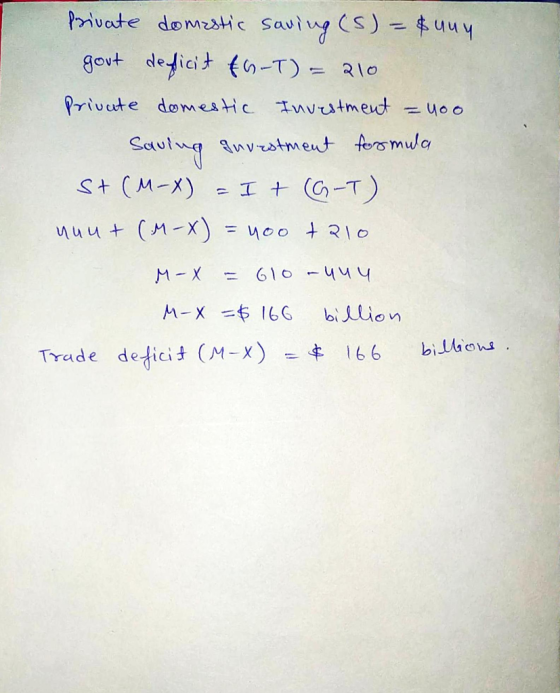
Suppose an economy has a private domestic savings of $444 billion, a government deficit of $210 billion, and private domestic investment of $400 billion. How much is the trade deficit (in billions of dollars)?
Recall the savings investment formula: S + (M – X) = I + (G - T)
Homework Answers
Add Answer to:
Suppose an economy has a private domestic savings of $444
billion, a government deficit of $210...
HON 54 Suppose an economy has a private domestic savings of $245 billion, a government surplus...
 HON 54 Suppose an economy has a private domestic savings of $245 billion, a government surplus of $500 billion, and private domestic investment of $1,125 billion. How much is the trade deficit (in billions of dollars)? Recall the savings investment formula: 5+ (M - X) = 1 + (G-T) Provide your answer below: billion
FEEDBACK Content attribution QUESTION 16.1 POINT Suppose an economy has a private domestic savings of $245...
 FEEDBACK Content attribution QUESTION 16.1 POINT Suppose an economy has a private domestic savings of $245 billion, a government surplus of $500 billion, and private domestic investment of $1,125 billion. How much is the trade deficit (in billions of dollars)? Recall the savings investment formula: S+(M -X) = 1 + (G-T) Provide your answer below: billion FEEDBAC Content attribution QUESTION 17 - 1 POINT A country's level of trade tells how much of its production it QUESTION 18 • 2...
Country private domestic savings of $650 billion, a government deficit of $200 billion, and private domestic...
Country private domestic savings of $650 billion, a government deficit of $200 billion, and private domestic investment of $500 billion. What is the trade surplus / deficit?
Assume the GDP is $6,000, private domestic savings are $1,100, and the government budget deficit is...
Assume the GDP is $6,000, private domestic savings are $1,100, and the government budget deficit is $200. Consumption is $3,800, and the trade deficit is $100. Find: (a) Investments (I), (b) Government spending (G)
Recall that national savings (S) is the sum of private savings and public savings. S =...
 Recall that national savings (S) is the sum of private savings and public savings. S = SP + S a. Show that private savings can be written as a function of investment, the current account and the government's budget deficit. (3 marks) b. Show that the current account can be written as a function of private savings, investment and the government's budget deficit. What does this imply about the ways that the government can reduce the current account deficit? (3...
4) Calculate the values for government purchases (G), private domestic saving (S), and private domestic investment...
 4) Calculate the values for government purchases (G), private domestic saving (S), and private domestic investment (1) from the following information (all variables are in billions of dollars). National income Disposable income Consumption Budget Deficit Net Exports Y = 5,200 YD = 4,400 C = 4,100 BD = 150 NX = 110
Suppose that investment expenditures increases by $300 billion in a closed and private economy (no government...
Suppose that investment expenditures increases by $300 billion in a closed and private economy (no government or foreign trade). Assume further that households have a marginal propensity to consume of 75 percent. What will be the final cumulative impact on spending? $900 billion $225 billion $375 billion $525 billion
An open economy is described by the following system of macroeconomic equations, in which all macroeconomic...
An open economy is described by the following system of macroeconomic equations, in which all macroeconomic aggregate are measured in billions of Namibian dollars, N$: Y = C + I + G + X – M C = 10 + 0.8 Yd T = 10+ 0.2Y X = 80 I = 35 G = 15 TR = 10 – 0.05Y M = 22 + 0.1Y Where: Y is domestic income Yd is private disposable income C is...
Q1 Suppose that investment (I) is $400 billion, private saving (S) is $400 billion, (autonomous) taxes (T) are $500 billion, exports (X) are $300 billion, and imports (M) are $200 billion. (a)...
Q1 Suppose that investment (I) is $400 billion, private saving (S) is $400 billion, (autonomous) taxes (T) are $500 billion, exports (X) are $300 billion, and imports (M) are $200 billion. (a) What is the government expenditure on goods and services? (Hint: S=Yd-C) (b) What is the government budget balance? For parts (c) and (d), think of the loanable funds approach: (c) Is the government exerting a positive or negative impact on investment? (d) What fiscal policy action might increase...
sing and government purchases are leakages. 8. In a mixed closed economy: A taxes and government...
 sing and government purchases are leakages. 8. In a mixed closed economy: A taxes and government purchases are leakages, while investment and saving are injections. • taxes and investment are injections, while saving and government purchases are leakages. taxes and savings are leakages, while investment and government purchases are injections. 1. government purchases and saving are injections, while investment and taxes are leakages. 9. In a mixed open economy, the equilibrium GDP is determined at that point where: A.S. +M+...
 HON 54 Suppose an economy has a private domestic savings of $245 billion, a government surplus of $500 billion, and private domestic investment of $1,125 billion. How much is the trade deficit (in billions of dollars)? Recall the savings investment formula: 5+ (M - X) = 1 + (G-T) Provide your answer below: billion
 FEEDBACK Content attribution QUESTION 16.1 POINT Suppose an economy has a private domestic savings of $245 billion, a government surplus of $500 billion, and private domestic investment of $1,125 billion. How much is the trade deficit (in billions of dollars)? Recall the savings investment formula: S+(M -X) = 1 + (G-T) Provide your answer below: billion FEEDBAC Content attribution QUESTION 17 - 1 POINT A country's level of trade tells how much of its production it QUESTION 18 • 2...
 Recall that national savings (S) is the sum of private savings and public savings. S = SP + S a. Show that private savings can be written as a function of investment, the current account and the government's budget deficit. (3 marks) b. Show that the current account can be written as a function of private savings, investment and the government's budget deficit. What does this imply about the ways that the government can reduce the current account deficit? (3...
 4) Calculate the values for government purchases (G), private domestic saving (S), and private domestic investment (1) from the following information (all variables are in billions of dollars). National income Disposable income Consumption Budget Deficit Net Exports Y = 5,200 YD = 4,400 C = 4,100 BD = 150 NX = 110
 sing and government purchases are leakages. 8. In a mixed closed economy: A taxes and government purchases are leakages, while investment and saving are injections. • taxes and investment are injections, while saving and government purchases are leakages. taxes and savings are leakages, while investment and government purchases are injections. 1. government purchases and saving are injections, while investment and taxes are leakages. 9. In a mixed open economy, the equilibrium GDP is determined at that point where: A.S. +M+...
Most questions answered within 3 hours.
-
Where is the error in this code sequence?
String s1 = "Hello";
String s2 = "ello";...
asked 11 months ago -
Financial data for Joel de Paris, Inc., for last year
follow:
Joel de Paris, Inc.
Balance...
asked 11 months ago -
Consider this reaction:
Al2(SO4)3 (aq)+ BaCl3
(aq) Al2Cl6 (aq)- +
3BaSO4(s) . What is the...
asked 11 months ago -
Suppose that Savneet is considering increasing her
recent random sample from 20 car rentals to 40...
asked 11 months ago -
Trucks arrive at an unloading terminal at an average rate of 120
per hour.
Trucks arrive...
asked 11 months ago -
Why are methanol and ethanol completely soluble in water while
octanol is not very little soluble....
asked 11 months ago -
A facilities manager at a university reads in a research report
that the mean amount of...
asked 11 months ago -
When the CuSO4 is rehydrated by adding water to the anhydrous
compound, is this an endothermic...
asked 11 months ago -
A ray of sunlight is passing from diamond into crown glass; the
angle of incidence is...
asked 11 months ago -
A block of mass 0.249 kg is placed on top of a light, vertical
spring of...
asked 11 months ago -
how do the kidneys compensate in the presences of acidosis
a) trigger hyperventilate
b) reserve acid...
asked 11 months ago -
Question 501 pts
The rental rate of capital to the firm increases. Which of the
following...
asked 11 months ago