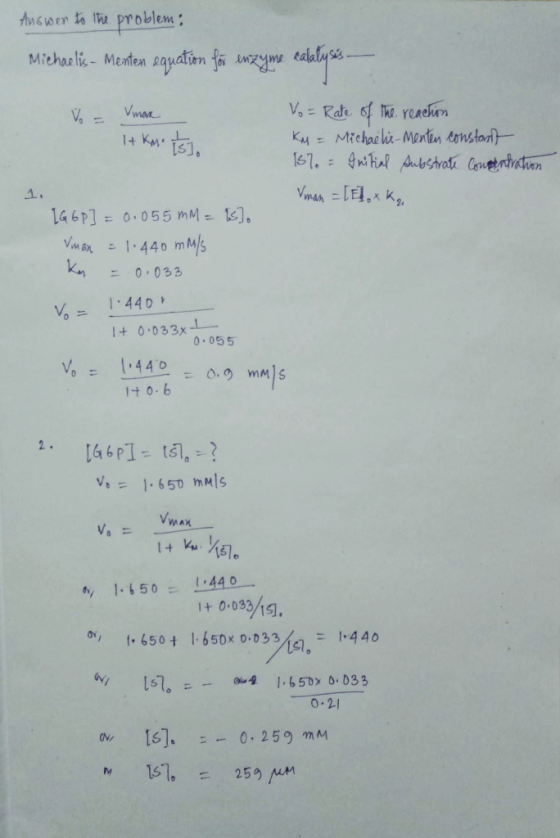
1.What will be the reaction rate at 0.0550 mM [G6P]? (2)
2. If the enzyme concentration is unchanged, at what G6P concentration will the reaction rate equal 1.650 mM/s? (2)
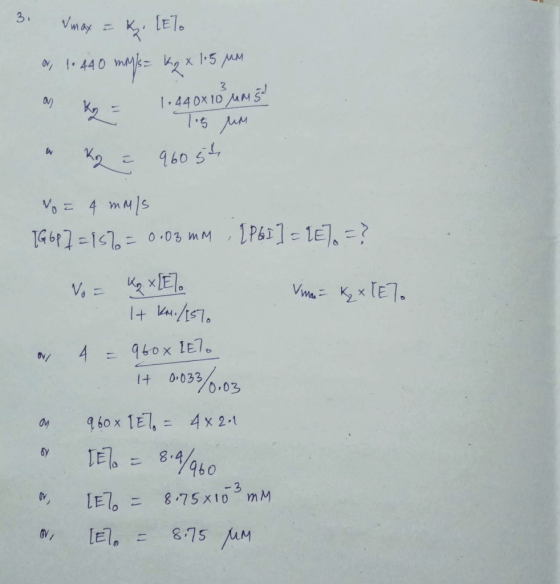
3. What PGI concentration is required to give a reaction rate of 4.000 mM/s at 0.0300 mM [G6P]? (2)
 Calculated Vmax=1.440mM/s
Km=0.0330 mM
Calculated Vmax=1.440mM/s
Km=0.0330 mM
Homework Answers
Add Answer to:
1.What will be the reaction rate at 0.0550 mM [G6P]? (2)
2. If the enzyme concentration...
1.Which step of glycolysis is catalyzed by phosphoglucose isomerase? What is the chemical “reason” for this...
 1.Which step of glycolysis is catalyzed by phosphoglucose
isomerase? What is the chemical “reason” for this reaction in
glycolysis? (2)
2. Calculate values of Km and Vmax for PGI. (4)
3. How long (in seconds) does a single catalytic event take?
(2)
The enzyme phosphoglucose isomerase (PGI) catalyzes the following reaction in glycolysis сH,ОРО,?- Phosphoglucose2-03POH2C сH,он н Н isomerase но Н Н он Н он он но но Н он Н Glucose 6-phosphate Fructose 6-phosphate Kinetics experiments were performed on...
1.Which step of glycolysis is catalyzed by phosphoglucose
isomerase? What is the chemical “reason” for this reaction in
glycolysis? (2)
2. Calculate values of Km and Vmax for PGI. (4)
3. How long (in seconds) does a single catalytic event take?
(2)
The enzyme phosphoglucose isomerase (PGI) catalyzes the following reaction in glycolysis сH,ОРО,?- Phosphoglucose2-03POH2C сH,он н Н isomerase но Н Н он Н он он но но Н он Н Glucose 6-phosphate Fructose 6-phosphate Kinetics experiments were performed on...
10.What type of inhibitor is this? How do you know? (2) 11.For your assigned inhibitor 1,...
 10.What type of inhibitor is this? How do you know? (2)
11.For your assigned inhibitor 1, what are the apparent Km &
Vmax? (NOTE: apparent Km& Vmax are just the Km & Vmax in
presence of inhibitor, at a given concentration.) (2)
Kinetics experiments were performed on PGI. Enzyme activity
(initial velocity, Vo) was measured at varying concentrations of
Glucose-6-phosphate (G6P). The enzyme concentration used in all
experiments was 1.5 μM.
12.What will be the reaction rate with 0.500 mM...
10.What type of inhibitor is this? How do you know? (2)
11.For your assigned inhibitor 1, what are the apparent Km &
Vmax? (NOTE: apparent Km& Vmax are just the Km & Vmax in
presence of inhibitor, at a given concentration.) (2)
Kinetics experiments were performed on PGI. Enzyme activity
(initial velocity, Vo) was measured at varying concentrations of
Glucose-6-phosphate (G6P). The enzyme concentration used in all
experiments was 1.5 μM.
12.What will be the reaction rate with 0.500 mM...
54. What is the catalyze reaction rate? Km=2 mM Kcat= 3 s-1 At the enzyme concentration=10...
54. What is the catalyze reaction rate? Km=2 mM Kcat= 3 s-1 At the enzyme concentration=10 nM and substrate concentration= 3 mM
Biochemistry. Please answer all completely. 13. Identify the electrophilic center and nucleophile in the below image...
 Biochemistry. Please answer all completely.
13. Identify the electrophilic center and nucleophile in the below image : R 14. Give an example of amino acids with R group shown below which can function as nucleophile during enzyme catalysis. Nucleophiles Negatively charged oxygen (as in an unprotonated hydroxyl group or an ionized carboxylic acid) Negatively charged sulfhydryl Uncharged amine group HN Imidazole 15. Identify the amino acids with the following side chains and also define if they will work as acid...
Biochemistry. Please answer all completely.
13. Identify the electrophilic center and nucleophile in the below image : R 14. Give an example of amino acids with R group shown below which can function as nucleophile during enzyme catalysis. Nucleophiles Negatively charged oxygen (as in an unprotonated hydroxyl group or an ionized carboxylic acid) Negatively charged sulfhydryl Uncharged amine group HN Imidazole 15. Identify the amino acids with the following side chains and also define if they will work as acid...
Trial Concentration Level Oxygen Concentration Change Data (ppt) Elapsed Time (s) Enzyme Reaction Rate (ppt/s) 1...
Trial Concentration Level Oxygen Concentration Change Data (ppt) Elapsed Time (s) Enzyme Reaction Rate (ppt/s) 1 2.5% 4.23 20.0 .21 2 5.0% 8.46 20.0 .42 3 10% 16.92 20.0 .85 Observations and Questions [1] Sample Calculation: Show your enzyme reaction rate calculation for Trial 1. [2] Convert enzyme concentrations of 2.5%, 5.0%, and 10% to ppt units.
Consider the data collected for an enzyme-catalyzed reaction. [S] (MM) 2 (MM :5-1) 0.20 0.86 0.33...
 Consider the data collected for an enzyme-catalyzed reaction. [S] (MM) 2 (MM :5-1) 0.20 0.86 0.33 1.20 2.00 2.42 4.00 2.69 Determine Vmax and Km for this reaction. mMs-1 Km = mM
Question 1 - Linked Reactions (10 marks) The reaction catalysed by pyruvate kinase is: Phosphoenolpyruvate+ ADPpyruvateATP Keg 3.63 x 10⁵ a) Calculate the AG" for this reaction. Show your work...
 Question 1 - Linked Reactions (10 marks) The reaction catalysed by pyruvate kinase is: Phosphoenolpyruvate+ ADPpyruvateATP Keg 3.63 x 10⁵ a) Calculate the AG" for this reaction. Show your working. 3 marks b) The hydrolysis of ATP has following equation: AG 30.5 kJ/mol Calculate the AG" for the following reaction: Phosphoenolpyruvate pyruvateP Show your working. 2 marks c) At 37 °C, the steady-state concentrations of phosphoenolpyruvate, ATP, and ADP have been measured to be 23 HM, 1.85 mM and 140...
What is the major product of the following reaction? 1) BD3, THE 2) NaOH, H2O2 он...
 What is the major product of the following reaction? 1) BD3, THE 2) NaOH, H2O2 он НО. D A B D ОН он OD ОА B EIO 20 What is the major product of the following reaction? Etон only B Eto OET A D C D A What is/are the major product(s) of the following reaction? Br Н,0 д он ОН он А в only с D Ос A What is the major product of the following reaction? HBr ROOR...
1) The rate constant for the reaction 2 N,Os(9) = 4 NO (9) + O2(9) is...
 1) The rate constant for the reaction 2 N,Os(9) = 4 NO (9) + O2(9) is reported in units of sl. What is the overall order of the reaction? 2) The rate law for a reaction was reported as rate=k[A] [B][C] with molar concentrations in moles per cubic decimetre and time in seconds. What are the units of k? 3) The rate constant for the pseudo first-order acid- catalysed hydrolysis of glucose is 4.07' 10-s. Calculate the half-life for the...
1. According to the paper, what does lactate dehydrogenase (LDH) do and what does it allow...
 1. According to the paper, what does lactate dehydrogenase
(LDH) do and what does it allow to happen within the myofiber? (5
points)
2. According to the paper, what is the major disadvantage of
relying on glycolysis during high-intensity exercise? (5
points)
3. Using Figure 1 in the paper, briefly describe the different
sources of ATP production at 50% versus 90% AND explain whether you
believe this depiction of ATP production applies to a Type IIX
myofiber in a human....
1. According to the paper, what does lactate dehydrogenase
(LDH) do and what does it allow to happen within the myofiber? (5
points)
2. According to the paper, what is the major disadvantage of
relying on glycolysis during high-intensity exercise? (5
points)
3. Using Figure 1 in the paper, briefly describe the different
sources of ATP production at 50% versus 90% AND explain whether you
believe this depiction of ATP production applies to a Type IIX
myofiber in a human....
 1.Which step of glycolysis is catalyzed by phosphoglucose
isomerase? What is the chemical “reason” for this reaction in
glycolysis? (2)
2. Calculate values of Km and Vmax for PGI. (4)
3. How long (in seconds) does a single catalytic event take?
(2)
The enzyme phosphoglucose isomerase (PGI) catalyzes the following reaction in glycolysis сH,ОРО,?- Phosphoglucose2-03POH2C сH,он н Н isomerase но Н Н он Н он он но но Н он Н Glucose 6-phosphate Fructose 6-phosphate Kinetics experiments were performed on...
1.Which step of glycolysis is catalyzed by phosphoglucose
isomerase? What is the chemical “reason” for this reaction in
glycolysis? (2)
2. Calculate values of Km and Vmax for PGI. (4)
3. How long (in seconds) does a single catalytic event take?
(2)
The enzyme phosphoglucose isomerase (PGI) catalyzes the following reaction in glycolysis сH,ОРО,?- Phosphoglucose2-03POH2C сH,он н Н isomerase но Н Н он Н он он но но Н он Н Glucose 6-phosphate Fructose 6-phosphate Kinetics experiments were performed on...
 10.What type of inhibitor is this? How do you know? (2)
11.For your assigned inhibitor 1, what are the apparent Km &
Vmax? (NOTE: apparent Km& Vmax are just the Km & Vmax in
presence of inhibitor, at a given concentration.) (2)
Kinetics experiments were performed on PGI. Enzyme activity
(initial velocity, Vo) was measured at varying concentrations of
Glucose-6-phosphate (G6P). The enzyme concentration used in all
experiments was 1.5 μM.
12.What will be the reaction rate with 0.500 mM...
10.What type of inhibitor is this? How do you know? (2)
11.For your assigned inhibitor 1, what are the apparent Km &
Vmax? (NOTE: apparent Km& Vmax are just the Km & Vmax in
presence of inhibitor, at a given concentration.) (2)
Kinetics experiments were performed on PGI. Enzyme activity
(initial velocity, Vo) was measured at varying concentrations of
Glucose-6-phosphate (G6P). The enzyme concentration used in all
experiments was 1.5 μM.
12.What will be the reaction rate with 0.500 mM...
 Biochemistry. Please answer all completely.
13. Identify the electrophilic center and nucleophile in the below image : R 14. Give an example of amino acids with R group shown below which can function as nucleophile during enzyme catalysis. Nucleophiles Negatively charged oxygen (as in an unprotonated hydroxyl group or an ionized carboxylic acid) Negatively charged sulfhydryl Uncharged amine group HN Imidazole 15. Identify the amino acids with the following side chains and also define if they will work as acid...
Biochemistry. Please answer all completely.
13. Identify the electrophilic center and nucleophile in the below image : R 14. Give an example of amino acids with R group shown below which can function as nucleophile during enzyme catalysis. Nucleophiles Negatively charged oxygen (as in an unprotonated hydroxyl group or an ionized carboxylic acid) Negatively charged sulfhydryl Uncharged amine group HN Imidazole 15. Identify the amino acids with the following side chains and also define if they will work as acid...
 Consider the data collected for an enzyme-catalyzed reaction. [S] (MM) 2 (MM :5-1) 0.20 0.86 0.33 1.20 2.00 2.42 4.00 2.69 Determine Vmax and Km for this reaction. mMs-1 Km = mM
 Question 1 - Linked Reactions (10 marks) The reaction catalysed by pyruvate kinase is: Phosphoenolpyruvate+ ADPpyruvateATP Keg 3.63 x 10⁵ a) Calculate the AG" for this reaction. Show your working. 3 marks b) The hydrolysis of ATP has following equation: AG 30.5 kJ/mol Calculate the AG" for the following reaction: Phosphoenolpyruvate pyruvateP Show your working. 2 marks c) At 37 °C, the steady-state concentrations of phosphoenolpyruvate, ATP, and ADP have been measured to be 23 HM, 1.85 mM and 140...
 What is the major product of the following reaction? 1) BD3, THE 2) NaOH, H2O2 он НО. D A B D ОН он OD ОА B EIO 20 What is the major product of the following reaction? Etон only B Eto OET A D C D A What is/are the major product(s) of the following reaction? Br Н,0 д он ОН он А в only с D Ос A What is the major product of the following reaction? HBr ROOR...
 1) The rate constant for the reaction 2 N,Os(9) = 4 NO (9) + O2(9) is reported in units of sl. What is the overall order of the reaction? 2) The rate law for a reaction was reported as rate=k[A] [B][C] with molar concentrations in moles per cubic decimetre and time in seconds. What are the units of k? 3) The rate constant for the pseudo first-order acid- catalysed hydrolysis of glucose is 4.07' 10-s. Calculate the half-life for the...
 1. According to the paper, what does lactate dehydrogenase
(LDH) do and what does it allow to happen within the myofiber? (5
points)
2. According to the paper, what is the major disadvantage of
relying on glycolysis during high-intensity exercise? (5
points)
3. Using Figure 1 in the paper, briefly describe the different
sources of ATP production at 50% versus 90% AND explain whether you
believe this depiction of ATP production applies to a Type IIX
myofiber in a human....
1. According to the paper, what does lactate dehydrogenase
(LDH) do and what does it allow to happen within the myofiber? (5
points)
2. According to the paper, what is the major disadvantage of
relying on glycolysis during high-intensity exercise? (5
points)
3. Using Figure 1 in the paper, briefly describe the different
sources of ATP production at 50% versus 90% AND explain whether you
believe this depiction of ATP production applies to a Type IIX
myofiber in a human....
Most questions answered within 3 hours.
-
Where is the error in this code sequence?
String s1 = "Hello";
String s2 = "ello";...
asked 11 months ago -
Financial data for Joel de Paris, Inc., for last year
follow:
Joel de Paris, Inc.
Balance...
asked 11 months ago -
Consider this reaction:
Al2(SO4)3 (aq)+ BaCl3
(aq) Al2Cl6 (aq)- +
3BaSO4(s) . What is the...
asked 11 months ago -
Suppose that Savneet is considering increasing her
recent random sample from 20 car rentals to 40...
asked 11 months ago -
Trucks arrive at an unloading terminal at an average rate of 120
per hour.
Trucks arrive...
asked 11 months ago -
Why are methanol and ethanol completely soluble in water while
octanol is not very little soluble....
asked 11 months ago -
A facilities manager at a university reads in a research report
that the mean amount of...
asked 11 months ago -
When the CuSO4 is rehydrated by adding water to the anhydrous
compound, is this an endothermic...
asked 11 months ago -
A ray of sunlight is passing from diamond into crown glass; the
angle of incidence is...
asked 11 months ago -
A block of mass 0.249 kg is placed on top of a light, vertical
spring of...
asked 11 months ago -
how do the kidneys compensate in the presences of acidosis
a) trigger hyperventilate
b) reserve acid...
asked 11 months ago -
Question 501 pts
The rental rate of capital to the firm increases. Which of the
following...
asked 11 months ago