It is about marginal rate of substitution.
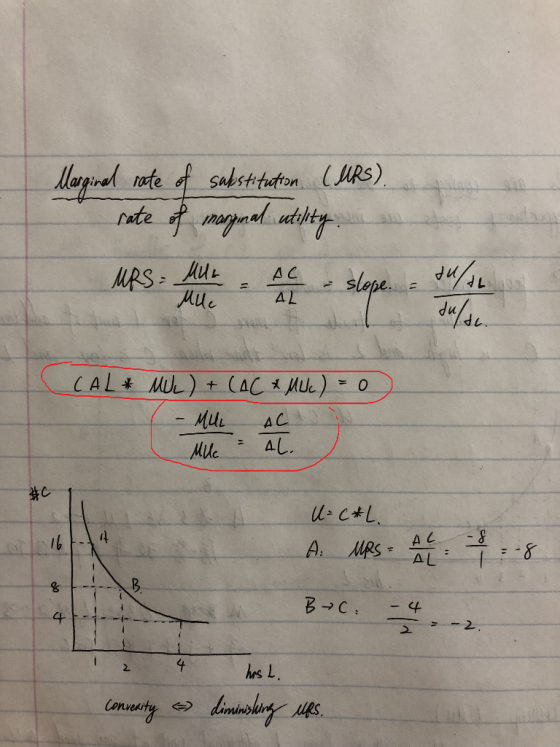
C stands for consumption
L stands for leisure time
U(C, L) = f(C, L)
I understand that in order to stay on the indifference curve, the increase in utility of C should be equal to the decrease in utility of L (suppose I exchange L for C).
My problem is why the equation is ẟL * MUL + ẟC * MUC = 0 and MRS= MUL / MUC . Does the first equation mean the utility of last L I give up = the utility of last C I get? But why the equation is not ẟL (change in amount of leisure time) * average utility of L + ẟC (change in amount of consumption) * average utility of C = 0
Homework Answers
In the above equation, ẟL * MUL + ẟC * MUC = 0, it is equal to zero because along the same indifference curve the utility does not change. The movement along the same indifference curve leads to no change in utility. Also,it means that utility of L1 given up = utility of the last C1 and thus there is no change in net utility.. Thus, the above equation is equated to zero.
It is observed that marginal utility is taken in the equation and not the average utility because the equation computes the change in the level of utility with the addition of use unit of extra work or leisure, thus,, marginal utility is taken to compute the change.
Add Answer to:
It is about marginal rate of substitution.
C stands for consumption
L stands for leisure time...
Question on MRS. L= leisure time C = consumpition I somehow understand this equation (?L *...
 Question on MRS.
L= leisure time
C = consumpition
I somehow understand this equation (?L * MUL) + (?C * MUC) = 0
because of points on the indifference curve, the total utility
won't change.
But MUL would change when L changes, such as MUL =10 when L=4
and MUL=5 when L =3. Why is ?L * MUL equal total change in utility
of L and the same for consumption? For me it should be ?L * average
utility of...
Question on MRS.
L= leisure time
C = consumpition
I somehow understand this equation (?L * MUL) + (?C * MUC) = 0
because of points on the indifference curve, the total utility
won't change.
But MUL would change when L changes, such as MUL =10 when L=4
and MUL=5 when L =3. Why is ?L * MUL equal total change in utility
of L and the same for consumption? For me it should be ?L * average
utility of...
Clark gains utility from consumption c and leisure l and his preferences for consumption and leisure...
Clark gains utility from consumption c and leisure l and his preferences for consumption and leisure can be expressed as U(c, l) = 2(√ c)(l). This utility function implies that Clark’s marginal utility of leisure is 2√ c and his marginal utility of consumption is l √ c . He has 16 hours per day to allocate between leisure (l) and work (h). His hourly wage is $12 after taxes. Clark also receives a daily check of $30 from the...
Cindy gains utility from consumption C and leisure L. The most leisure she can consume in any giv...
 Cindy gains utility from consumption C and leisure L. The most leisure she can consume in any given week is 80 hours. Her utility function is: a) Derive Cindy's marginal rate of substitution (MRS) b) Suppose Cindy receives $800 each week from her grandmother regardless of how much Cindy works. What is Cindy's reservation wage?
Cindy gains utility from consumption C and leisure L. The most leisure she can consume in any given week is 80 hours. Her utility function...
Cindy gains utility from consumption C and leisure L. The most leisure she can consume in any given week is 80 hours. Her utility function is: a) Derive Cindy's marginal rate of substitution (MRS) b) Suppose Cindy receives $800 each week from her grandmother regardless of how much Cindy works. What is Cindy's reservation wage?
Cindy gains utility from consumption C and leisure L. The most leisure she can consume in any given week is 80 hours. Her utility function...
13) Consider the standard labor-leisure choice model. Consumer gets utility from consumption (C) and leisure (L)....
13) Consider the standard labor-leisure choice model. Consumer gets utility from consumption (C) and leisure (L). She has H total hours. She works N S hours and receives the hourly wage, w. She has some non-labor income π and pays lump-sum tax T. Further suppose (π – T) > 0. The shape of utility function is downward-sloping and bowed-in towards the origin (the standard U- shaped case just like a cobb-douglas function) If this consumer decides to NOT WORK AT...
Problem #1: Optimal labor supply Clark gains utility from consumption c and leisure l and his...
Problem #1: Optimal labor supply Clark gains utility from consumption c and leisure l and his preferences for consumption and leisure can be expressed as U(c, l) = 2(√ c)(l). This utility function implies that Clark’s marginal utility of leisure is 2√ c and his marginal utility of consumption is l √ c . He has 16 hours per day to allocate between leisure (l) and work (h). His hourly wage is $12 after taxes. Clark also receives a daily...
Denise has utility over consumption c and leisure l defined by the following function: U(c, l)...
Denise has utility over consumption c and leisure l defined by the following function: U(c, l) = c + l a) Suppose Denise has two units of consumption and three units of leisure. What is her utility? b) Suppose Denise has four units of consumption and one unit of leisure. What is her utility? c) Graph her indifference curves. Draw at least three separate indifference curves, for U = {2, 4, 6}. Label your axes accordingly.
4. Let a person's utility function over consumption, X, and leisure, L, be given by U...
 4. Let a person's utility function over consumption, X, and leisure, L, be given by U = XL2, SO MUx = L2 and MUL = 2xL.The individual may work up to 24 hours per day at wage rate, w = $10 per hour, and he has non-labor income of $50 per day. The price of x, px, is $5. (a) Find the utility-maximizing x and L. (b) Show that at the utility- maximizing quantities of x and L, the consumer's...
Suppose Tom has a utility function U=C*L C= consumption L= hours of leisure Tom has 100...
Suppose Tom has a utility function U=C*L C= consumption L= hours of leisure Tom has 100 hours to divide between work and leisure per week wage is $20/hr 1. Write down budget constraint in terms of consumption and hours of work 2.Tom make decisions on hours of work, leisure and consumption to max. utility. Explain why we can collapse this problem to one in which he chooses hours of leisure only 3. Find optimal hours of work and total consumption...
Alpha cares about his daily consumption c and leisure time t. His leisure time t =...
Alpha cares about his daily consumption c and leisure time t. His leisure time t = 24 − ℓ, where ℓ is the number of hours worked in a day. If he works ℓ hours in a day, he receives $wℓ income, which he consumes by the end of the day. Alpha’s daily utility function is u(c, t) = ct. 1. Write down Alpha’s budget equation which gives a relation between his daily consumption and leisure time. 2. Find the...
1. Janet's utility depends on consumption c and leisure l. She earns a wage equal to...
1. Janet's utility depends on consumption c and leisure l. She earns a wage equal to w per hour, has an investment income equal to M(greater than or equal to) 0 and needs to sleep at least 8 hours a night. Normalize the price of consumption goods at $1. (i) Draw her indifference curves between hours of leisure and consumption, her budget line and her equilibrium choice of c and l. What is the slope of the budget line and...
 Question on MRS.
L= leisure time
C = consumpition
I somehow understand this equation (?L * MUL) + (?C * MUC) = 0
because of points on the indifference curve, the total utility
won't change.
But MUL would change when L changes, such as MUL =10 when L=4
and MUL=5 when L =3. Why is ?L * MUL equal total change in utility
of L and the same for consumption? For me it should be ?L * average
utility of...
Question on MRS.
L= leisure time
C = consumpition
I somehow understand this equation (?L * MUL) + (?C * MUC) = 0
because of points on the indifference curve, the total utility
won't change.
But MUL would change when L changes, such as MUL =10 when L=4
and MUL=5 when L =3. Why is ?L * MUL equal total change in utility
of L and the same for consumption? For me it should be ?L * average
utility of...
 Cindy gains utility from consumption C and leisure L. The most leisure she can consume in any given week is 80 hours. Her utility function is: a) Derive Cindy's marginal rate of substitution (MRS) b) Suppose Cindy receives $800 each week from her grandmother regardless of how much Cindy works. What is Cindy's reservation wage?
Cindy gains utility from consumption C and leisure L. The most leisure she can consume in any given week is 80 hours. Her utility function...
Cindy gains utility from consumption C and leisure L. The most leisure she can consume in any given week is 80 hours. Her utility function is: a) Derive Cindy's marginal rate of substitution (MRS) b) Suppose Cindy receives $800 each week from her grandmother regardless of how much Cindy works. What is Cindy's reservation wage?
Cindy gains utility from consumption C and leisure L. The most leisure she can consume in any given week is 80 hours. Her utility function...
 4. Let a person's utility function over consumption, X, and leisure, L, be given by U = XL2, SO MUx = L2 and MUL = 2xL.The individual may work up to 24 hours per day at wage rate, w = $10 per hour, and he has non-labor income of $50 per day. The price of x, px, is $5. (a) Find the utility-maximizing x and L. (b) Show that at the utility- maximizing quantities of x and L, the consumer's...
Most questions answered within 3 hours.
-
Where is the error in this code sequence?
String s1 = "Hello";
String s2 = "ello";...
asked 11 months ago -
Financial data for Joel de Paris, Inc., for last year
follow:
Joel de Paris, Inc.
Balance...
asked 11 months ago -
Consider this reaction:
Al2(SO4)3 (aq)+ BaCl3
(aq) Al2Cl6 (aq)- +
3BaSO4(s) . What is the...
asked 11 months ago -
Suppose that Savneet is considering increasing her
recent random sample from 20 car rentals to 40...
asked 11 months ago -
Trucks arrive at an unloading terminal at an average rate of 120
per hour.
Trucks arrive...
asked 11 months ago -
Why are methanol and ethanol completely soluble in water while
octanol is not very little soluble....
asked 11 months ago -
A facilities manager at a university reads in a research report
that the mean amount of...
asked 11 months ago -
When the CuSO4 is rehydrated by adding water to the anhydrous
compound, is this an endothermic...
asked 11 months ago -
A ray of sunlight is passing from diamond into crown glass; the
angle of incidence is...
asked 11 months ago -
A block of mass 0.249 kg is placed on top of a light, vertical
spring of...
asked 11 months ago -
how do the kidneys compensate in the presences of acidosis
a) trigger hyperventilate
b) reserve acid...
asked 11 months ago -
Question 501 pts
The rental rate of capital to the firm increases. Which of the
following...
asked 11 months ago