You contribute $1,000 annually to a retirement account for eight years and stop making payments at...
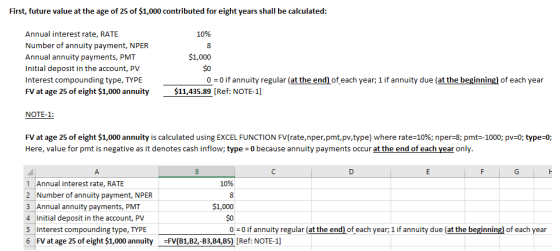
You contribute $1,000 annually to a retirement account for eight years and stop making payments at the age of 25. Your twin brother (or sister . . . whichever applies) opens an account at age 25 and contributes $1,000 a year until retirement at age 65 (40 years). You both earn 10 percent on your investments. How much can each of you withdraw for 20 years (that is, ages 66 through 85) from the retirement accounts? PLEASE PROVIDE INPUTS AND WHAT TO SOLVE FOR IN THE FINANCIAL CALCULATOR DO NOT NEED FORMULAS
Homework Answers
![Second, considering $11,435.89 as the initial deposit for me and $1,000 as year-end deposit for my sister for next 40 years (from age-26 thru 65), FV shall be For me For my sister 10% 40 $0 $11,435.89 0 Annual interest rate, RATE Number of annuity payment, NPER Annual annuity payments, PMT Initial deposit in the account, PV Interest compounding type, TYPE FV at age 65 of this cashflow/annuity $517,579.78 $442,592.56 [Ref: NOTE-2] NOTE-2: For me: FV at age 65 of this cashflow is calculated using EXCEL FUNCTION FV(rate,nper,pmt,pv,type) where rate-10%; nper-40; pmt=0; pv=-11435.89; type:0; Here, value for pv is negative as it denotes cash inflow; type 0 because interest accrues at the end of each year only For me: FV at age 65 of this annuity is calculated using EXCEL FUNCTION FV(rate,nper,pmt,pv,type) where rate-10%; nper-40, pmt=-1000; pv=0; type-0; Here value for pmt is negative as it denotes cash inflow; type 0 because annuity payments occur at the end of each year only 10% $1,000 [Given] $0 [For me, it is as calculated above] 0-0 if annuity regular (at the end) of each year; 1 if annuity due (at the beginningl of each year For me For my sister 10% 2 Annual interest rate, RATE 3 Number of annuity payment, NPER $0 $11,435.89 1,000 [Given] 5 6 7 Annual annuity payments, PMT Initial deposit in the account, PV Interest compounding type, TYPE FV at age 65 of this cashflow/annuity $0 [For me, it is as calculated abovel 0 0 if annuity regular (at the end) of each year; 1 if annuity due (at the beginning) of each year -N(B2,03,84,-B5B6) -N(C2,C3,-C4,C5,C6) [Ref: NOTE-2]](http://img.homeworklib.com/questions/af049500-6e6d-11ea-aae0-f97b74b40a86.png?x-oss-process=image/resize,w_560)
![Finally, considering $517,579.78 for me and $442,592.56 for my sister as initial amount available in account and annual possible withdrawal from ages 66 through 85 shall be: For me For my sister 10% 20 $517,579.78 $442,592.56 [As calculated above] Annual Interest rate, RATE # of years of withdrawals, NPER Initial amount available, PV Balance in account at the end, FV Annual withdrawals type, TYPE Annual withdrawal possible NOTE-3: 10% 20 $0 $0 [Because all will be withdrawn over 20 years] 0 0 if withdrawn at the end of each year; 1 if withdrawn at the beginning of each year $60,794.73 $51,986.76 [Ref: NOTE-3] For me: Annual withdrawal possible is calculated using EXCEL FUNCTION PMT(rate,nper,pv,fv,type) where rate-10%; nper-20; pV-517579.78; fv:0; type:0; Here value for pv is input as negative figure because it denotes cash inflow; type 0 as annual withdrawals occur at the end of each year For my siser: Annual withdrawal possible is calculated using EXCEL FUNCTION PMT(rate,nper,pv,fv,type) where rate-10%; nper=20, pV-442592.56; fv=0; type:0; Here, value for pv is input as negative figure because it denotes cash inflow; type-0 as annual withdrawals occur at the end of each year For me 10% 20 $517,579.78 $0 For my sister 2 Annual Interest rate, RATE 3 #Of years of withdrawals, NPER 4 Initial amount available, PV 5 Balance in account at the end, FV 20 $442,592.56 (As calculated above] $0 [Because all will be withdrawn over 20 years] drawals type, TYPE -O if withdrawn at the end of each year; 1 if withdrawn at the beginning of each year 7 Annual withdrawal possible PMT82,83-B4,B5,B6PMTC2,c3,-C4.CS.C6) [Ref: NOTE-3](http://img.homeworklib.com/questions/af8c5f90-6e6d-11ea-9d34-fb482fb698f2.png?x-oss-process=image/resize,w_560)
Add Answer to:
You contribute $1,000 annually to a retirement account for eight
years and stop making payments at...
You contribute $1,000 annually to a retirement account for eight years and stop making payments at...
You contribute $1,000 annually to a retirement account for eight years and stop making payments at the age of 25. Your twin brother (or sister . . . whichever applies) opens an account at age 25 and contributes $1,000 a year until retirement at age 65 (40 years). You both earn 10 percent on your investments. How much can each of you withdraw for 20 years (that is, ages 66 through 85) from the retirement accoun
You contribute $2,000 annually to a retirement account for seven years and stop making payments at...
You contribute $2,000 annually to a retirement account for seven years and stop making payments at the age of 45. Your twin brother (or sister . . . whichever applies) opens an account at age 45 and contributes $2,000 a year until retirement at age 65 (20 years). You both earn 9 percent on your investments. How much can each of you withdraw for 25 years (that is, ages 66 through 90) from the retirement accounts? You can withdraw $...
Problem 7-28 You contribute $2,000 annually to a retirement account for nine years and stop making...
Problem 7-28 You contribute $2,000 annually to a retirement account for nine years and stop making payments at the age of 40. Your twin brother (or sister . . . whichever applies) opens an account at age 40 and contributes $2,000 a year until retirement at age 65 (25 years). You both earn 12 percent on your investments. How much can each of you withdraw for 25 years (that is, ages 66 through 90) from the retirement accounts? Use Appendix...
You annually invest $1,000 in an individual retirement account (IRA) starting at the age of 20...
You annually invest $1,000 in an individual retirement account (IRA) starting at the age of 20 and make the contributions for 15 years. Your twin sister does the same starting at age 35 and makes the contributions for 25 years. Both of you earn 7 percent annually on your investment. What amounts will you and your sister have at age 60? Use Appendix A and Appendix C to answer the question. Round your answers to the nearest dollar. Amount on...
Worker A annually invests $1,000 in an IRA pension account for ten years (ages 26 through...
Worker A annually invests $1,000 in an IRA pension account for ten years (ages 26 through 35) and never makes another contribution. Worker B annually invests $1,200 in an IRA account for thirty years (ages 36 through 65). Which worker will have more in his or her account when he or she retires (at the age of 65) if they both earn 8 percent on their investments? Provide detailed calculation.
You are planning to invest $1,000 in an account earning 8% per year for retirement. a....
You are planning to invest $1,000 in an account earning 8% per year for retirement. a. If you put the $1,000 in an account at age 23, and withdraw it 44 years later, how much will you have? b. If you wait 10 years before making the deposit, so that it stays in the account for only 34 years, how much will you have at the end?
Investment A You are 25 years old, having just started working. You are considering a retirement...
Investment A You are 25 years old, having just started working. You are considering a retirement plan for a retirement at the age of 65. You want to be able to withdraw $79,000 from your savings account on each birthday for 20 years following your retirement at the age of 65. Your first withdrawal will be on your 66th birthday. To achieve your goal, you intend to make equal annual deposits in a pension scheme which offers 7% interest per...
You are 25 years old, having just started working. You are considering a retirement plan for...
You are 25 years old, having just started working. You are considering a retirement plan for a retirement at the age of 65. You want to be able to withdraw $76,000 from your savings account on each birthday for 20 years following your retirement at the age of 65. Your first withdrawal will be on your 66th birthday. To achieve your goal, you intend to make equal annual deposits in a pension scheme which offers 7% interest per year. According...
Assume you earn $50,000 annually and your employer offers (a) a flexible spending account to which you can contribute a maximum of $2,000 this year and (b) a 401(k) retirement account to which you may contribute up to $3,000. Your 401(k) contribution will
 Assume you earn $50,000 annually and your employer offers (a) a flexible spending account to which you can contribute a maximum of $2,000 this year and (b) a 401(k) retirement account to which you may contribute up to $3,000. Your 401(k) contribution will be matched 50 percent by your employer. Assuming you can only afford to contribute a total of $3,000 to both these benefits, explain what you would do with your $3,000. Write an explanation of your decision and...
You wish to retire in 12 years and currently have $50,000 in a savings account yielding...
You wish to retire in 12 years and currently have $50,000 in a savings account yielding 5 percent annually and $100,000 in quality “blue chip” stocks yielding 10 percent. If you expect to add $30,000 at the end of each year to your stock portfolios, how much will you have in your retirement fund when you retire? What rate of return must you earn on your retirement funds if you want to withdraw $102,000 per year for the next 15...
Most questions answered within 3 hours.
-
Where is the error in this code sequence?
String s1 = "Hello";
String s2 = "ello";...
asked 10 months ago -
Financial data for Joel de Paris, Inc., for last year
follow:
Joel de Paris, Inc.
Balance...
asked 10 months ago -
Consider this reaction:
Al2(SO4)3 (aq)+ BaCl3
(aq) Al2Cl6 (aq)- +
3BaSO4(s) . What is the...
asked 10 months ago -
Suppose that Savneet is considering increasing her
recent random sample from 20 car rentals to 40...
asked 10 months ago -
Trucks arrive at an unloading terminal at an average rate of 120
per hour.
Trucks arrive...
asked 10 months ago -
Why are methanol and ethanol completely soluble in water while
octanol is not very little soluble....
asked 10 months ago -
A facilities manager at a university reads in a research report
that the mean amount of...
asked 10 months ago -
When the CuSO4 is rehydrated by adding water to the anhydrous
compound, is this an endothermic...
asked 10 months ago -
A ray of sunlight is passing from diamond into crown glass; the
angle of incidence is...
asked 10 months ago -
A block of mass 0.249 kg is placed on top of a light, vertical
spring of...
asked 10 months ago -
how do the kidneys compensate in the presences of acidosis
a) trigger hyperventilate
b) reserve acid...
asked 10 months ago -
Question 501 pts
The rental rate of capital to the firm increases. Which of the
following...
asked 10 months ago