
Homework Answers
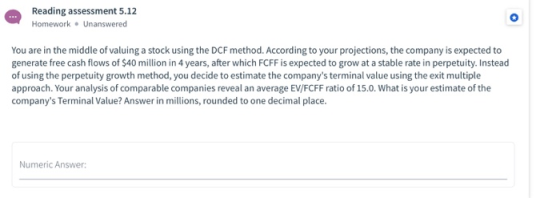
Assuming multiple is based on leading FCFF
Enterprise Value=EV/FCFF multiple*FCFF=40*15=600 million
Add Answer to:
if u answer is 150 million, it’s incorrect answer
Example 5.12: A company had total revenues...
A company had total revenues of $129 million, operating profit margin of 19%, and depreciation and...
A company had total revenues of $129 million, operating profit margin of 19%, and depreciation and amortization expense of $15 million over the trailing twelve months. The company currently has $39 million in total debt and $13 million in cash and cash equivalents. If the company's market capitalization (market value of its equity) is $543 million, what is its EV/EBITDA ratio? Round to one decimal place.
A company had total revenues of $114 million, operating profit margin of 22%, and depreciation and...
A company had total revenues of $114 million, operating profit margin of 22%, and depreciation and amortization expense of $11 million over the trailing twelve months. The company currently has $44 million in total debt and $11 million in cash and cash equivalents. If the company's market capitalization (market value of its equity) is $571 million, what is its EV/EBITDA ratio? Round to one decimal place.
A company had total revenues of $104 million, operating profit margin of 24%, and depreciation and amortization expense...
A company had total revenues of $104 million, operating profit margin of 24%, and depreciation and amortization expense of $9 million over the trailing twelve months. The company currently has $49 million in total debt and $10 million in cash and cash equivalents. If the company's market capitalization (market value of its equity) is $593 million, what is its EV/EBITDA ratio? Round to one decimal place.
I am sorry that I have uploaded more than one question, because I still have many...
 I
am sorry that I have uploaded more than one question, because I
still have many questions, but there are no more questions. I hope
you can help me answer this question. If you can only answer one
question, please do not answer this question, thank you.
1.
2.
Example 5.12: A company had total revenues of $200 million, operating profit margin of 20%, and depreciation and amortization expense of $10 million over the trailing twelve months. The company currently...
I
am sorry that I have uploaded more than one question, because I
still have many questions, but there are no more questions. I hope
you can help me answer this question. If you can only answer one
question, please do not answer this question, thank you.
1.
2.
Example 5.12: A company had total revenues of $200 million, operating profit margin of 20%, and depreciation and amortization expense of $10 million over the trailing twelve months. The company currently...
A company has generated revenues of $150 million over the last twelve months. Operating profit margin...
A company has generated revenues of $150 million over the last twelve months. Operating profit margin is 35%. Depreciation and amortization expenses are $20 million. Market capitalization (value of equity) is $250 million, total debt is $60 million, and cash is $10 million. What is the company's EV/EBITDA multiple? Round to one decimal place.
You are in the middle of valuing a stock using the DCF method. According to your projections, the company is expected to...
You are in the middle of valuing a stock using the DCF method. According to your projections, the company is expected to generate free cash flows of $51 million in 4 years, after which FCFF is expected to grow at a stable rate in perpetuity. Instead of using the perpetuity growth method, you decide to estimate the company's terminal value using the exit multiple approach. Your analysis of comparable companies reveal an average EV/FCFF ratio of 13.3. What is your...
You are in the middle of valuing a stock using the DCF method. According to your...
You are in the middle of valuing a stock using the DCF method. According to your projections, the company is expected to generate free cash flows of $71 million in 4 years, after which FCFF is expected to grow at a stable rate in perpetuity. Instead of using the perpetuity growth method, you decide to estimate the company's terminal value using the exit multiple approach. Your analysis of comparable companies reveal an average EV/FCFF ratio of 10.3. What is your...
You are in the middle of valuing a stock using the DCF method. According to your...
You are in the middle of valuing a stock using the DCF method. According to your projections, the company is expected to generate free cash flows of $51 million in 4 years, after which FCFF is expected to grow at a stable rate in perpetuity. Instead of using the perpetuity growth method, you decide to estimate the company's terminal value using the exit multiple approach. Your analysis of comparable companies reveal an average EV/FCFF ratio of 13.3. What is your...
A company is projected to generate a free cash flow of $100 million next year (year...
A company is projected to generate a free cash flow of $100 million next year (year 1) and $120 million in two years (year 2). After that it is projected grow at a steady rate in perpetuity. The company's cost of capital is 10%. It has $400 million of debt and $40 million in cash. There are 60 million shares outstanding. Comparable companies trade at an average EV/FCFF multiple of 6.9. Using the exit multiple method for terminal value and...
1.A. What's the FCFF of a company with total revenues of $900 million, operating profit margin...
1.A. What's the FCFF of a company with total revenues of $900 million, operating profit margin of 25%, tax rate of 35% and reinvestment rate of 20%? Answer in millions, rounded to one decimal place. 1.B. You are valuing a company with free cash flows expected to grow at a stable 1.5% rate in perpetuity. Analysts are forecasting free cash flows of $50 million for next year (FCFF1). The company has $40 million of debt and $5 million of cash....
 I
am sorry that I have uploaded more than one question, because I
still have many questions, but there are no more questions. I hope
you can help me answer this question. If you can only answer one
question, please do not answer this question, thank you.
1.
2.
Example 5.12: A company had total revenues of $200 million, operating profit margin of 20%, and depreciation and amortization expense of $10 million over the trailing twelve months. The company currently...
I
am sorry that I have uploaded more than one question, because I
still have many questions, but there are no more questions. I hope
you can help me answer this question. If you can only answer one
question, please do not answer this question, thank you.
1.
2.
Example 5.12: A company had total revenues of $200 million, operating profit margin of 20%, and depreciation and amortization expense of $10 million over the trailing twelve months. The company currently...
Most questions answered within 3 hours.
-
Where is the error in this code sequence?
String s1 = "Hello";
String s2 = "ello";...
asked 10 months ago -
Financial data for Joel de Paris, Inc., for last year
follow:
Joel de Paris, Inc.
Balance...
asked 10 months ago -
Consider this reaction:
Al2(SO4)3 (aq)+ BaCl3
(aq) Al2Cl6 (aq)- +
3BaSO4(s) . What is the...
asked 10 months ago -
Suppose that Savneet is considering increasing her
recent random sample from 20 car rentals to 40...
asked 10 months ago -
Trucks arrive at an unloading terminal at an average rate of 120
per hour.
Trucks arrive...
asked 10 months ago -
Why are methanol and ethanol completely soluble in water while
octanol is not very little soluble....
asked 10 months ago -
A facilities manager at a university reads in a research report
that the mean amount of...
asked 10 months ago -
When the CuSO4 is rehydrated by adding water to the anhydrous
compound, is this an endothermic...
asked 10 months ago -
A ray of sunlight is passing from diamond into crown glass; the
angle of incidence is...
asked 10 months ago -
A block of mass 0.249 kg is placed on top of a light, vertical
spring of...
asked 10 months ago -
how do the kidneys compensate in the presences of acidosis
a) trigger hyperventilate
b) reserve acid...
asked 10 months ago -
Question 501 pts
The rental rate of capital to the firm increases. Which of the
following...
asked 10 months ago