

Homework Answers
Add Answer to:
Aspirin can be made in the laboratory by reacting acetic anhydride (C,HeOs) with salicylic acid (CHeO3)...
Aspirin can be made in the laboratory by reacting acetic anhydride (C4H6O3) with salicylic acid (C7H6O3)...
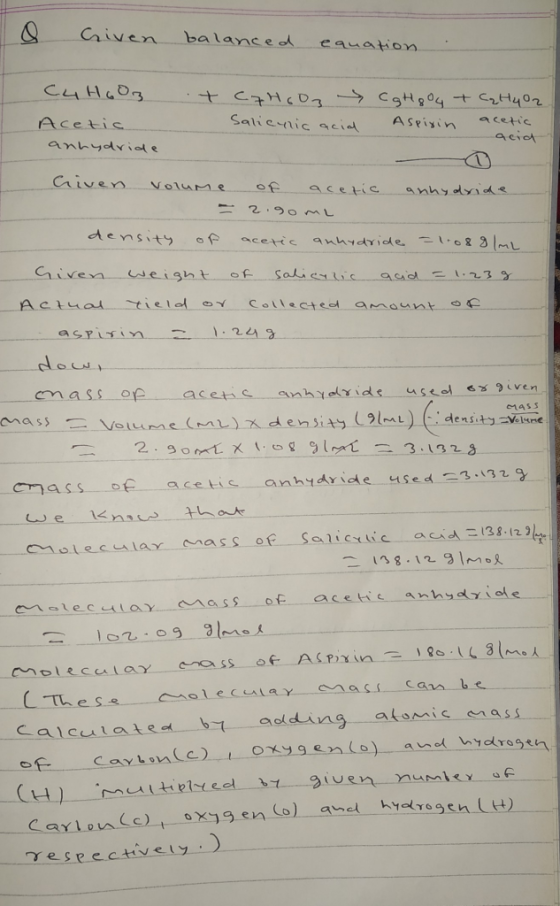
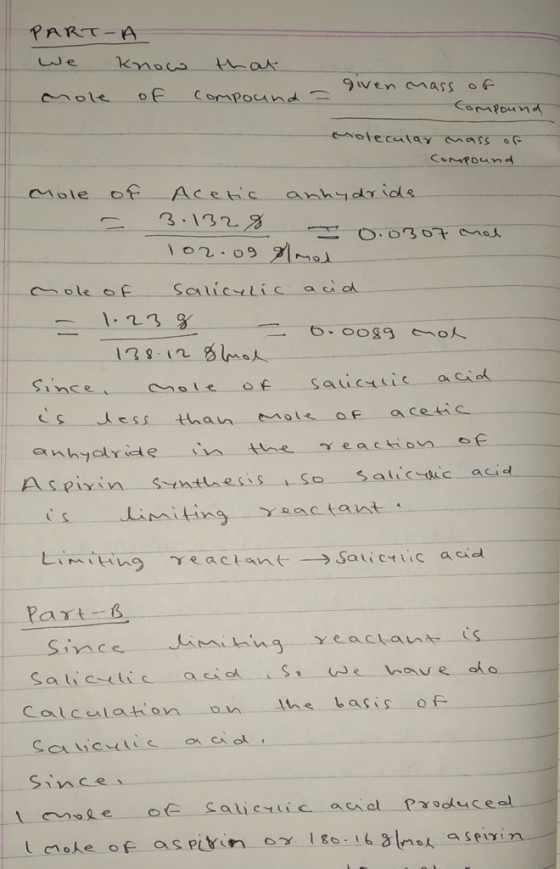
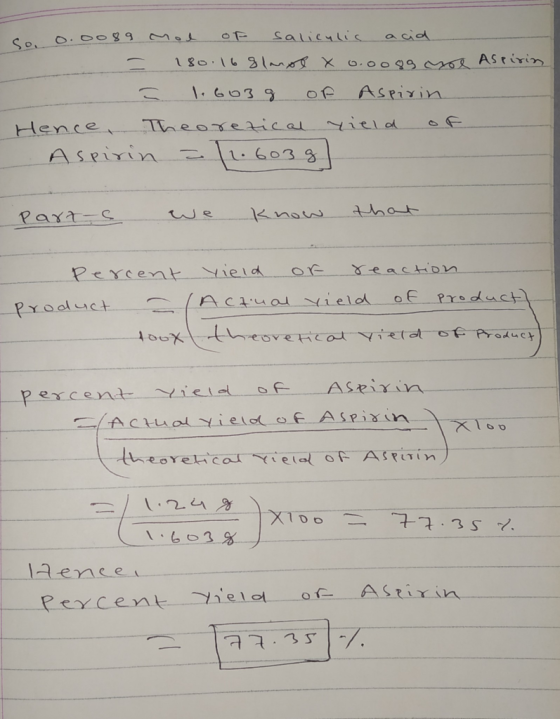
Aspirin can be made in the laboratory by reacting acetic anhydride (C4H6O3) with salicylic acid (C7H6O3) to form aspirin (C9H8O4) and acetic acid (C2H4O2). The balanced equation is C4H6O3+C7H6O3→C9H8O4+C2H4O2.In a laboratory synthesis, a student begins with 2.90 mL of acetic anhydride (density=1.08g/ml) and 1.26 g of salicylic acid. Once the reaction is complete, the student collects 1.22 g of aspirin. Determine the theoretical yield of aspirin for the reaction. Determine the percent yield of aspirin for the reaction.
Aspirin can be made in the laboratory by reacting acetic anhydride (C4H6O3) with salicylic acid (C7H6O3)...
Aspirin can be made in the laboratory by reacting acetic anhydride (C4H6O3) with salicylic acid (C7H6O3) to form aspirin (C9H8O4) and acetic acid (C2H4O2). The balanced equation is C4H6O3+C7H6O3→C9H8O4+C2H4O2 In a laboratory synthesis, a student begins with 3.10 mL of acetic anhydride (density=1.08g/ml) and 1.24 g of salicylic acid. Once the reaction is complete, the student collects 1.21 g of aspirin. Determine the theoretical yield of aspirin for the reaction. And determine the percent yield of aspirin for the reaction.
Aspirin can be made by reacting acetic anhydride (C4H6O3) with salicylic acid (C7H6O3) to form aspirin...
Aspirin can be made by reacting acetic anhydride (C4H6O3) with salicylic acid (C7H6O3) to form aspirin (C9H8O4). C4H6O3 + C7H6O3 --> C2H4O2 + C9H8O4 When synthesizing aspirin, a student began with 3.05 mL of acetic anhydride (density = 1.08 g/mL) and 1.85 g of salicylic acid. The reaction was allowed to run its course and 1.84 grams of aspirin was collected by the student. Determine the limiting reactant, theoretical yield of aspirin, and percent yield for the reaction.
Aspirin can be synthesized in the lab by combining salicylic acid (C7H6O3) and acetic anhydride (C4H6O3)...
Aspirin can be synthesized in the lab by combining salicylic acid (C7H6O3) and acetic anhydride (C4H6O3) to form aspirin (C9H8O4) and acetic acid (C2H4O2).C2H4O2). The balanced equation for this reaction is C7H6O3+C4H6O3⟶C9H8O4+C2H4O2 A student started with 4.00 mL acetic anhydride (density=1.08 g/mL) and 2.07 g salicylic acid. The student synthesized 2.00 g of aspirin. Select the limiting reactant. acetic acid (C2H4O2) salicylic acid (C7H6O3) aspirin (C9H8O4) acetic anhydride (C4H6O3) Calculate the theoretical yield of aspirin (C9H8O4). theoretical yield: Calculate the...
Aspirin can be sunthesized in the lab by combining salicylic acid (C7H6O3) and acetic anhydride (C4H6O3)...
Aspirin can be sunthesized in the lab by combining salicylic acid (C7H6O3) and acetic anhydride (C4H6O3) to form aspirin (C9H8O4) and acetic acid (C2H4O2). The balanced equation for this reaction is C7H6O3+C4H6O3⟶C9H8O4+C2H4O2 A student started with 4.45 mL acetic anhydride (density=1.08 g/mL) and 2.34 g salicylic acid. The student synthesized 2.47 g of aspirin. Calculate the theoretical yield of aspirin (C9H8O4) in grams Calculate the percent yield for aspirin (C9H8O4)
10) A student prepares aspirin (acetylsalicylic acid, C,H,0.) by reacting salicylic acid (C,H,O,) with acetic anhydride...
 10) A student prepares aspirin (acetylsalicylic acid, C,H,0.) by reacting salicylic acid (C,H,O,) with acetic anhydride (C.H.O.). The balanced equation for the reaction is: 2 C,H,O, + C,H,O, + 2 C,H,O, + H,O The lab calls for 3.00 g of salicylic acid to be mixed with 6.40 g of acetic anhydride. What is the limiting reagent and what is the maximum amount of aspirin which can be prepared if the yield for the reaction is 91%?
QUESTION 3 Salicylic acid reacts with acetic anhydride to form aspirin and acetic acid as shown. Use the equation to answer Questions 3 – 6. (salicylic acid) ...
QUESTION 3 Salicylic acid reacts with acetic anhydride to form aspirin and acetic acid as shown. Use the equation to answer Questions 3 – 6. (salicylic acid) (aspirin) C7H6O3 (s) + C4H6O3 (l) → C9H8O4 (s) + CH3COOH (l) MM = 138 MM = 180 If we divide 180 by 138 we find that 1.00 g salicylic acid will produce a maximum of 1.30 g aspirin. 3. A student starts with 3.20 g salicylic acid. What is the maximum amount...
1. Mass of salicylic acid (g) 2.0089 5.10ml & 2. Volume of acetic anhydride (mL) Limiting...
 1. Mass of salicylic acid (g) 2.0089 5.10ml & 2. Volume of acetic anhydride (mL) Limiting reactant is (circle one): Salicylic Acid or Acetic Anhydride Calculation for Limiting Reactant: 3. Theoretical yield of aspirin (9) Calculation for Theoretical Yield of aspirin: 4. Mass of filter paper 0.3369 N 5. Mass of filter paper + aspirin 2.471g 6. Experimental Yield of aspirin (g) 7. Percent Yield Synthesis of Aspirin An early oral pain reliever, salicylic acid, was determined to cause stomach...
The reaction of salicylic acid, C7H6O3, with acetic anhydride, C4H6O3, forms the compound known as aspirin...
The reaction of salicylic acid, C7H6O3, with acetic anhydride, C4H6O3, forms the compound known as aspirin (acetylsalicylic acid), C9H8O4, and acetic acid (CH3COOH). A. Write the balanced equation for this reaction. B. Determine the limiting reagent for the production of aspirin if 3.25 g of each reagent is used. C. Calculate the theoretical yield in g of aspirin. D. What mass of the reagent that was NOT limiting remains at the end of the reaction? Please respond in a clear,...
 10) A student prepares aspirin (acetylsalicylic acid, C,H,0.) by reacting salicylic acid (C,H,O,) with acetic anhydride (C.H.O.). The balanced equation for the reaction is: 2 C,H,O, + C,H,O, + 2 C,H,O, + H,O The lab calls for 3.00 g of salicylic acid to be mixed with 6.40 g of acetic anhydride. What is the limiting reagent and what is the maximum amount of aspirin which can be prepared if the yield for the reaction is 91%?
 1. Mass of salicylic acid (g) 2.0089 5.10ml & 2. Volume of acetic anhydride (mL) Limiting reactant is (circle one): Salicylic Acid or Acetic Anhydride Calculation for Limiting Reactant: 3. Theoretical yield of aspirin (9) Calculation for Theoretical Yield of aspirin: 4. Mass of filter paper 0.3369 N 5. Mass of filter paper + aspirin 2.471g 6. Experimental Yield of aspirin (g) 7. Percent Yield Synthesis of Aspirin An early oral pain reliever, salicylic acid, was determined to cause stomach...
Most questions answered within 3 hours.
-
Where is the error in this code sequence?
String s1 = "Hello";
String s2 = "ello";...
asked 11 months ago -
Financial data for Joel de Paris, Inc., for last year
follow:
Joel de Paris, Inc.
Balance...
asked 11 months ago -
Consider this reaction:
Al2(SO4)3 (aq)+ BaCl3
(aq) Al2Cl6 (aq)- +
3BaSO4(s) . What is the...
asked 11 months ago -
Suppose that Savneet is considering increasing her
recent random sample from 20 car rentals to 40...
asked 11 months ago -
Trucks arrive at an unloading terminal at an average rate of 120
per hour.
Trucks arrive...
asked 11 months ago -
Why are methanol and ethanol completely soluble in water while
octanol is not very little soluble....
asked 11 months ago -
A facilities manager at a university reads in a research report
that the mean amount of...
asked 11 months ago -
When the CuSO4 is rehydrated by adding water to the anhydrous
compound, is this an endothermic...
asked 11 months ago -
A ray of sunlight is passing from diamond into crown glass; the
angle of incidence is...
asked 11 months ago -
A block of mass 0.249 kg is placed on top of a light, vertical
spring of...
asked 11 months ago -
how do the kidneys compensate in the presences of acidosis
a) trigger hyperventilate
b) reserve acid...
asked 11 months ago -
Question 501 pts
The rental rate of capital to the firm increases. Which of the
following...
asked 11 months ago