Calculate (A⃗ ×B⃗ )⋅C⃗ for the three vectors A⃗ with magnitude A = 4.98 and angle...
Calculate (A⃗ ×B⃗ )⋅C⃗ for the three vectors A⃗ with magnitude A = 4.98 and angle θA = 27.1 ∘ measured in the sense from the +x - axis toward the +y - axis, B⃗ with B = 4.06 and θB = 60.6 ∘, and C⃗ with magnitude C = 6.00 and in the +z - direction. Vectors A⃗ and B⃗ are in the xy-plane.
Homework Answers

Add Answer to:
Calculate (A⃗ ×B⃗ )⋅C⃗ for the three vectors A⃗ with magnitude A
= 4.98 and angle...
Vector A⃗ has magnitude 8.80 m and is in the xy-plane at an angle of 128 degrees...
Vector A⃗ has magnitude 8.80 m and is in the xy-plane at an angle of 128 degrees counterclockwise from the +x–axis (38 degrees past the +y-axis). The sum A⃗ +B⃗ is in the −y-direction and has magnitude 12.0 m. a) What is the magnitude of vector B⃗ ? b)What is the direction angle of vector B⃗ measured counterclockwise from the +x-axis?
A⃗ is 75.0 m long at a 28∘angle with respect to the +x axis. B⃗ is...
A⃗ is 75.0 m long at a 28∘angle with respect to the +x axis. B⃗ is 45.0 m long at a 56∘ angle above the -x axis. 1)What is the magnitude of the sum of vectors A⃗ and B⃗? (Express your answer to two significant figures.) 2)What is the angle with the +x axis of the sum of vectors A⃗ and B⃗ ? (Express your answer to two significant figures.)
Consider vectors A⃗ = 2.0 ι^ + 3.0j^ and B⃗ = -4.0ι^ + 5.0 j^. 1. Calculate A⃗ +...
Consider vectors A⃗ = 2.0 ι^ + 3.0j^ and B⃗ = -4.0ι^ + 5.0 j^. 1. Calculate A⃗ + B⃗ . Express your answer as xι^+yj^. 2. Calculate A⃗ - B⃗ . Express your answer as xι^+yj^. 3. If the direction (but not the magnitude) of B⃗ is allowed to change by any amount you like, how large can |A⃗ + B⃗ | be? 4. If the direction (but not the magnitude) of B⃗ is allowed to change by any amount you like, how small can |A⃗ +...
Vector A⃗ has a magnitude of 30.0 m and makes an angle of 30∘ above the...
Vector A⃗ has a magnitude of 30.0 m and makes an angle of 30∘ above the positive x axis. Vector B⃗ has a magnitude of 13.0 m and is oriented 60∘ to the left of the y axis. A)Find the magnitude of A⃗ −B⃗ . B)Find the direction of A⃗ −B⃗ . C)Find the magnitude of 2A⃗ +B⃗ D)Find the direction of 2A⃗ +B⃗ . E)Find the magnitude of −A⃗ +3B⃗ . F)Find the direction of −A⃗ +3B⃗ .
Vector A⃗ has a magnitude of 4.0 units in the negative y direction. Vector B⃗ has...
Vector A⃗ has a magnitude of 4.0 units in the negative y direction. Vector B⃗ has a positive x component of 4.0 units and a negative y component of 9.0 units. A) What is the angle between the vectors? B) Determine A⃗ * B⃗
Vector A⃗ has a magnitude of 29 m and makes an angle of 30∘ above the...
Vector A⃗ has a magnitude of 29 m and makes an angle of 30∘ above the positive x axis. Vector B⃗ has a magnitude of 10 m and is oriented 60∘ to the left of the y axis. Find the magnitude and direction of: a) A⃗ − B⃗ b) 2A⃗ + B⃗ c) −A⃗ + 3B⃗
Problem 6: Problem 1.86 in Young &Freedman Later in our study of physics we will encounuanties...
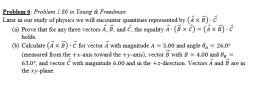 Problem 6: Problem 1.86 in Young &Freedman Later in our study of physics we will encounuanties represented by (AxB) c. (a) Prove that for any three vectors A, B, and C, the equality A . (BX C)-ИХ B) . C holds (b) Calculate (AX B) . C for vector A with magnitude A-5.00 and angle θ,-26.00 (measured from the +x-axis toward the +y-axis), vector B with B = 4.00 and θ,- 63.0% and vector C with magnitude 6.00 and in...
Vectors A and B lie in an xy plane. A has magnitude 8.5 and angle 101...
 Vectors A and B lie in an xy plane. A has magnitude 8.5 and
angle 101 degrees relative to +x direction; B has components Bx=
-8.32 and By= -6.42. What are the angles between the negative
direction of the y axis and (a) the direction of A (b) the
direction of the product A x B, and (c) the direction of A x (B +
3.00k)?
Chapter 03, Prablem 047 What are the angles between the negative relative to +薫direction;...
Vectors A and B lie in an xy plane. A has magnitude 8.5 and
angle 101 degrees relative to +x direction; B has components Bx=
-8.32 and By= -6.42. What are the angles between the negative
direction of the y axis and (a) the direction of A (b) the
direction of the product A x B, and (c) the direction of A x (B +
3.00k)?
Chapter 03, Prablem 047 What are the angles between the negative relative to +薫direction;...
Three vectors a → , b → , and c → , each have a magnitude...
Three vectors a → , b → , and c → , each have a magnitude of 43.0 m and lie in an xy plane. Their directions relative to the positive direction of the x axis are 26.0 ˚, 192 ˚, and 313 ˚, respectively. What are (a) the magnitude and (b) the angle of the vector a → + b → + c → (relative to the +x direction in the range of (-180°, 180°)), and (c) the magnitude...
Three vectors a → , b → , and c → , each have a magnitude...
Three vectors a → , b → , and c → , each have a magnitude of 48.0 m and lie in an xy plane. Their directions relative to the positive direction of the x axis are 32.0 ˚, 193 ˚, and 313 ˚, respectively. What are (a) the magnitude and (b) the angle of the vector a → + b → + c → (relative to the +x direction in the range of (-180°, 180°)), and (c) the magnitude...
 Problem 6: Problem 1.86 in Young &Freedman Later in our study of physics we will encounuanties represented by (AxB) c. (a) Prove that for any three vectors A, B, and C, the equality A . (BX C)-ИХ B) . C holds (b) Calculate (AX B) . C for vector A with magnitude A-5.00 and angle θ,-26.00 (measured from the +x-axis toward the +y-axis), vector B with B = 4.00 and θ,- 63.0% and vector C with magnitude 6.00 and in...
 Vectors A and B lie in an xy plane. A has magnitude 8.5 and
angle 101 degrees relative to +x direction; B has components Bx=
-8.32 and By= -6.42. What are the angles between the negative
direction of the y axis and (a) the direction of A (b) the
direction of the product A x B, and (c) the direction of A x (B +
3.00k)?
Chapter 03, Prablem 047 What are the angles between the negative relative to +薫direction;...
Vectors A and B lie in an xy plane. A has magnitude 8.5 and
angle 101 degrees relative to +x direction; B has components Bx=
-8.32 and By= -6.42. What are the angles between the negative
direction of the y axis and (a) the direction of A (b) the
direction of the product A x B, and (c) the direction of A x (B +
3.00k)?
Chapter 03, Prablem 047 What are the angles between the negative relative to +薫direction;...
Most questions answered within 3 hours.
-
Where is the error in this code sequence?
String s1 = "Hello";
String s2 = "ello";...
asked 10 months ago -
Financial data for Joel de Paris, Inc., for last year
follow:
Joel de Paris, Inc.
Balance...
asked 10 months ago -
Consider this reaction:
Al2(SO4)3 (aq)+ BaCl3
(aq) Al2Cl6 (aq)- +
3BaSO4(s) . What is the...
asked 10 months ago -
Suppose that Savneet is considering increasing her
recent random sample from 20 car rentals to 40...
asked 10 months ago -
Trucks arrive at an unloading terminal at an average rate of 120
per hour.
Trucks arrive...
asked 10 months ago -
Why are methanol and ethanol completely soluble in water while
octanol is not very little soluble....
asked 10 months ago -
A facilities manager at a university reads in a research report
that the mean amount of...
asked 10 months ago -
When the CuSO4 is rehydrated by adding water to the anhydrous
compound, is this an endothermic...
asked 10 months ago -
A ray of sunlight is passing from diamond into crown glass; the
angle of incidence is...
asked 10 months ago -
A block of mass 0.249 kg is placed on top of a light, vertical
spring of...
asked 10 months ago -
how do the kidneys compensate in the presences of acidosis
a) trigger hyperventilate
b) reserve acid...
asked 10 months ago -
Question 501 pts
The rental rate of capital to the firm increases. Which of the
following...
asked 10 months ago