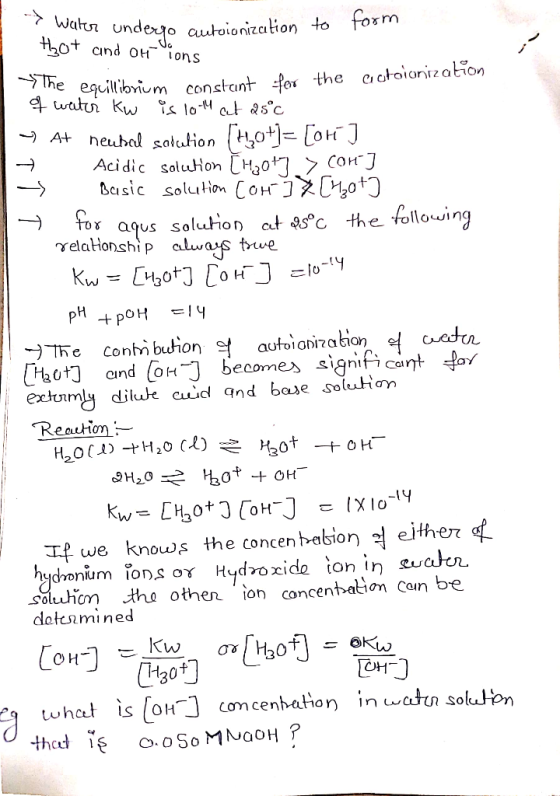
Write the chemical reaction for the auto-ionizatooj for water and the Kw expression in terms of...
Homework Answers
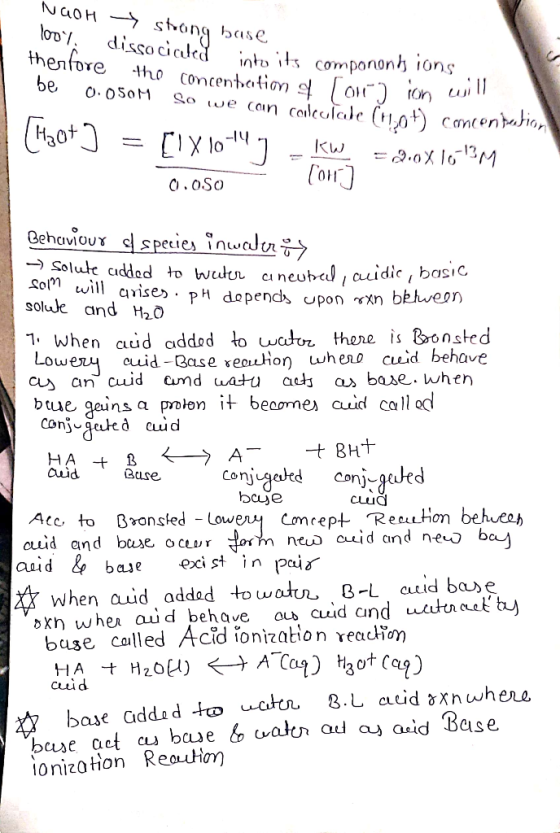
Be able to identify or provide the conjugate acids and conjugate bases of any acid or base.
Remember, a conjugate
base will have one less hydrogen than the acid and the conjugate acid will have one more hydrogen.
Keep your
charges straight. Remember the hydrogen is removed as a proton.
Categories of behavior of solutes in water –
what are the major species in water
1) If a solute has strong covalent bonds there is no reaction between solute and water. The pH will be
unchanged when the solute dissolves. These are molecules with no H in the formula or contain an H that will
not come off easily such as that found in methanol (CH3OH), ethanol (CH3CH2OH) or alkane chains such as
butane (CH3CH2CH2CH3)
2) The solute is covalent and undergoes a reaction with water to produce a proton.
a) There is a complete reaction with water when the solute is a strong acid (HClO4, H2SO4, HNO3, HI,
HBr, HCl0) There will be no undissociated acid molecules left. The major species in solution after this
reaction will be the conjugate base, H3O
+
, the anion, and H2O
HNO3(aq) + H2O(l) -> NO3-(aq) + H3O+(aq)
b) There is a partial reaction with water when the solute is a weak acid. Any acid that is not a strong acid is considered to be a weak acid. There will be an equilibrium and the major species in solution will be the weak acid and water. There will be small amounts of the conjugate base and the hydronium ion.
HF(aq) + H2O(l) -> F-(aq) + H3O+(aq) (acid ionization)
3) The solute is ionic. It will dissociate into ions and the component ions may undergo reaction with water.
a) Strong bases will dissociate to form OH-. Strong bases are the hydroxides of Group I and Group II
metals. (NaOH and KOH are common strong bases. LiOH, RbOH, and CsOH are less common
strong bases. Ca(OH)2, Ba(OH)2 and Sr(OH)2 will produce two moles OH-
per mole of solid). These strong bases will completely dissociate in water. The major species in water will be the metal ion, the hydroxide ion and the water
The reaction of interest is:
OH-(aq) + H2O(l) -> H2O(l) + OH-(aq). Since there is no net change
in the molecules present after the reaction, it is sufficient to know that the base dissociates in water.
b) anion example: NaCN(aq) -> Na+(aq) + CN-(aq)
Na+ + H2O -> no reaction
CN- + H2O -> HCN + OH- (base ionization)
c) cation example CH3NH3Cl(aq) -> CH3NH3 (aq) + Cl- (aq)
Cl-(aq) + H2O(l) -> no reaction
CH3NH3+(aq) + H2O(l) -> CH3NH2-(aq) + H3O+(aq) acid ionization
Be able to write the chemical equations that show the acid base reaction of solutes in water.
☆Acid Ionization, Ka and pKa ->
The acid ionization reaction is the transfer of a proton from the acid to water.
HA(aq) + H2O(l) -> A-(aq) + H3O+(aq)
The equilibrium expression for this reaction is
Keq = [A-][H3O+]/[HA] = Ka
For the acid ionization, Keq is written Ka and is called the acid dissociation constant.
Ka values allow one to compare the strength of acids. Since it is an equilibrium constant, the larger the Ka, the more products there are, which means there will have been more dissociation of the acid and more protons formed. Thus, the larger the Ka, the stronger the acid. For strong acids, the reaction lies so far to the right that [HA] is very small and it is difficult to determine the Ka accurately. However, comparing the values of weak acids is very useful.
The p notation can be employed, such that pKa = -log(Ka).
Note that the larger the Ka, the smaller the pKa. Thus the stronger the acid, the smaller the pKa.
Although we will discuss bases more later, a comment can be made now on the relative strength of bases. The relative strength of an acid is based on the extent to which it produces protons. The relative strength of a base depends on its affinity for a proton. The greater the affinity, the stronger the base.
In general, the stronger acid will produce a weaker conjugate base.
Consider:
HF(aq) + H2O(l) -> F-(aq) + H3O+
(aq) Ka = 7.2 x 10⁻⁴
CH3COOH(aq) + H2O(l) -> CH3COO- + H3O+
Ka = 1.85 x 10⁻⁵
In the first reaction there is a competition between H2O and F-for the proton.
In the second reaction there is a competition between H2O and CH3COO-for the proton.
The first reaction lies further to the right than the second reaction. Thus water can steal the proton from F-easier than from CH3COO-. Thus, F- is the weaker base and HF is the stronger acid.
That is – the stronger the acid, the weaker the conjugate base or the weaker the base, the
stronger the acid
Add Answer to:
Write the chemical reaction for the auto-ionizatooj for water and
the Kw expression in terms of...
Write the chemical equilibrium reaction for the auto-ionization of water. Label each chemical with its appropriate...
 Write the chemical equilibrium reaction for the auto-ionization of water. Label each chemical with its appropriate phase designation (solid. liq, gas, or aqueous). Also express the Kw for this process along with its value. 14.
a. Write the reaction for a monoprotic acid HA with water and its equilibrium constant expression...
 a. Write the reaction for a monoprotic acid HA with water and its equilibrium constant expression (K) b. Write the reaction for the conjugate base of HA with water and its equilibrium constant expression (Kb) c. Write the reaction for the auto-ionization of water and its equilibrium constant expression (Kw) d. Use the equilibrium expressions for Ka and Ko to prove that K Kb = Kw. What is the physical significance of the KaKb = Kw relationship?
Question 11 of 17 > Write the chemical reaction for the ammonium ion in water, whose...
 Question 11 of 17 > Write the chemical reaction for the ammonium ion in water, whose equilibrium constant is K, Include the physical states for each species. K, reaction: Write the chemical reaction for ammonia in water, whose equilibrium constant is ks. Include the physical states for each species Ky reaction:
1) Write the chemical reaction for hydrogen thiocyanate in water, whose equilibrium constant is ?a. Include...
1) Write the chemical reaction for hydrogen thiocyanate in water, whose equilibrium constant is ?a. Include the physical states for each species. ?a reaction: Write the chemical reaction for the thiocyanate ion in water, whose equilibrium constant is ?b. Include the physical states for each species. ?b reaction: 2) Enough of a monoprotic acid is dissolved in water to produce a 1.24 M solution. The pH of the resulting solution is 2.84 Calculate the Ka for the acid. ?a= 3)...
Write the balanced chemical equation for the reaction of the weak acid HCN with water. Include...
 Write the balanced chemical equation for the reaction of the weak acid HCN with water. Include the phase of each species chemical equation Complete the Ka expression for this reaction. Answer Bank H,O] [он ] Ка [CN HCN Sc H0* Screen
For each chemical listed write the reaction of these ions in water. Include the phases of...
For each chemical listed write the reaction of these ions in water. Include the phases of all species. Identify and label the conjugate pairs in your reaction and write the equilibrium constant for each of the reactions you propose. Please write out all answers step-by-step :-) a. HPO3 2- b. F - c. HCO3 -
Write the balanced chemical equation for the reaction of the weak acid HCN with water. Include...
 Write the balanced chemical equation for the reaction of the weak acid HCN with water. Include the phase of each species. chemical equation: HCNaq +H,9, H,09 + CNaq Complete the K, expression for this reaction. Answer Bank Ka= [ H0] (CN) [,0] HCN] [OH) [H]
can someone help me? im really confused Write the Kw expression for water Why isn't water...
 can
someone help me? im really confused
Write the Kw expression for water Why isn't water written in the Kw expression for water?
can
someone help me? im really confused
Write the Kw expression for water Why isn't water written in the Kw expression for water?
Write the chemical reaction for the autoionization of water (equilibrium constant Kw). Look up the numerical...
Write the chemical reaction for the autoionization of water (equilibrium constant Kw). Look up the numerical value for Kw at Tinitial (Use the average of Tinitial from both trials) -Its 6.81x10^-15 How is the equation in Question 1 related to the net ionic equation for the strong acid-strong base neutralization shown below? H3O+(aq) + OH-(aq) → H2O(l) + H2O(l) Use the value of Kw and the relationship between the equations in Questions 1 and 3 to find the numerical value...
The value of the equilibrium constant for the following chemical reaction (the auto-ionization of water) is...
The value of the equilibrium constant for the following chemical reaction (the auto-ionization of water) is 1.0x10⁻¹⁴ at 298 K. 2H2O(l) ßà OH-(aq) + H3O+(aq) K = 1.0x10⁻¹⁴ Using this information and your equilibrium identities, select the correct value for the equilibrium expression for the following chemical reaction (at 298 K as well): 6H2O(l) ßà 3OH-(aq) + 3H3O+(aq) K = ? Question 5 options: 1x10¹⁴ 1x10-28 1x10-14 1x10-42 3x10-14 1x10-15
 Write the chemical equilibrium reaction for the auto-ionization of water. Label each chemical with its appropriate phase designation (solid. liq, gas, or aqueous). Also express the Kw for this process along with its value. 14.
 a. Write the reaction for a monoprotic acid HA with water and its equilibrium constant expression (K) b. Write the reaction for the conjugate base of HA with water and its equilibrium constant expression (Kb) c. Write the reaction for the auto-ionization of water and its equilibrium constant expression (Kw) d. Use the equilibrium expressions for Ka and Ko to prove that K Kb = Kw. What is the physical significance of the KaKb = Kw relationship?
 Question 11 of 17 > Write the chemical reaction for the ammonium ion in water, whose equilibrium constant is K, Include the physical states for each species. K, reaction: Write the chemical reaction for ammonia in water, whose equilibrium constant is ks. Include the physical states for each species Ky reaction:
 Write the balanced chemical equation for the reaction of the weak acid HCN with water. Include the phase of each species chemical equation Complete the Ka expression for this reaction. Answer Bank H,O] [он ] Ка [CN HCN Sc H0* Screen
 Write the balanced chemical equation for the reaction of the weak acid HCN with water. Include the phase of each species. chemical equation: HCNaq +H,9, H,09 + CNaq Complete the K, expression for this reaction. Answer Bank Ka= [ H0] (CN) [,0] HCN] [OH) [H]
 can
someone help me? im really confused
Write the Kw expression for water Why isn't water written in the Kw expression for water?
can
someone help me? im really confused
Write the Kw expression for water Why isn't water written in the Kw expression for water?
Most questions answered within 3 hours.
-
Where is the error in this code sequence?
String s1 = "Hello";
String s2 = "ello";...
asked 10 months ago -
Financial data for Joel de Paris, Inc., for last year
follow:
Joel de Paris, Inc.
Balance...
asked 10 months ago -
Consider this reaction:
Al2(SO4)3 (aq)+ BaCl3
(aq) Al2Cl6 (aq)- +
3BaSO4(s) . What is the...
asked 10 months ago -
Suppose that Savneet is considering increasing her
recent random sample from 20 car rentals to 40...
asked 10 months ago -
Trucks arrive at an unloading terminal at an average rate of 120
per hour.
Trucks arrive...
asked 10 months ago -
Why are methanol and ethanol completely soluble in water while
octanol is not very little soluble....
asked 10 months ago -
A facilities manager at a university reads in a research report
that the mean amount of...
asked 10 months ago -
When the CuSO4 is rehydrated by adding water to the anhydrous
compound, is this an endothermic...
asked 10 months ago -
A ray of sunlight is passing from diamond into crown glass; the
angle of incidence is...
asked 10 months ago -
A block of mass 0.249 kg is placed on top of a light, vertical
spring of...
asked 10 months ago -
how do the kidneys compensate in the presences of acidosis
a) trigger hyperventilate
b) reserve acid...
asked 10 months ago -
Question 501 pts
The rental rate of capital to the firm increases. Which of the
following...
asked 10 months ago