
Homework Answers
Add Answer to:
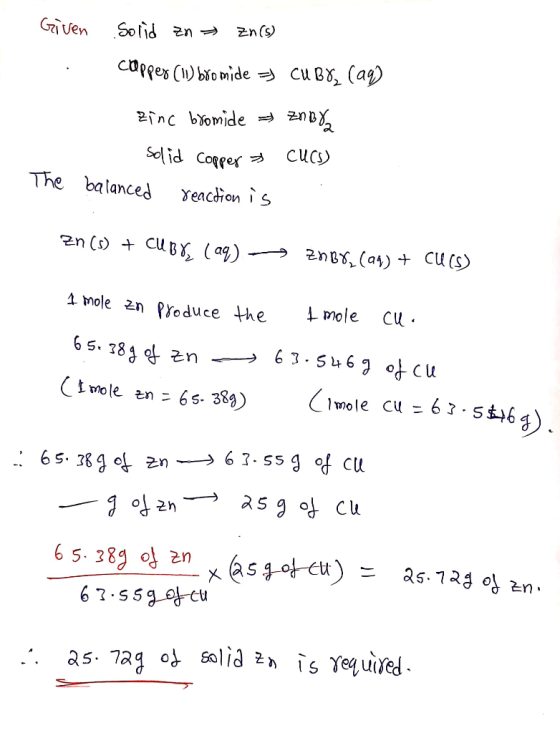
7. Solid zinc and aqueous copper (II) bromide react in a single replacement reaction producing zinc...
#13 Write a chemical equation for the reaction of zinc metal with aqueous copper (II) nitrate...
#13 Write a chemical equation for the reaction of zinc metal with aqueous copper (II) nitrate to produce aqueous zinc (II) nitrate and copper metal. #17 Potassium chlorate decomposes to potassium chloride and oxygen, as shown in the equation below. 2 KClO3 (s) → 2 KCl (s) + 3 O2 (g) How many grams of oxygen are produced if 148 grams of potassium chloride are produced from the decomposition of 244 grams of potassium chlorate? #18 If the student collected...
Aqueous solutions of lead(II) nitrate and sodium chloride react to form solid lead(II) chloride and aqueous...
Aqueous solutions of lead(II) nitrate and sodium chloride react to form solid lead(II) chloride and aqueous sodium nitrate according to the reaction below. Pb(NO3)2 (aq) + 2 NaCl (aq) → 2 NaNO3 (aq) + PbCl2 (s) What is the molarity of the sodium chloride solution if 85.0 mL of it will produce 5.97 g of the lead(II) chloride? Question 16 (1 point) Aqueous solutions of copper (II) bromide and silver (I) acetate react to form solid silver (I) bromide and...
16 Cts with aqueous copper(II) chloride accord- 101. Zinc metal reacts with aqueous copper(1) ing to...
 16 Cts with aqueous copper(II) chloride accord- 101. Zinc metal reacts with aqueous copper(1) ing to this equation: Zn (s) + CuCl2 (aq) → ZnCl2 (aq) + Cu (s) In this reaction, what mass of copper metal can be pro- duced from the reaction of 500 mL of 1.20-M aq. cu 2 with excess zinc? 10 103. The concentration of bromide ion may be determined by gravimetric analysis, using this reaction: Ag+ (aq) + Br (aq) → AgBr (s) A...
please help!! 2. When zinc metal reacts with copper(II) nitrate, zinc(II) nitrate and copper metal are...
 please help!!
2. When zinc metal reacts with copper(II) nitrate, zinc(II) nitrate and copper metal are the products. How many grams of zinc metal are required to react completely with 725 mL of 0.1955 M copper (II) nitrate solution? What mass of copper metal is produced? You will need a balanced equation to solve this problem! 3. One step in the process of manufacturing nitric acid (HNO3), a staple industrial chemical, is 3 NO2 (g) + H20 (1) ► 2HNO3...
please help!!
2. When zinc metal reacts with copper(II) nitrate, zinc(II) nitrate and copper metal are the products. How many grams of zinc metal are required to react completely with 725 mL of 0.1955 M copper (II) nitrate solution? What mass of copper metal is produced? You will need a balanced equation to solve this problem! 3. One step in the process of manufacturing nitric acid (HNO3), a staple industrial chemical, is 3 NO2 (g) + H20 (1) ► 2HNO3...
1) When aqueous solutions of copper(II) iodide and potassium carbonate are combined, solid copper(II) carbonate and...
1) When aqueous solutions of copper(II) iodide and potassium carbonate are combined, solid copper(II) carbonate and a solution of potassium iodide are formed. The net ionic equation for this reaction is: 2) When aqueous solutions of sodium cyanide and hydrobromic acid are mixed, an aqueous solution of sodium bromide and hydrocyanic acid results. Write the net ionic equation for the reaction. 3) When solid Zn metal is put into an aqueous solution of NiSO4, solid Ni metal and a solution...
Consider that copper (II) oxide and aluminum metal undergo a single replacement reaction. If you begin...
Consider that copper (II) oxide and aluminum metal undergo a single replacement reaction. If you begin with 95.42 g of copper (II) oxide and 106.55 g of aluminum, how much of your excess reagent (in grams) will be leftover if the reaction goes to 100% completion? Hint: Finding your limiting reagent will help.
Consider that copper (II) oxide and aluminum metal undergo a single replacement reaction. If you begin...
Consider that copper (II) oxide and aluminum metal undergo a single replacement reaction. If you begin with 448.74 g of copper (II) oxide and 88.49 g of aluminum, how much of your excess reagent (in grams) will be leftover if the reaction goes to 100% completion? Hint: Finding your limiting reagent will help. follow sig fig rules
Write the net ionic equation for the reaction of zinc metal with aqueous copper(II) nitrate. Include...
Write the net ionic equation for the reaction of zinc metal with aqueous copper(II) nitrate. Include physical states. net ionic equation:
71. The reaction between Copper (II) Chloride and Sodium Nitrate is a simple double replacement reaction....
 71. The reaction between Copper (II) Chloride and Sodium Nitrate is a simple double replacement reaction. a) Write and balance the reaction between Copper (II) Chloride and Sodium Nitrate b) If 15.0 grams of Copper (II) Chloride react with 20.0 grams of Sodium Nitrate, what is the theoretical yield for Sodium Chloride? A d oi mlbo2 d tal do oA oholdoony2o no d s What is the limiting reagent for this reaction? c) nWnoitulo e chododes sis o bo ei...
In lab, you reacted copper metal with aqueous nitric acid to produce aqueous copper (II) nitrate,...
In lab, you reacted copper metal with aqueous nitric acid to produce aqueous copper (II) nitrate, nitrogen dioxide gas and water. Cu (s) + 4HNO3 (aq) ---- > Cu(NO3)2 (aq) + 2NO2 (g) + 2H2O (l) a) If 0.210 gram of copper is reacted with 35.0 mL of 0.551 mol/L nitric acid, how many molecules and how grams of copper (II) nitrate are produced? b) How many moles of the reagent that is in excess are left over? c) If...
 16 Cts with aqueous copper(II) chloride accord- 101. Zinc metal reacts with aqueous copper(1) ing to this equation: Zn (s) + CuCl2 (aq) → ZnCl2 (aq) + Cu (s) In this reaction, what mass of copper metal can be pro- duced from the reaction of 500 mL of 1.20-M aq. cu 2 with excess zinc? 10 103. The concentration of bromide ion may be determined by gravimetric analysis, using this reaction: Ag+ (aq) + Br (aq) → AgBr (s) A...
 please help!!
2. When zinc metal reacts with copper(II) nitrate, zinc(II) nitrate and copper metal are the products. How many grams of zinc metal are required to react completely with 725 mL of 0.1955 M copper (II) nitrate solution? What mass of copper metal is produced? You will need a balanced equation to solve this problem! 3. One step in the process of manufacturing nitric acid (HNO3), a staple industrial chemical, is 3 NO2 (g) + H20 (1) ► 2HNO3...
please help!!
2. When zinc metal reacts with copper(II) nitrate, zinc(II) nitrate and copper metal are the products. How many grams of zinc metal are required to react completely with 725 mL of 0.1955 M copper (II) nitrate solution? What mass of copper metal is produced? You will need a balanced equation to solve this problem! 3. One step in the process of manufacturing nitric acid (HNO3), a staple industrial chemical, is 3 NO2 (g) + H20 (1) ► 2HNO3...
 71. The reaction between Copper (II) Chloride and Sodium Nitrate is a simple double replacement reaction. a) Write and balance the reaction between Copper (II) Chloride and Sodium Nitrate b) If 15.0 grams of Copper (II) Chloride react with 20.0 grams of Sodium Nitrate, what is the theoretical yield for Sodium Chloride? A d oi mlbo2 d tal do oA oholdoony2o no d s What is the limiting reagent for this reaction? c) nWnoitulo e chododes sis o bo ei...
Most questions answered within 3 hours.
-
Where is the error in this code sequence?
String s1 = "Hello";
String s2 = "ello";...
asked 10 months ago -
Financial data for Joel de Paris, Inc., for last year
follow:
Joel de Paris, Inc.
Balance...
asked 10 months ago -
Consider this reaction:
Al2(SO4)3 (aq)+ BaCl3
(aq) Al2Cl6 (aq)- +
3BaSO4(s) . What is the...
asked 10 months ago -
Suppose that Savneet is considering increasing her
recent random sample from 20 car rentals to 40...
asked 10 months ago -
Trucks arrive at an unloading terminal at an average rate of 120
per hour.
Trucks arrive...
asked 10 months ago -
Why are methanol and ethanol completely soluble in water while
octanol is not very little soluble....
asked 10 months ago -
A facilities manager at a university reads in a research report
that the mean amount of...
asked 10 months ago -
When the CuSO4 is rehydrated by adding water to the anhydrous
compound, is this an endothermic...
asked 10 months ago -
A ray of sunlight is passing from diamond into crown glass; the
angle of incidence is...
asked 10 months ago -
A block of mass 0.249 kg is placed on top of a light, vertical
spring of...
asked 10 months ago -
how do the kidneys compensate in the presences of acidosis
a) trigger hyperventilate
b) reserve acid...
asked 10 months ago -
Question 501 pts
The rental rate of capital to the firm increases. Which of the
following...
asked 10 months ago