
Homework Answers
* Fracture point is represented by the breaking stress which has nothing to do with the length, it is simply Force per unit area hence same force is required to get the fracture point for a longer bone. Option (E) is correct.
* Angle of twist is given by = TL/JG where L
is length of rod so clearly there is a linear relation between
angle and length hence curve between them should be a straight
line. Hence option (C) is correct
* 
Add Answer to:
(1 point) A length or bone Escompressed to its fracture point by a force of 6600...
A length of bone is compressed to its fracture point by a force of 6600 N....
A length of bone is compressed to its fracture point by a force of 6600 N. The force required to compress a longer length of the same bone to its fracture point is A. time dependent. B. smaller than 6600 N. C. equal to 6600 N. D. larger than 6600 N. E. unable to tell.
(1 point) A soccer ball is thrown straight up a distance of 6.0 m and retums...
 (1 point) A soccer ball is thrown straight up a distance of 6.0 m and retums to your hand. Neglecting air resistance, you know that OA. the accelcration was constant throughout its motion B, the acceleration wฮ5 upward on the way up and downward on the way down О С, the speed was zero at the maximum height, but the velocity was never zero. D. the ball took longer to go up than come down. E. the velocity was constant...
(1 point) A soccer ball is thrown straight up a distance of 6.0 m and retums...
 (1 point) A soccer ball is thrown straight up a distance of 6.0 m and retums to your hand. Neglecting air resistance, you know that OA. the accelcration was constant throughout its motion B, the acceleration wฮ5 upward on the way up and downward on the way down О С, the speed was zero at the maximum height, but the velocity was never zero. D. the ball took longer to go up than come down. E. the velocity was constant...
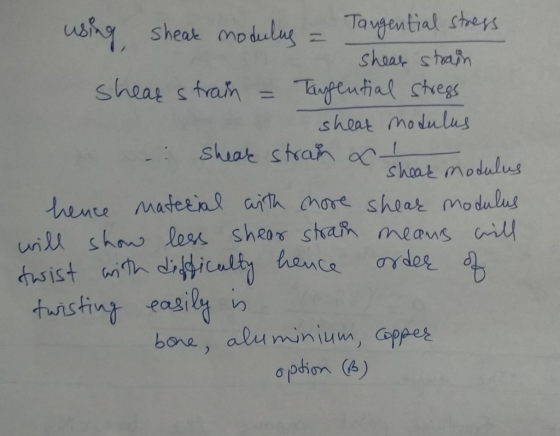
(1 point) The shear modulus of bone is 9×10⁹ N/m2, of copper 4×10¹⁰ N/m2, and of...
(1 point) The shear modulus of bone is 9×10⁹ N/m2, of copper 4×10¹⁰ N/m2, and of aluminum 2.5×10¹⁰ N/m2. For identical pieces (same dimensions) of these materials, which one would twist most easily? Rank in order from easiest to most difficult. A. Aluminum, copper, bone B. Bone, aluminum, copper C. Bone, copper, aluminum D. Copper, aluminum, bone E. Aluminum, bone, copper
When subjected to a force of compression, the length of a bone (compression Young's modulus 9.4...
When subjected to a force of compression, the length of a bone (compression Young's modulus 9.4 x 10⁹ N/m2, tensile Young's modulus 1.6 x 10¹⁰ N/m2) decreases by 1.8 x 10⁻⁵ m. When this same bone is subjected to a tensile force of the same magnitude, by how much does it stretch?
Assume that Young's Modulus for bone is 1.50 *10^10 N/m2 and that the bone will fracture...
Assume that Young's Modulus for bone is 1.50 *10^10 N/m2 and that the bone will fracture if more than 1.50 *10^8 N/m2 is exerted. (b) If a force of this magnitude is applied compressively, by how much does the 27.0 cm long bone shorten? in "mm"
Assume that Young's Modulus for bone is 1.50 ✕ 1010 N/m2 and that the bone will...
Assume that Young's Modulus for bone is 1.50 ✕ 1010 N/m2 and that the bone will fracture if more than 1.50 ✕ 108 N/m2 is exerted. (a) What is the maximum force that can be exerted on the femur bone in the leg if it has a minimum effective diameter of 2.70 cm? (b) If a force of this magnitude is applied compressively, by how much does the 28.0 cm long bone shorten?
The tibia is the shin bone in humans. If the maximum strain it can experience before...
 The tibia is the shin bone in humans. If the maximum strain it can experience before fracturing corresponds to a 1.2% change in length, what is the maximum force that can be applied to a tibia of cross-sectional area 3 cm2 before fracturing? Assume the Young's modulus for the tibia is E = 1.40 x 10¹⁰ N/m2. Note: kN = kilonewtons. Select one: a. 0.5 kN b. 5.0 KN c. 50.4 kN d. 504.0 kN
A copper wire of length 1 meter, cross sectional area 7.1 X 10‑6 m2 and Young’s...
A copper wire of length 1 meter, cross sectional area 7.1 X 10‑6 m2 and Young’s modulus 11 X 1010 N/m2 has a mass load hung on it. If its increase in length is 1 mm, what is the value of the mass? a) 40kg b) 80kg c) 200kg d) 400kg e) 800kg Please help me. Thank you
QUESTION 4 a) The human femur bone breaks if compressive stress greater than 1.50 * 10...
 QUESTION 4 a) The human femur bone breaks if compressive stress greater than 1.50 * 10 N/m2 is imposed on it. Assuming the Young's modulus for bone is 1.50 * 1010 N/m2, determine 1) the maximum force that can be exerted on the femur bone in the leg if it has a cross-sectional area of 4.90 x 10⁻⁴ m2 by how much does a 0.400 m long bone shorten if this maximum force is applied compressively to the bone. (6...
 (1 point) A soccer ball is thrown straight up a distance of 6.0 m and retums to your hand. Neglecting air resistance, you know that OA. the accelcration was constant throughout its motion B, the acceleration wฮ5 upward on the way up and downward on the way down О С, the speed was zero at the maximum height, but the velocity was never zero. D. the ball took longer to go up than come down. E. the velocity was constant...
 (1 point) A soccer ball is thrown straight up a distance of 6.0 m and retums to your hand. Neglecting air resistance, you know that OA. the accelcration was constant throughout its motion B, the acceleration wฮ5 upward on the way up and downward on the way down О С, the speed was zero at the maximum height, but the velocity was never zero. D. the ball took longer to go up than come down. E. the velocity was constant...
 The tibia is the shin bone in humans. If the maximum strain it can experience before fracturing corresponds to a 1.2% change in length, what is the maximum force that can be applied to a tibia of cross-sectional area 3 cm2 before fracturing? Assume the Young's modulus for the tibia is E = 1.40 x 10¹⁰ N/m2. Note: kN = kilonewtons. Select one: a. 0.5 kN b. 5.0 KN c. 50.4 kN d. 504.0 kN
 QUESTION 4 a) The human femur bone breaks if compressive stress greater than 1.50 * 10 N/m2 is imposed on it. Assuming the Young's modulus for bone is 1.50 * 1010 N/m2, determine 1) the maximum force that can be exerted on the femur bone in the leg if it has a cross-sectional area of 4.90 x 10⁻⁴ m2 by how much does a 0.400 m long bone shorten if this maximum force is applied compressively to the bone. (6...
Most questions answered within 3 hours.
-
Where is the error in this code sequence?
String s1 = "Hello";
String s2 = "ello";...
asked 10 months ago -
Financial data for Joel de Paris, Inc., for last year
follow:
Joel de Paris, Inc.
Balance...
asked 10 months ago -
Consider this reaction:
Al2(SO4)3 (aq)+ BaCl3
(aq) Al2Cl6 (aq)- +
3BaSO4(s) . What is the...
asked 10 months ago -
Suppose that Savneet is considering increasing her
recent random sample from 20 car rentals to 40...
asked 10 months ago -
Trucks arrive at an unloading terminal at an average rate of 120
per hour.
Trucks arrive...
asked 10 months ago -
Why are methanol and ethanol completely soluble in water while
octanol is not very little soluble....
asked 10 months ago -
A facilities manager at a university reads in a research report
that the mean amount of...
asked 10 months ago -
When the CuSO4 is rehydrated by adding water to the anhydrous
compound, is this an endothermic...
asked 10 months ago -
A ray of sunlight is passing from diamond into crown glass; the
angle of incidence is...
asked 10 months ago -
A block of mass 0.249 kg is placed on top of a light, vertical
spring of...
asked 10 months ago -
how do the kidneys compensate in the presences of acidosis
a) trigger hyperventilate
b) reserve acid...
asked 10 months ago -
Question 501 pts
The rental rate of capital to the firm increases. Which of the
following...
asked 10 months ago