

Homework Answers
(a) The two constraints are
(supposing all income is exhausted in consumption) and
or
. Putting
in
, we have
or
, which is the representative budget constraint.
(b) The exogenous variables are w (wage) and h (total number of hours). These variables are to be having given values in the model. The endogenous variables are c (consumption), l (leisure) and N (hours worked).
(c) The Lagrangian function would be
or
.
(d) The FOCs are as below.
or
or
or
.
or
or
or
.
or
or
or
.
(e) Comparing the first two FOCs, we have
or
, which is the utility maximizing combination. But this
combination would be as
, for -1/w is the slope of the constraint, considering leisure is
on the x-axis. Hence, we have
or
. The MRS is basically the slope of the utility curve for a
particular utility level. This means that to remain on the same
utility level, the agent would have to sacrifice MRS amount of
consumption to get a marginal unit of leisure.
Add Answer to:
Alt Alt Fn question 2 (22 pts.) Consider a representative agent with preferences over consumption c...
Question 2 (22 pts.) Consider a representative agent with preferences over consumption c and leisure I...
 Question 2 (22 pts.) Consider a representative agent with preferences over consumption c and leisure I represented by Uel)Inc + InI. Her budget constraint is c S wN, where w is the wage rate and N -the number of hours worked. The representative agent also chooses how to allocate her time between work and leisure activities given her time constraint 1 + N = h, where h is the total number of hours. a) (2 pt.) Combine the budget constraint...
Question 2 (22 pts Consider a representative agent with preferences over consumption c and leisune eted...
 Question 2 (22 pts Consider a representative agent with preferences over consumption c and leisune eted by D(c,l).Inc+1η l. Her budget constraint is.c wM, wherw w the wage fat and N-the rof hours worked. The representative agent aso chooses how to allocate her time between work and lsu activities gven her time constraintN-h, where h is the total number oll hours al pt) Combine the budget constraint and the time constraint of the regesentative agent into a single constraint b)...
Question 2 (22 pts.) Consider a representative agent with preferences over consumption c and leisure l...
 Question 2 (22 pts.) Consider a representative agent with preferences over consumption c and leisure l represented by (c,)In c+Inl. Her budget constraint is c S wN, where w is the wage rate and N-the number of hours worked. The representative agent also chooses how to allocate her time between work and leisure activities given her time constraintl+N-h, where h is the total number of hours. We were unable to transcribe this image
Consider a representative consumer who has preferences over an aggregate consumption good c and leisure l....
Consider a representative consumer who has preferences over an aggregate consumption good c and leisure l. Her preferences are described by the utility function: U(c,l) = ln(c) + ln(l) The consumer has a time endowment of h hours which can be used to work at the market or enjoyed as leisure. The real wage rate is w per hour. The worker pays a proportional wage tax of rate t, so the worker’s after-tax wage is (1−t)w. The consumer also has...
3. Consider a representative consumer who has preferences over an aggregate consumption good e and leisure....
 3. Consider a representative consumer who has preferences over an aggregate consumption good e and leisure. Her preferences are described by the uility function: U(c,l) In(e) +In(l) The consumer has a time endowment of h hours which can be used to work at the market or enjoyed as leisure. The real wage rate is w per hour. The worker pays a proportional wage tax of rate t, so the worker's after-tax wage is (1 t). The consumer also has dividend...
Suppose Andrea has preferences over consumption (C) and leisure (l). Suppose also her time constraint is...
Suppose Andrea has preferences over consumption (C) and leisure (l). Suppose also her time constraint is such that l + h = h¯, where h is the number of hours worked and h¯ is the time available. Suppose also h¯ = 8. If she works she receives an hourly wage (?) of 10. (a) (5 points) Suppose first her income depends only on the number of hours worked. Write and plot her budget constraint. What is the slope of her...
Consider a specific version of the static representative agent economy. In particular, we will dispense with...
Consider a specific version of the static representative agent economy. In particular, we will dispense with capital and let the production function satisfy y=zn. The household's utility function is given by u=2θc^1/2+2l^1/2 where θ > 0 and the budget constraint is now just c=w(1-l). Verify that this utility function satisfies u1, u2>0 and u11 ,u22<0
A worker's preferences over consumption (c) and leisure (l) can be represented by U(cl) = cl....
 A worker's preferences over consumption (c) and leisure (l) can be represented by U(cl) = cl. The price of consumption is given by p = 1 and the wage by w=1 (a) Suppose we measure leisure in hours per day such that the maximum value I can take is 24. Let's represent hours worked by h; then we have h = 24-1. Write the Budget Constraint of this worker in terms of c and l. (b) Explain briefly why w/p...
3. Consider a consumer who has well-behaved preferences over leisure (L) and consumption (x) They have...
 3. Consider a consumer who has well-behaved preferences over leisure (L) and consumption (x) They have nonlabor income m and have 24 hours in the day that must be divided between leisure and working. They are initially paid a wage w for each hour of work. The price of x is 1 (a) Suppose they optimally choose to work 8 hours. Draw the consumer's budget set and an indifference curve showing this situation. (b) Now suppose that they are paid...
1. Suppose a consumer's preference over consumption (C) and leisure (1) can be described by a...
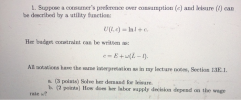 1. Suppose a consumer's preference over consumption (C) and leisure (1) can be described by a utility function: U (1,c) = Inl+c. Her budget constraint can be written as: c=E+w(L-1). All notations have the same interpretation as in my lecture notes, Section 13E.1. a. (3 points) Solve her demand for leisure. b. (2 points) How does her labor supply decision depend on the wage rate w?
 Question 2 (22 pts.) Consider a representative agent with preferences over consumption c and leisure I represented by Uel)Inc + InI. Her budget constraint is c S wN, where w is the wage rate and N -the number of hours worked. The representative agent also chooses how to allocate her time between work and leisure activities given her time constraint 1 + N = h, where h is the total number of hours. a) (2 pt.) Combine the budget constraint...
 Question 2 (22 pts Consider a representative agent with preferences over consumption c and leisune eted by D(c,l).Inc+1η l. Her budget constraint is.c wM, wherw w the wage fat and N-the rof hours worked. The representative agent aso chooses how to allocate her time between work and lsu activities gven her time constraintN-h, where h is the total number oll hours al pt) Combine the budget constraint and the time constraint of the regesentative agent into a single constraint b)...
 Question 2 (22 pts.) Consider a representative agent with preferences over consumption c and leisure l represented by (c,)In c+Inl. Her budget constraint is c S wN, where w is the wage rate and N-the number of hours worked. The representative agent also chooses how to allocate her time between work and leisure activities given her time constraintl+N-h, where h is the total number of hours. We were unable to transcribe this image
 3. Consider a representative consumer who has preferences over an aggregate consumption good e and leisure. Her preferences are described by the uility function: U(c,l) In(e) +In(l) The consumer has a time endowment of h hours which can be used to work at the market or enjoyed as leisure. The real wage rate is w per hour. The worker pays a proportional wage tax of rate t, so the worker's after-tax wage is (1 t). The consumer also has dividend...
 A worker's preferences over consumption (c) and leisure (l) can be represented by U(cl) = cl. The price of consumption is given by p = 1 and the wage by w=1 (a) Suppose we measure leisure in hours per day such that the maximum value I can take is 24. Let's represent hours worked by h; then we have h = 24-1. Write the Budget Constraint of this worker in terms of c and l. (b) Explain briefly why w/p...
 3. Consider a consumer who has well-behaved preferences over leisure (L) and consumption (x) They have nonlabor income m and have 24 hours in the day that must be divided between leisure and working. They are initially paid a wage w for each hour of work. The price of x is 1 (a) Suppose they optimally choose to work 8 hours. Draw the consumer's budget set and an indifference curve showing this situation. (b) Now suppose that they are paid...
 1. Suppose a consumer's preference over consumption (C) and leisure (1) can be described by a utility function: U (1,c) = Inl+c. Her budget constraint can be written as: c=E+w(L-1). All notations have the same interpretation as in my lecture notes, Section 13E.1. a. (3 points) Solve her demand for leisure. b. (2 points) How does her labor supply decision depend on the wage rate w?
Most questions answered within 3 hours.
-
Where is the error in this code sequence?
String s1 = "Hello";
String s2 = "ello";...
asked 10 months ago -
Financial data for Joel de Paris, Inc., for last year
follow:
Joel de Paris, Inc.
Balance...
asked 10 months ago -
Consider this reaction:
Al2(SO4)3 (aq)+ BaCl3
(aq) Al2Cl6 (aq)- +
3BaSO4(s) . What is the...
asked 10 months ago -
Suppose that Savneet is considering increasing her
recent random sample from 20 car rentals to 40...
asked 10 months ago -
Trucks arrive at an unloading terminal at an average rate of 120
per hour.
Trucks arrive...
asked 10 months ago -
Why are methanol and ethanol completely soluble in water while
octanol is not very little soluble....
asked 10 months ago -
A facilities manager at a university reads in a research report
that the mean amount of...
asked 10 months ago -
When the CuSO4 is rehydrated by adding water to the anhydrous
compound, is this an endothermic...
asked 10 months ago -
A ray of sunlight is passing from diamond into crown glass; the
angle of incidence is...
asked 10 months ago -
A block of mass 0.249 kg is placed on top of a light, vertical
spring of...
asked 10 months ago -
how do the kidneys compensate in the presences of acidosis
a) trigger hyperventilate
b) reserve acid...
asked 10 months ago -
Question 501 pts
The rental rate of capital to the firm increases. Which of the
following...
asked 10 months ago