
Homework Answers
Add Answer to:
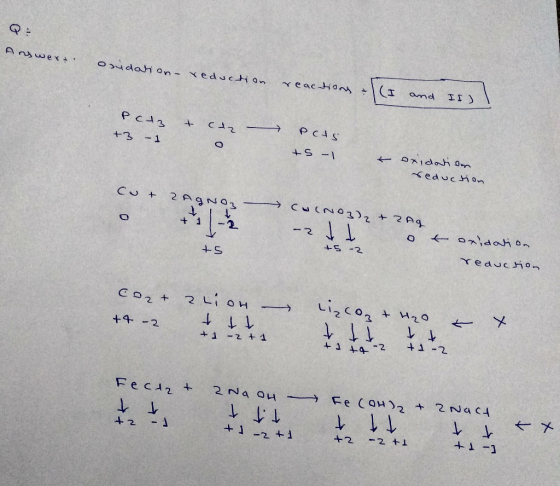
Question 3 2.5 pts Which of the following are oxidation-reduction reactions? I. PCI; + Cl2 →...
rect Question 19 0/5 pt Which of the following are oxidation-reduction reactions? 1. PC13 + Cl2...
 rect Question 19 0/5 pt Which of the following are oxidation-reduction reactions? 1. PC13 + Cl2 PCIE II. Cu + 2AgNO3 - Cu(NO3)2 + 2Ag III. CO2 + 2LIOH -- Li2CO3 + H20 IV. FeCl2 + 2NaOH - Fe(OH)2 + 2Naci I and II 1.11, and III IV 1, 11, 111, and IV correct Question 20 0/5 pts Answer the following questions that refer to the unbalanced reaction shown below as it occurs in acidic solution: _Cr202- (aq) + __...
All of the following reactions can be described as displacement reactions except: a.) Zn(s) + FeCl2(aq)...
All of the following reactions can be described as displacement reactions except: a.) Zn(s) + FeCl2(aq) → ZnCl2(aq) + Fe(s). b.) C6H6(l) + Cl2(g) → C6H5Cl(l) + HCl(g). c.) 2Na(s) + 2H2O(l) → 2NaOH(aq) + H2(g). d.) Cu(s) + 2AgNO3(aq) → Cu(NO3)2(aq) + 2Ag(s). e.) CuSO4(aq) + Fe(s) → Cu(s) + FeSO4(aq).
All of the following reactions can be described as displacement reactions except Select one: a. 2Na(s)...
 All of the following reactions can be described as displacement reactions except Select one: a. 2Na(s) + 2H2O(1) ► 2NaOH(aq) + H2(g). ob. CoH(1) + Cl2(g) → CH3C1(1) + HCl(g). oc. CuSO4(aq) + Fe(s) → Cu(s) + FeSO4(aq). O d. Zn(s) + FeCl2(aq) → ZnCl2(aq) + Fe(s). e. Cu(s) + 2AgNO3(aq) + Cu(NO3)2(aq) + 2Ag(s).
(10 pts) Balance the following redox reactions by first separating the oxidation and reduction half-reactions. a....
 (10 pts) Balance the following redox reactions by first separating the oxidation and reduction half-reactions. a. Cut (aq) + Fe (s) Fe3+ (aq) + Cu(s) b. Cu(s) + HNO3 (aq) Cu2+ (aq) + NO (g) (basic solution) c. NH(aq) + O2(g) → N03 (aq) + H2O(l) (acidic solution) d. Cd(s) + NiO(OH)(s) + Ca(OH)2(s) + Ni(OH)2(s) (Nicad battery) e. The oxidation of iodide ion (1) by permanganate ion (MnO4) in basic solution to yield molecular iodine (12) and manganese(IV) oxide...
for each reaction- classify as oxidation-reduction,acid-base or precipitation Classify each of the following reactions as oxidation-reduction,...
 for each reaction- classify as oxidation-reduction,acid-base
or precipitation
Classify each of the following reactions as oxidation-reduction, acid-base, or Note that in order to be a redox reaction, the oxidation number of an element must be different when it is a reactant than when it is a product. (1 point each) precipitation. Classification Reaction Number 24 Ca (s) +2 H2O ()- Ca(OH)2 (s) + H2 (g) 25 CdCl2 (aq)+ Na2S (aq)CdS (s) +2 NaCl (aq) Zn(OH)2 (s) + H2SO4 (aq)ZnSO4 (aq)...
for each reaction- classify as oxidation-reduction,acid-base
or precipitation
Classify each of the following reactions as oxidation-reduction, acid-base, or Note that in order to be a redox reaction, the oxidation number of an element must be different when it is a reactant than when it is a product. (1 point each) precipitation. Classification Reaction Number 24 Ca (s) +2 H2O ()- Ca(OH)2 (s) + H2 (g) 25 CdCl2 (aq)+ Na2S (aq)CdS (s) +2 NaCl (aq) Zn(OH)2 (s) + H2SO4 (aq)ZnSO4 (aq)...
Classify the following as acid-base reactions or oxidation-reduction reactions. (a) 3 HClO4(aq) + Fe(OH)3(s) → Fe(ClO4)3(aq)...
Classify the following as acid-base reactions or oxidation-reduction reactions. (a) 3 HClO4(aq) + Fe(OH)3(s) → Fe(ClO4)3(aq) + 3 H2O(l) (b) HC2H3O2(aq) + NaHCO3(aq) → NaC2H3O2(aq) + CO2(g) + H2O(l) (c) 4 H2O(l) + 2 KMnO4(aq) → 2 MnO2(s) + 2 KOH(aq) + 3 H2O2(aq) (d) Cl2(g) + KOH(aq) → KClO(aq) + HCl(aq) (e) 2 Fe(s) + 3 NaOCl(aq) → Fe2O3(s) + 3 NaCl(aq) (f) CaC2(s) + 2 H2O(l) → C2H2(g) + Ca(OH)2(s) Explain your reasoning
4. (6 pts.) Oxidation-Reduction Reactions: write out two ways you can identify the species that has...
 4. (6 pts.) Oxidation-Reduction Reactions: write out two ways you can identify the species that has been oxidized in a redox reaction: b. Identify the element reduced and the element oxidized in the following oxidation- reduction reactions. Fe(s) + CuCl2(aq) FeCl2(aq) + Cu(s) Element Oxidized: Element Reduced: C(s) + O2(g) → C02(g) Element Oxidized: Element Reduced:
Split the following unbalanced redox reactions into a reduction half-reaction and an oxidation half-reaction. Balance both...
Split the following unbalanced redox reactions into a reduction half-reaction and an oxidation half-reaction. Balance both the elements and the number of electrons. a) Fe(3+) + Cu --> Fe(2+) + Cu(2+) b) CH4 + O2 --> CO2 + H2O
Which of the following equations are balanced? (i) 2 Al + 3 H2SO4 --> Al2(SO4)3 +...
Which of the following equations are balanced? (i) 2 Al + 3 H2SO4 --> Al2(SO4)3 + 3 H2 (ii) Cl2 + NaI --> NaCl + I2 (iii) C2H6O + 7 O2 --> 2 CO2 + 3 H2O (iv) 3 Cu + 7 HNO3 --> 3 Cu(NO3)2 + 2 NO + 4 H2O (v) 2 NH3 + 3 CuO --> 3 Cu + 3 H2O + N2 Select one: a. i, iii and v b. i and v c. iii and...
Which of the following reactions is spontaneous in the reverse direction as written? I) Ni+2(aq) +...
Which of the following reactions is spontaneous in the reverse direction as written? I) Ni+2(aq) + Pb(s) → Ni(s) + Pb+2(aq) Ecell° = -0.124 V II) Pb+2(aq) + H2(g) → Pb(s) + 2H+(aq) Ecell° = -0.126 V III) Cu+2(aq) + Fe(s) → Cu(s) + Fe+2(aq) Ecell° = +0.78 V IV) Zn+2(aq) + 2Ag(s) → Zn+2(aq) + 2Ag+(aq) Ecell° = -1.562 V a. I, II & IV b. IV c. III d. II e. I f. II & IV g. I...
 rect Question 19 0/5 pt Which of the following are oxidation-reduction reactions? 1. PC13 + Cl2 PCIE II. Cu + 2AgNO3 - Cu(NO3)2 + 2Ag III. CO2 + 2LIOH -- Li2CO3 + H20 IV. FeCl2 + 2NaOH - Fe(OH)2 + 2Naci I and II 1.11, and III IV 1, 11, 111, and IV correct Question 20 0/5 pts Answer the following questions that refer to the unbalanced reaction shown below as it occurs in acidic solution: _Cr202- (aq) + __...
 All of the following reactions can be described as displacement reactions except Select one: a. 2Na(s) + 2H2O(1) ► 2NaOH(aq) + H2(g). ob. CoH(1) + Cl2(g) → CH3C1(1) + HCl(g). oc. CuSO4(aq) + Fe(s) → Cu(s) + FeSO4(aq). O d. Zn(s) + FeCl2(aq) → ZnCl2(aq) + Fe(s). e. Cu(s) + 2AgNO3(aq) + Cu(NO3)2(aq) + 2Ag(s).
 (10 pts) Balance the following redox reactions by first separating the oxidation and reduction half-reactions. a. Cut (aq) + Fe (s) Fe3+ (aq) + Cu(s) b. Cu(s) + HNO3 (aq) Cu2+ (aq) + NO (g) (basic solution) c. NH(aq) + O2(g) → N03 (aq) + H2O(l) (acidic solution) d. Cd(s) + NiO(OH)(s) + Ca(OH)2(s) + Ni(OH)2(s) (Nicad battery) e. The oxidation of iodide ion (1) by permanganate ion (MnO4) in basic solution to yield molecular iodine (12) and manganese(IV) oxide...
 for each reaction- classify as oxidation-reduction,acid-base
or precipitation
Classify each of the following reactions as oxidation-reduction, acid-base, or Note that in order to be a redox reaction, the oxidation number of an element must be different when it is a reactant than when it is a product. (1 point each) precipitation. Classification Reaction Number 24 Ca (s) +2 H2O ()- Ca(OH)2 (s) + H2 (g) 25 CdCl2 (aq)+ Na2S (aq)CdS (s) +2 NaCl (aq) Zn(OH)2 (s) + H2SO4 (aq)ZnSO4 (aq)...
for each reaction- classify as oxidation-reduction,acid-base
or precipitation
Classify each of the following reactions as oxidation-reduction, acid-base, or Note that in order to be a redox reaction, the oxidation number of an element must be different when it is a reactant than when it is a product. (1 point each) precipitation. Classification Reaction Number 24 Ca (s) +2 H2O ()- Ca(OH)2 (s) + H2 (g) 25 CdCl2 (aq)+ Na2S (aq)CdS (s) +2 NaCl (aq) Zn(OH)2 (s) + H2SO4 (aq)ZnSO4 (aq)...
 4. (6 pts.) Oxidation-Reduction Reactions: write out two ways you can identify the species that has been oxidized in a redox reaction: b. Identify the element reduced and the element oxidized in the following oxidation- reduction reactions. Fe(s) + CuCl2(aq) FeCl2(aq) + Cu(s) Element Oxidized: Element Reduced: C(s) + O2(g) → C02(g) Element Oxidized: Element Reduced:
Most questions answered within 3 hours.
-
Where is the error in this code sequence?
String s1 = "Hello";
String s2 = "ello";...
asked 11 months ago -
Financial data for Joel de Paris, Inc., for last year
follow:
Joel de Paris, Inc.
Balance...
asked 11 months ago -
Consider this reaction:
Al2(SO4)3 (aq)+ BaCl3
(aq) Al2Cl6 (aq)- +
3BaSO4(s) . What is the...
asked 11 months ago -
Suppose that Savneet is considering increasing her
recent random sample from 20 car rentals to 40...
asked 11 months ago -
Trucks arrive at an unloading terminal at an average rate of 120
per hour.
Trucks arrive...
asked 11 months ago -
Why are methanol and ethanol completely soluble in water while
octanol is not very little soluble....
asked 11 months ago -
A facilities manager at a university reads in a research report
that the mean amount of...
asked 11 months ago -
When the CuSO4 is rehydrated by adding water to the anhydrous
compound, is this an endothermic...
asked 11 months ago -
A ray of sunlight is passing from diamond into crown glass; the
angle of incidence is...
asked 11 months ago -
A block of mass 0.249 kg is placed on top of a light, vertical
spring of...
asked 11 months ago -
how do the kidneys compensate in the presences of acidosis
a) trigger hyperventilate
b) reserve acid...
asked 11 months ago -
Question 501 pts
The rental rate of capital to the firm increases. Which of the
following...
asked 11 months ago