Physical chemistry problem
 The Answer is (A)
Please by steps, thanks
Homework Answers
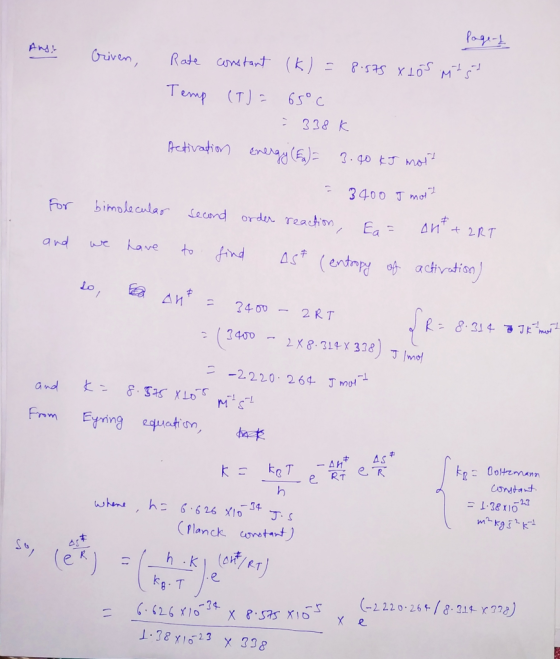
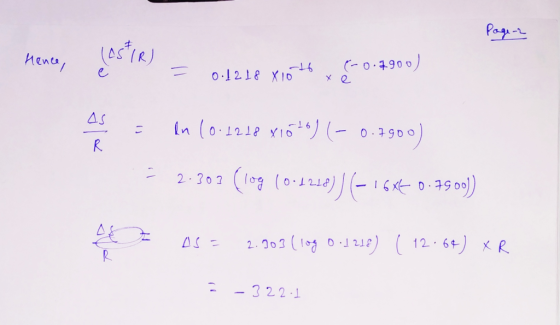
Add Answer to:
Physical chemistry problem
The Answer is (A)
Please by steps, thanks
10. A second order reaction...
3. A reaction 2A 2B + C is known to follow second-order kinetics, with k =...
 3. A reaction 2A 2B + C is known to follow second-order kinetics, with k = 7.20x10*M's' at 25.0 °C. (20 points) During one experiment, the initial concentration of A is [A]. = 0.120 M (a) Calculate the half-life (1,2), in hours, for this experiment. (b) Calculate the initial reaction rate (in M/s) for this reaction (4 points) (c) How long will it take (in hours) for the concentration of C to reach [C] = 0.0540 M (6 points) (d)...
A second-order reaction has a rate constant of 7.0 x 10^-4 /(M ⋅ s) at 30.°C....
A second-order reaction has a rate constant of 7.0 x 10^-4 /(M ⋅ s) at 30.°C. At 40.°C, the rate constant is 2.2 x 10^-3 /(M ⋅ s). What are the activation energy and frequency factor for this reaction? Predict the value of the rate constant at 45°C. Activation energy = ----------- kJ/mol Frequency factor = -------------- /(M ⋅ s) Rate constant =-------------- /(M ⋅ s)
The rate constant for this second-order reaction is 0.430 M-'.s at 300 °C. A- products How...
 The rate constant for this second-order reaction is 0.430 M-'.s at 300 °C. A- products How long, in seconds, would it take for the concentration of A to decrease from 0.670 M to 0.310 M? 1 = 6.355 Incorrect Calculate the rate constant, k, for a reaction at 56,0 °C that has an activation energy of 88.6 kJ/mol and a frequency factor of 6.85 x 10's-1 k= 2.2188 SI Incorrect
a.) The rate constant for the base-catalyzed hydrolysis of ethyl acetate is 1.78×10³ L mol-1 s...
a.) The rate constant for the base-catalyzed hydrolysis of ethyl acetate is 1.78×10³ L mol-1 s -1 at 25 °C and 1.38×10⁴ L mol-1 s -1 at 37 °C. Calculate EA, (delta)H‡ , the Arrhenius Constant, and (delta) S ‡ . b.) The isomerization of HNC into HCN is important in the chemistry of interstellar gas clouds. HNC → HCN Has an activation energy of 210 kJ/mol and an activation entropy of -105 J mol-1 K-1 . Calculate the first-order...
For the first-order reaction: Ag) — Bg) the rate constant is k-6x 10⁴ s-at -10°C, and...
 For the first-order reaction: Ag) — Bg) the rate constant is k-6x 10⁴ s-at -10°C, and the activation energy is 64 kJ/mol. What is the rate constant at 20°C? (R-8.314 J/mol x K) 0 a. 6x 10451 b.4.3 x 1045-1 OC. 4.1 x 10851 Od. 1.2 x 10051 Oe-2.2 x 1045-1
** Please show all steps & explain how to solve the solution ** A first order...
 ** Please show all steps & explain how to solve the
solution **
A first order reaction has rate constants of 4.6 x 10⁻² s-1 and 5.7 × 10⁻² s-1 at 0°C and 20°C, respectively. What is the value of the activation energy? Activation energy- kJ/mol Try Another Version ltem attempts remaining Submlt Answer
** Please show all steps & explain how to solve the
solution **
A first order reaction has rate constants of 4.6 x 10⁻² s-1 and 5.7 × 10⁻² s-1 at 0°C and 20°C, respectively. What is the value of the activation energy? Activation energy- kJ/mol Try Another Version ltem attempts remaining Submlt Answer
Physical Chemistry. Please show all your work. I will rate. If your answer is not b)...
 Physical Chemistry. Please show all your work. I will rate. If
your answer is not b) 1KJ please explain why it is not the correct
answer? Thank you in advance
3. Suppose the reaction Gibbs free energy is 1 k.J/mol, independent of temperature. The reaction enthalpy, at 50K, is equal to (a) 20 J/mol (b) 1 kJ/mol (c) 50 kJ/mol (d) not enough information
Physical Chemistry. Please show all your work. I will rate. If
your answer is not b) 1KJ please explain why it is not the correct
answer? Thank you in advance
3. Suppose the reaction Gibbs free energy is 1 k.J/mol, independent of temperature. The reaction enthalpy, at 50K, is equal to (a) 20 J/mol (b) 1 kJ/mol (c) 50 kJ/mol (d) not enough information
d listing r. (Individ For a particular first-order reaction, it takes 24 minutes for the concentration...
 d listing r. (Individ For a particular first-order reaction, it takes 24 minutes for the concentration of the reactant to decrease to 25% of its initial value, what is the value for rate constant (in S-1) for the reaction? A) 2.0-104 s-1 B)9.6 x 10⁻⁴ s-1 C) 1.2 × 10⁻² s-1 D)5.8 102s-1 12. In the first order reaction A → products, [A1-0.400 M initially and 0250 M after 15.0 mun, what willl after 175 min? e A) 1.67-10-3 M...
Could you please give me a full answer a full and correct answer for this question...
 Could you please give me a full answer a full and correct answer
for this question
9.45. The rate constant for a second-order reaction in solution is 3.95 × 10⁻⁴ dm3 mol-1 s-1 at 25°C, and the activation energy is 120.0 kJ mol-1.Calculate, at 25 °C, the preexponential factor A, the enthalpy of activation Δ H, the Gibbse activation Δ'So
Could you please give me a full answer a full and correct answer
for this question
9.45. The rate constant for a second-order reaction in solution is 3.95 × 10⁻⁴ dm3 mol-1 s-1 at 25°C, and the activation energy is 120.0 kJ mol-1.Calculate, at 25 °C, the preexponential factor A, the enthalpy of activation Δ H, the Gibbse activation Δ'So
A second order reaction was observed to have a rate constant of 8.9 middot 10^-3 at...
 A second order reaction was observed to have a rate constant of 8.9 middot 10^-3 at 3.0 degree C and 7.1 middot 10^-2 at 35.0 degree C. What is the activation energy in kJ/mole for the reaction? You may want to determine this graphically.
 3. A reaction 2A 2B + C is known to follow second-order kinetics, with k = 7.20x10*M's' at 25.0 °C. (20 points) During one experiment, the initial concentration of A is [A]. = 0.120 M (a) Calculate the half-life (1,2), in hours, for this experiment. (b) Calculate the initial reaction rate (in M/s) for this reaction (4 points) (c) How long will it take (in hours) for the concentration of C to reach [C] = 0.0540 M (6 points) (d)...
 The rate constant for this second-order reaction is 0.430 M-'.s at 300 °C. A- products How long, in seconds, would it take for the concentration of A to decrease from 0.670 M to 0.310 M? 1 = 6.355 Incorrect Calculate the rate constant, k, for a reaction at 56,0 °C that has an activation energy of 88.6 kJ/mol and a frequency factor of 6.85 x 10's-1 k= 2.2188 SI Incorrect
 For the first-order reaction: Ag) — Bg) the rate constant is k-6x 10⁴ s-at -10°C, and the activation energy is 64 kJ/mol. What is the rate constant at 20°C? (R-8.314 J/mol x K) 0 a. 6x 10451 b.4.3 x 1045-1 OC. 4.1 x 10851 Od. 1.2 x 10051 Oe-2.2 x 1045-1
 ** Please show all steps & explain how to solve the
solution **
A first order reaction has rate constants of 4.6 x 10⁻² s-1 and 5.7 × 10⁻² s-1 at 0°C and 20°C, respectively. What is the value of the activation energy? Activation energy- kJ/mol Try Another Version ltem attempts remaining Submlt Answer
** Please show all steps & explain how to solve the
solution **
A first order reaction has rate constants of 4.6 x 10⁻² s-1 and 5.7 × 10⁻² s-1 at 0°C and 20°C, respectively. What is the value of the activation energy? Activation energy- kJ/mol Try Another Version ltem attempts remaining Submlt Answer
 Physical Chemistry. Please show all your work. I will rate. If
your answer is not b) 1KJ please explain why it is not the correct
answer? Thank you in advance
3. Suppose the reaction Gibbs free energy is 1 k.J/mol, independent of temperature. The reaction enthalpy, at 50K, is equal to (a) 20 J/mol (b) 1 kJ/mol (c) 50 kJ/mol (d) not enough information
Physical Chemistry. Please show all your work. I will rate. If
your answer is not b) 1KJ please explain why it is not the correct
answer? Thank you in advance
3. Suppose the reaction Gibbs free energy is 1 k.J/mol, independent of temperature. The reaction enthalpy, at 50K, is equal to (a) 20 J/mol (b) 1 kJ/mol (c) 50 kJ/mol (d) not enough information
 d listing r. (Individ For a particular first-order reaction, it takes 24 minutes for the concentration of the reactant to decrease to 25% of its initial value, what is the value for rate constant (in S-1) for the reaction? A) 2.0-104 s-1 B)9.6 x 10⁻⁴ s-1 C) 1.2 × 10⁻² s-1 D)5.8 102s-1 12. In the first order reaction A → products, [A1-0.400 M initially and 0250 M after 15.0 mun, what willl after 175 min? e A) 1.67-10-3 M...
 Could you please give me a full answer a full and correct answer
for this question
9.45. The rate constant for a second-order reaction in solution is 3.95 × 10⁻⁴ dm3 mol-1 s-1 at 25°C, and the activation energy is 120.0 kJ mol-1.Calculate, at 25 °C, the preexponential factor A, the enthalpy of activation Δ H, the Gibbse activation Δ'So
Could you please give me a full answer a full and correct answer
for this question
9.45. The rate constant for a second-order reaction in solution is 3.95 × 10⁻⁴ dm3 mol-1 s-1 at 25°C, and the activation energy is 120.0 kJ mol-1.Calculate, at 25 °C, the preexponential factor A, the enthalpy of activation Δ H, the Gibbse activation Δ'So
 A second order reaction was observed to have a rate constant of 8.9 middot 10^-3 at 3.0 degree C and 7.1 middot 10^-2 at 35.0 degree C. What is the activation energy in kJ/mole for the reaction? You may want to determine this graphically.
Most questions answered within 3 hours.
-
Where is the error in this code sequence?
String s1 = "Hello";
String s2 = "ello";...
asked 10 months ago -
Financial data for Joel de Paris, Inc., for last year
follow:
Joel de Paris, Inc.
Balance...
asked 10 months ago -
Consider this reaction:
Al2(SO4)3 (aq)+ BaCl3
(aq) Al2Cl6 (aq)- +
3BaSO4(s) . What is the...
asked 10 months ago -
Suppose that Savneet is considering increasing her
recent random sample from 20 car rentals to 40...
asked 10 months ago -
Trucks arrive at an unloading terminal at an average rate of 120
per hour.
Trucks arrive...
asked 10 months ago -
Why are methanol and ethanol completely soluble in water while
octanol is not very little soluble....
asked 10 months ago -
A facilities manager at a university reads in a research report
that the mean amount of...
asked 10 months ago -
When the CuSO4 is rehydrated by adding water to the anhydrous
compound, is this an endothermic...
asked 10 months ago -
A ray of sunlight is passing from diamond into crown glass; the
angle of incidence is...
asked 10 months ago -
A block of mass 0.249 kg is placed on top of a light, vertical
spring of...
asked 10 months ago -
how do the kidneys compensate in the presences of acidosis
a) trigger hyperventilate
b) reserve acid...
asked 10 months ago -
Question 501 pts
The rental rate of capital to the firm increases. Which of the
following...
asked 10 months ago