
Homework Answers

Add Answer to:
To practice Problem-Solving Strategy 8.1 Static equilibrium problems. and Felbow. Part 1 When you lift an...
Learning Goal: To practice Problem-Solving Strategy 8.1 Static equilibrium problems. When you lift an object by...
Learning Goal: To practice Problem-Solving Strategy 8.1 Static equilibrium problems. When you lift an object by moving only your forearm, the main lifting muscle in your arm is the biceps. Suppose the mass of a forearm is 1.40 kg . If the biceps is connected to the forearm a distance dbiceps = 3.50 cm from the elbow, how much force Fbiceps must the biceps exert to hold a 950 g ball at the end of the forearm at distance dball...
Learning Goal: To practice Problem-Solving Strategy 8.1 Static equilibrium Part C When you lift an object...
 Learning Goal: To practice Problem-Solving Strategy 8.1 Static equilibrium Part C When you lift an object by moving only your forearm, the main lifting muscle in your arm is the biceps. Suppose the mass of a forearm is 1.40 kg. If the biceps is connected to the forearm a distance dbiceps 3.00 cm from the elbow, how much force Fbicepa must the biceps exert to hold a 700 g ball at the end of the forearm at distance dball 32.0...
Review I Constants Learning Goal: To practice Problem-Solving Strategy 8.1 Static equilibrium problems. Correct When you...
 Review I Constants Learning Goal: To practice Problem-Solving Strategy 8.1 Static equilibrium problems. Correct When you lift an object by moving only your forearm, the main lifting muscle in your arm is the biceps. Suppose the mass of a forearm is 1.20 kg. If the biceps is connected to the forearm a distance diceps = 2.50 cm from the elbow, how much force Fices must the biceps exert to hold a 500 g ball at the end af the forearm...
To practice Problem-Soving Strabegy 8 1 Staic equlibrium problems When you in an object by moving only your torearm, the main ifting musdle in your arm is the biceps Suppose the mass of...
 To practice Problem-Soving Strabegy 8 1 Staic equlibrium problems When you in an object by moving only your torearm, the main ifting musdle in your arm is the biceps Suppose the mass of a fore arm is 150 kg If the biceps is connected to the fore arm a distanvce d 3.00 cm trom the elbow, how much force must the biceps exert to hold a 750 g ball at the end of Part F the forearm at distance d...
When you lift an object by moving only your forearm, the main lifting muscle in your...
When you lift an object by moving only your forearm, the main lifting muscle in your arm is the biceps. Suppose the mass of a forearm is 1.40 kg .If the biceps is connected to the forearm a distance dbiceps = 3.50 cm from the elbow, how much force Fbiceps must the biceps exert to hold a 850 g ball at the end of the forearm at distance dball = 33.0 cmfrom the elbow, with the forearm parallel to the...
Consider a person holding a bag like in the diagram, palm facing upwards, forearm parallel to...
 Consider a person holding a bag like in the diagram, palm facing
upwards, forearm parallel to the floor, and upper arm making a
right angle with their forearm. Masses are added to the bag until
the subject can no longer comfortably keep the angle between their
upper arm and forearm at 90 degrees.
Weight of person: 170 lbs (756.5 N)
Body Segment and Percentage Amount of Total Body Weight
Head( 7.3%), Hand(0.7%), Trunk(50.7%) Thigh(10.3%), Upper
Arm(2.6%)
Calf(4.3%), (Forearm1.6%), Foot(1.5%)
The...
Consider a person holding a bag like in the diagram, palm facing
upwards, forearm parallel to the floor, and upper arm making a
right angle with their forearm. Masses are added to the bag until
the subject can no longer comfortably keep the angle between their
upper arm and forearm at 90 degrees.
Weight of person: 170 lbs (756.5 N)
Body Segment and Percentage Amount of Total Body Weight
Head( 7.3%), Hand(0.7%), Trunk(50.7%) Thigh(10.3%), Upper
Arm(2.6%)
Calf(4.3%), (Forearm1.6%), Foot(1.5%)
The...
PRACTICE IT Use the worked example above to help you solve this problem. In a car...
 PRACTICE IT Use the worked example above to help you solve this problem. In a car lift used in a service station, compressed air exerts a force on a small piston of circular cross section having a radius of r = 4.55 cm. This pressure is transmitted by an incompressible liquid to a second piston of radius 13.7 cm. (a) What force must the compressed air exert on the small piston in order to lift a car weighing 13,300 N?...
When building the pyramids in Egypt, skilled workers (not slaves ... your history teacher lied) had...
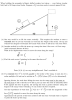 When building the pyramids in Egypt, skilled workers (not slaves ... your history teacher lied) had to lift large stone blocks. Suppose a 22 ton stone needs to moved upward 9 feet. b 41 9 40 (a) One way would be to lift the stone vertically. This requires the workers to exert a constant force of 2.5 tons vertically (to overcome the weight of the stone). Set up and evaluate the integral to determine how much work is done to...
(1) Suppose you lift a stone that has a mass of 5.3 kilograms off the floor...
(1) Suppose you lift a stone that has a mass of 5.3 kilograms off the floor onto a shelf that is 2 meters high. How much work have you done? Joules (2) Suppose you lift a laptop that weighs 3.2 pounds off the floor onto a shelf that is 4 feet high. How much work have you done? foot-pounds (3) The force on a particle is described by 9x^3−1 pounds at a point xx feet along the x-axis. Find the...
 Learning Goal: To practice Problem-Solving Strategy 8.1 Static equilibrium Part C When you lift an object by moving only your forearm, the main lifting muscle in your arm is the biceps. Suppose the mass of a forearm is 1.40 kg. If the biceps is connected to the forearm a distance dbiceps 3.00 cm from the elbow, how much force Fbicepa must the biceps exert to hold a 700 g ball at the end of the forearm at distance dball 32.0...
 Review I Constants Learning Goal: To practice Problem-Solving Strategy 8.1 Static equilibrium problems. Correct When you lift an object by moving only your forearm, the main lifting muscle in your arm is the biceps. Suppose the mass of a forearm is 1.20 kg. If the biceps is connected to the forearm a distance diceps = 2.50 cm from the elbow, how much force Fices must the biceps exert to hold a 500 g ball at the end af the forearm...
 To practice Problem-Soving Strabegy 8 1 Staic equlibrium problems When you in an object by moving only your torearm, the main ifting musdle in your arm is the biceps Suppose the mass of a fore arm is 150 kg If the biceps is connected to the fore arm a distanvce d 3.00 cm trom the elbow, how much force must the biceps exert to hold a 750 g ball at the end of Part F the forearm at distance d...
 Consider a person holding a bag like in the diagram, palm facing
upwards, forearm parallel to the floor, and upper arm making a
right angle with their forearm. Masses are added to the bag until
the subject can no longer comfortably keep the angle between their
upper arm and forearm at 90 degrees.
Weight of person: 170 lbs (756.5 N)
Body Segment and Percentage Amount of Total Body Weight
Head( 7.3%), Hand(0.7%), Trunk(50.7%) Thigh(10.3%), Upper
Arm(2.6%)
Calf(4.3%), (Forearm1.6%), Foot(1.5%)
The...
Consider a person holding a bag like in the diagram, palm facing
upwards, forearm parallel to the floor, and upper arm making a
right angle with their forearm. Masses are added to the bag until
the subject can no longer comfortably keep the angle between their
upper arm and forearm at 90 degrees.
Weight of person: 170 lbs (756.5 N)
Body Segment and Percentage Amount of Total Body Weight
Head( 7.3%), Hand(0.7%), Trunk(50.7%) Thigh(10.3%), Upper
Arm(2.6%)
Calf(4.3%), (Forearm1.6%), Foot(1.5%)
The...
 PRACTICE IT Use the worked example above to help you solve this problem. In a car lift used in a service station, compressed air exerts a force on a small piston of circular cross section having a radius of r = 4.55 cm. This pressure is transmitted by an incompressible liquid to a second piston of radius 13.7 cm. (a) What force must the compressed air exert on the small piston in order to lift a car weighing 13,300 N?...
 When building the pyramids in Egypt, skilled workers (not slaves ... your history teacher lied) had to lift large stone blocks. Suppose a 22 ton stone needs to moved upward 9 feet. b 41 9 40 (a) One way would be to lift the stone vertically. This requires the workers to exert a constant force of 2.5 tons vertically (to overcome the weight of the stone). Set up and evaluate the integral to determine how much work is done to...
Most questions answered within 3 hours.
-
Where is the error in this code sequence?
String s1 = "Hello";
String s2 = "ello";...
asked 11 months ago -
Financial data for Joel de Paris, Inc., for last year
follow:
Joel de Paris, Inc.
Balance...
asked 11 months ago -
Consider this reaction:
Al2(SO4)3 (aq)+ BaCl3
(aq) Al2Cl6 (aq)- +
3BaSO4(s) . What is the...
asked 11 months ago -
Suppose that Savneet is considering increasing her
recent random sample from 20 car rentals to 40...
asked 11 months ago -
Trucks arrive at an unloading terminal at an average rate of 120
per hour.
Trucks arrive...
asked 11 months ago -
Why are methanol and ethanol completely soluble in water while
octanol is not very little soluble....
asked 11 months ago -
A facilities manager at a university reads in a research report
that the mean amount of...
asked 11 months ago -
When the CuSO4 is rehydrated by adding water to the anhydrous
compound, is this an endothermic...
asked 11 months ago -
A ray of sunlight is passing from diamond into crown glass; the
angle of incidence is...
asked 11 months ago -
A block of mass 0.249 kg is placed on top of a light, vertical
spring of...
asked 11 months ago -
how do the kidneys compensate in the presences of acidosis
a) trigger hyperventilate
b) reserve acid...
asked 11 months ago -
Question 501 pts
The rental rate of capital to the firm increases. Which of the
following...
asked 11 months ago