
Homework Answers
Add Answer to:
Prepare For It! Prelab Question A student weighs a flask, foil cover, and rubber band and...
DATA TABLE Trial 1 Trial 2 Mass of Erlenmeyer flask, rubber band and foil cover (g) 90.560 90.10 Temperature of wat...
 DATA TABLE Trial 1 Trial 2 Mass of Erlenmeyer flask, rubber band and foil cover (g) 90.560 90.10 Temperature of water bath (°C) 100t 99.1 Mass of Erlenmeyer flask, rubber band, foil cover and condensed 0819 gas sample (9) Mass of the condensed gas sample (9) 251.59 Barometric (atmospheric) pressure (mmHg) 128.96 28.93 Volume of the Erlenmeyer flask (mL) 170 170 Molar mass of the unknown sample (g/mole) Average molar mass (g/mol): DATA ANALYSIS (Show your calculations) 1. Determine the...
THE MOLAR MASS OF A VOLATILE LIQUID 1. A foil-covered flask was found to have a...
 THE MOLAR MASS OF A VOLATILE LIQUID 1. A foil-covered flask was found to have a mass of 161.38 have a mass of 167.38 g. A volatile liquid was placed L00.0°C at a barometric pressure of 743.8 mm Hg. The foil-covered inside and heated to 100.0°C at a barometric press flask containing the vapor had a mass the molar mass of this volatile liquid. 's the vapor had a mass of 167.71 g and a volume of 147.0 mL. Calculate...
A student weighs an empty special round bottom flask and stopper. He finds the mass to...
A student weighs an empty special round bottom flask and stopper. He finds the mass to be 56.972 g. He then adds about 5 mL of an unknown liquid and heats the flask in a boiling water bath at 100oC. He allows all the liquid to vaporized and then removes the flask from the bath, stoppers it, and lets it cool. Upon cooling, he briefly removes the stopper, then replaces it and weighs the flask and condensed vapor, obtaining a...
Barometric Pressure 0.992 atm Mass of Flask + Foil 56 g Mass of Flask + Foil...
Barometric Pressure 0.992 atm Mass of Flask + Foil 56 g Mass of Flask + Foil + Condensed Liquid 59 g Mass of Condensed Liquid 3 g Volume of Flask 300 ml Temperature of Water Bath when Vaporization Begins 333 K Temperature of Water Bath when Water Begins to Boil 363 K Molar Mass 46 g mol Ideal gas law PV=nRT P=pressure V=volume of gas n=number of moles R=gas constant T=temperature Molar volume V=RT/P Density of gas D=PM x RT Molar mass M=(mRT)/(PV) I...
i dont understand why the molecular weight i calculated (42.012 g/mol) for my unknown liquid (acetone)...
 i dont understand why the molecular weight i calculated
(42.012 g/mol) for my unknown liquid (acetone) is less than the
actual molecular weight (58.08 g/mol). what errors could i have
made in my lab that would account for the difference.
Molecular Weight of a Volatile Liquid In this experiment, an amount of liquid more than sufficient to fill the flask when vaporized is placed in a flask of measured volume and mass. The flask is then heated in a boiling...
i dont understand why the molecular weight i calculated
(42.012 g/mol) for my unknown liquid (acetone) is less than the
actual molecular weight (58.08 g/mol). what errors could i have
made in my lab that would account for the difference.
Molecular Weight of a Volatile Liquid In this experiment, an amount of liquid more than sufficient to fill the flask when vaporized is placed in a flask of measured volume and mass. The flask is then heated in a boiling...
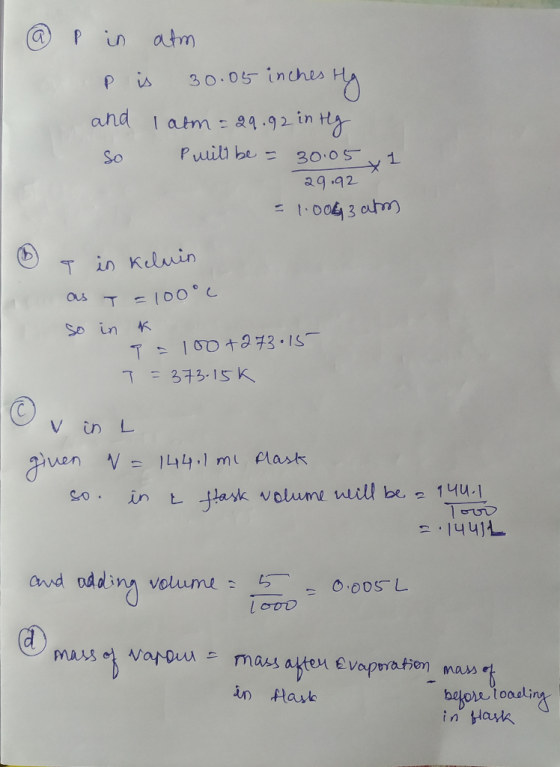
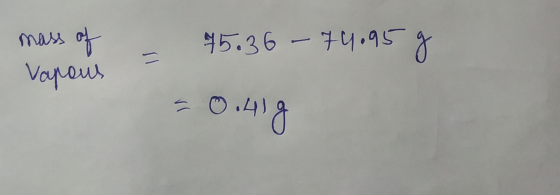
How do you solve Part D. Calculations (Moles of vapor, mass of vapor, and molar mass...
 How do you solve Part D.
Calculations (Moles of vapor, mass of vapor, and molar mass of
vapor)
3. a. The following data were recorded in determining the molar mass of a volatile liquid following the Experimental Procedure of this experiment. Complete the table for analysis. (See Report Sheet.) Record calculated values with the correct number of significant figures. Calculation Zone 74.722 Part D.1 98.7 74.921_ Part D.2 A. Preparing the Sample 1. Mass of dry flask, foil, and rubber...
How do you solve Part D.
Calculations (Moles of vapor, mass of vapor, and molar mass of
vapor)
3. a. The following data were recorded in determining the molar mass of a volatile liquid following the Experimental Procedure of this experiment. Complete the table for analysis. (See Report Sheet.) Record calculated values with the correct number of significant figures. Calculation Zone 74.722 Part D.1 98.7 74.921_ Part D.2 A. Preparing the Sample 1. Mass of dry flask, foil, and rubber...
An empty 149 mL flask weighs 68.322 g before a sample of volatile liquid is added....
 An empty 149 mL flask weighs 68.322 g before a sample of volatile liquid is added. The flask is then placed In a hot (95.0 degree C) water bath; the barometric pressure is 740 mm Hg. The liquid vaporizes and the gas fills the flask. After cooling the flask and condensed liquid together weigh 68.697 g. What is the molar mass of the volatile liquid? 9.73g/mol 78.09 g/mol 4.80 times 10^-3 g/mol 49.69/mol 44.01 g/mol
1. Under what conditions do real gases behave most like an ideal gas? 3. A student had an...
1. Under what conditions do real gases behave most like an ideal gas? 3. A student had an unknown liquid and wished to determine its molecular weight. The following data was collected using the procedure of this experiment: Weight of the 125 mL Erlenmeyer flask and cover (Al foil and Cu wire), 75.33 g Weight of cooled flask and cover containing condensed liquid, 87.6 g Temperature of boiling water, 100.5 oC Volume of the 125 mL Erlenmeyer flask, 165.5 mL Atmospheric pressure, 780.3...
Chame nsead tu age 06-17 Experiment 8: Molar Mass of a Volatile Liquid Purpose To determine...
 Chame nsead tu age 06-17 Experiment 8: Molar Mass of a Volatile Liquid Purpose To determine the molar mass of a pure substance we need to find out (a) the number of moles in a given sample, and (b) the mass of the same sample. Molar mass is then: mass divided by moles Introduction Using the ideal gas equation, PV= nRT, we can determine the number of moles (n) of gas or vapor under measured conditions of pressure (P), volume...
List t wo reasons why it is necessary to put a pinhole in the aluminum foil...
 List t wo reasons why it is necessary to put a pinhole in the aluminum foil 2. Why was it NOT necessary to clean and dry the flask before performing your second determination? 3. A certain liquid has a molecular weight of 100 g/mole. The following data were obtained for a Dumas molecular weight determination: V-0.265 liters T 372 K and P 1.02 atm g of condensed vapor 0.58 g From this data a molecular weight of 65.5 g/mole was...
 DATA TABLE Trial 1 Trial 2 Mass of Erlenmeyer flask, rubber band and foil cover (g) 90.560 90.10 Temperature of water bath (°C) 100t 99.1 Mass of Erlenmeyer flask, rubber band, foil cover and condensed 0819 gas sample (9) Mass of the condensed gas sample (9) 251.59 Barometric (atmospheric) pressure (mmHg) 128.96 28.93 Volume of the Erlenmeyer flask (mL) 170 170 Molar mass of the unknown sample (g/mole) Average molar mass (g/mol): DATA ANALYSIS (Show your calculations) 1. Determine the...
 THE MOLAR MASS OF A VOLATILE LIQUID 1. A foil-covered flask was found to have a mass of 161.38 have a mass of 167.38 g. A volatile liquid was placed L00.0°C at a barometric pressure of 743.8 mm Hg. The foil-covered inside and heated to 100.0°C at a barometric press flask containing the vapor had a mass the molar mass of this volatile liquid. 's the vapor had a mass of 167.71 g and a volume of 147.0 mL. Calculate...
 i dont understand why the molecular weight i calculated
(42.012 g/mol) for my unknown liquid (acetone) is less than the
actual molecular weight (58.08 g/mol). what errors could i have
made in my lab that would account for the difference.
Molecular Weight of a Volatile Liquid In this experiment, an amount of liquid more than sufficient to fill the flask when vaporized is placed in a flask of measured volume and mass. The flask is then heated in a boiling...
i dont understand why the molecular weight i calculated
(42.012 g/mol) for my unknown liquid (acetone) is less than the
actual molecular weight (58.08 g/mol). what errors could i have
made in my lab that would account for the difference.
Molecular Weight of a Volatile Liquid In this experiment, an amount of liquid more than sufficient to fill the flask when vaporized is placed in a flask of measured volume and mass. The flask is then heated in a boiling...
 How do you solve Part D.
Calculations (Moles of vapor, mass of vapor, and molar mass of
vapor)
3. a. The following data were recorded in determining the molar mass of a volatile liquid following the Experimental Procedure of this experiment. Complete the table for analysis. (See Report Sheet.) Record calculated values with the correct number of significant figures. Calculation Zone 74.722 Part D.1 98.7 74.921_ Part D.2 A. Preparing the Sample 1. Mass of dry flask, foil, and rubber...
How do you solve Part D.
Calculations (Moles of vapor, mass of vapor, and molar mass of
vapor)
3. a. The following data were recorded in determining the molar mass of a volatile liquid following the Experimental Procedure of this experiment. Complete the table for analysis. (See Report Sheet.) Record calculated values with the correct number of significant figures. Calculation Zone 74.722 Part D.1 98.7 74.921_ Part D.2 A. Preparing the Sample 1. Mass of dry flask, foil, and rubber...
 An empty 149 mL flask weighs 68.322 g before a sample of volatile liquid is added. The flask is then placed In a hot (95.0 degree C) water bath; the barometric pressure is 740 mm Hg. The liquid vaporizes and the gas fills the flask. After cooling the flask and condensed liquid together weigh 68.697 g. What is the molar mass of the volatile liquid? 9.73g/mol 78.09 g/mol 4.80 times 10^-3 g/mol 49.69/mol 44.01 g/mol
 Chame nsead tu age 06-17 Experiment 8: Molar Mass of a Volatile Liquid Purpose To determine the molar mass of a pure substance we need to find out (a) the number of moles in a given sample, and (b) the mass of the same sample. Molar mass is then: mass divided by moles Introduction Using the ideal gas equation, PV= nRT, we can determine the number of moles (n) of gas or vapor under measured conditions of pressure (P), volume...
 List t wo reasons why it is necessary to put a pinhole in the aluminum foil 2. Why was it NOT necessary to clean and dry the flask before performing your second determination? 3. A certain liquid has a molecular weight of 100 g/mole. The following data were obtained for a Dumas molecular weight determination: V-0.265 liters T 372 K and P 1.02 atm g of condensed vapor 0.58 g From this data a molecular weight of 65.5 g/mole was...
Most questions answered within 3 hours.
-
Where is the error in this code sequence?
String s1 = "Hello";
String s2 = "ello";...
asked 10 months ago -
Financial data for Joel de Paris, Inc., for last year
follow:
Joel de Paris, Inc.
Balance...
asked 10 months ago -
Consider this reaction:
Al2(SO4)3 (aq)+ BaCl3
(aq) Al2Cl6 (aq)- +
3BaSO4(s) . What is the...
asked 10 months ago -
Suppose that Savneet is considering increasing her
recent random sample from 20 car rentals to 40...
asked 10 months ago -
Trucks arrive at an unloading terminal at an average rate of 120
per hour.
Trucks arrive...
asked 10 months ago -
Why are methanol and ethanol completely soluble in water while
octanol is not very little soluble....
asked 10 months ago -
A facilities manager at a university reads in a research report
that the mean amount of...
asked 10 months ago -
When the CuSO4 is rehydrated by adding water to the anhydrous
compound, is this an endothermic...
asked 10 months ago -
A ray of sunlight is passing from diamond into crown glass; the
angle of incidence is...
asked 10 months ago -
A block of mass 0.249 kg is placed on top of a light, vertical
spring of...
asked 10 months ago -
how do the kidneys compensate in the presences of acidosis
a) trigger hyperventilate
b) reserve acid...
asked 10 months ago -
Question 501 pts
The rental rate of capital to the firm increases. Which of the
following...
asked 10 months ago