You will float a wood block in a container filled with water. Derive a formula predicting...
You will float a wood block in a container filled with water. Derive a formula predicting the percentage of the block submerged. (Hint: This is a problem in fluid statics. The weight of the block must be balanced by the buoyant force). The formula should be expressed as a ratio in terms of the volume of the block, V_block, and the volume of displaced water, V_water. The result should be given in terms of the density of the block, ρ_block, and the density of water, ρ_water.
I know this question has already been answered, but I get lost. If you could answer it step-by-step and use a picture I would appreciate it!!
Homework Answers
Summary of answer-in the solution we used the principal that upthrust force on a body is equal to the amount of water displaced by it.also in floating condition the weight of block will be equal to the the upthrust force acting on the block.
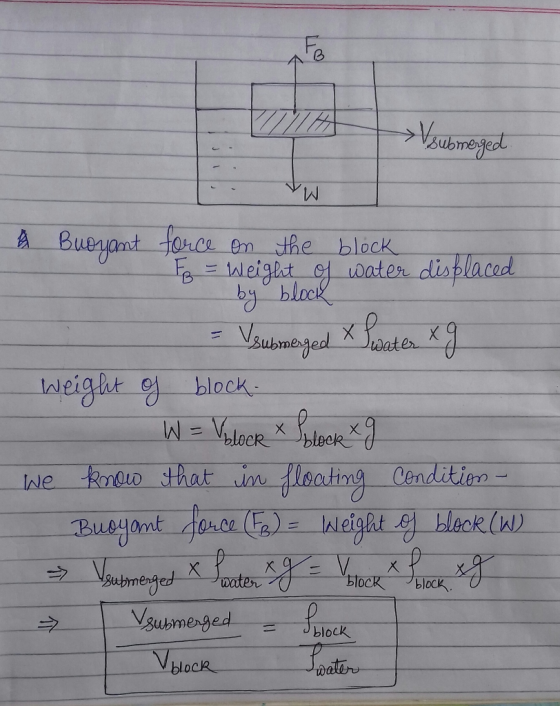
for any confusion with the solution please comment.
Add Answer to:
You will float a wood block in a container filled with water.
Derive a formula predicting...
105.00 L 5.00 kg 0.00 N Fluid Oil Water Weight of 5.00 kg wood block =...
 105.00 L 5.00 kg 0.00 N Fluid Oil Water Weight of 5.00 kg wood block = 49 N Step 2: Place the wood block in the water and notice that it floats. When the wood block rests on the ground, the downward gravitational force is balanced by an upward normal (“contact") force. When floating, the gravitational force is still there, but the normal (contact") force is not. The force exerted by the fluid is the buoyant force (B). When floating,...
B. Floating, wooden block s 13. Remove the brick block from the water.be 14. Use the...
 B. Floating, wooden block s 13. Remove the brick block from the water.be 14. Use the scale to determine the weight of the wood block out of water. 49.00 N 15. Note the exact water level reading in the container of water and record the reading below. 100.00L 16. Now, complete submerge the wooden block in the water and hold it there under the water with the mouse. Note the new water level reading in the container of water and...
A block of wood of mass 2kg floats in water, and it is noted that volume...
 A block of wood of mass 2kg floats in water, and it is noted
that volume is 3/4 is submerged. density of water 1000
kg/m3.
a) What is the buoyant force of the block? hint:
V is volume and g is 9.81 m/s2.
b) What is the density of the block?
A block of wood of mass 2kg floats in water, and it is noted
that volume is 3/4 is submerged. density of water 1000
kg/m3.
a) What is the buoyant force of the block? hint:
V is volume and g is 9.81 m/s2.
b) What is the density of the block?
2. 95% of a wood block is submerged in water (density= 1000 kg/m). A layer of...
 2. 95% of a wood block is submerged in water (density= 1000 kg/m). A layer of oil with a density of 880 kg/m' is now poured on top, to a depth that more than covers the block, as shown. Find the resulting new volume fraction submerged in water, V(in water) / V(block). Hints: (i) You get two buoyant forces - one for each liquid; Also note that (ii) volume, V(block) = V(in water) + V(in oil). d=880 kg/m² V =...
A 4.00 cm x 4.00 cm x 4.00 cm cube of density 920 kg/m3 is floating at rest at the top of a beaker of cross sectional area 100 cm2 with 500 mL of water in it. 500 mL of oil of density 900 kg/m3 is add...
A 4.00 cm x 4.00 cm x 4.00 cm cube of density 920 kg/m3 is floating at rest at the top of a beaker of cross sectional area 100 cm2 with 500 mL of water in it. 500 mL of oil of density 900 kg/m3 is added to the top of the beaker, and the cube is observed to float completely submerged, unevenly straddling the boundary between the oil and water. a. Draw a picture showing the beaker, layers of...
A 10 cm * 10 cm * 10cm block of wood with density 700 kg/m^3 is...
A 10 cm * 10 cm * 10cm block of wood with density 700 kg/m^3 is held underwater by a string tied to the bottom of the container. a) What is the tension of the string? b) Will the block float or sink if the string is removed? If it floats and after reaching equilibrium, what will be the volume portion of the block above water surface? c) What should be the mass of a piece of metal put on...
A) A 4.00 cm x 4.00 cm x 4.00 cm cube of density 920 kg/m3 is...
A) A 4.00 cm x 4.00 cm x 4.00 cm cube of density 920 kg/m3 is floating at rest at the top of a beaker of cross sectional area 100 cm2 with 500 mL of water in it (1 mL of water has a volume of 1 cm3 or 1x10⁻⁶ m3 ). 500 mL of oil of density 900 kg/m3 is added to the top of the beaker, and the cube is observed to float completely submerged, unevenly straddling the...
mass of One way of restating Archimedes' Principle is that the mass of a block that...
 mass of One way of restating Archimedes' Principle is that the mass of a block that is floating in a fuid is equal to the the fluid displaced by the block. Imagine that we have a solid block in which all of the sides are 1 cm long-a cube with a volume of 1 cm (Fig.A1.4.2A). We set it in a beaker of pure water and find that, when the block and water come to rest, 70% of the block...
I need help with lab this week. I have posted theory and procedures to the lab. The questions wit...
I need help with lab this week. I have posted theory and procedures to the lab. The questions with ????????? are the ones I need help with. Please Help!! Thank you Theory Density is defined as mass per unit volume that has a metric unit of kg per cubic meter. Grams per cubic centimeter i.e. g/cm3 actually is widely used as the unit of density. The densities for objects with regular shapes are easily to be determined. For objects with...
 105.00 L 5.00 kg 0.00 N Fluid Oil Water Weight of 5.00 kg wood block = 49 N Step 2: Place the wood block in the water and notice that it floats. When the wood block rests on the ground, the downward gravitational force is balanced by an upward normal (“contact") force. When floating, the gravitational force is still there, but the normal (contact") force is not. The force exerted by the fluid is the buoyant force (B). When floating,...
 B. Floating, wooden block s 13. Remove the brick block from the water.be 14. Use the scale to determine the weight of the wood block out of water. 49.00 N 15. Note the exact water level reading in the container of water and record the reading below. 100.00L 16. Now, complete submerge the wooden block in the water and hold it there under the water with the mouse. Note the new water level reading in the container of water and...
 A block of wood of mass 2kg floats in water, and it is noted
that volume is 3/4 is submerged. density of water 1000
kg/m3.
a) What is the buoyant force of the block? hint:
V is volume and g is 9.81 m/s2.
b) What is the density of the block?
A block of wood of mass 2kg floats in water, and it is noted
that volume is 3/4 is submerged. density of water 1000
kg/m3.
a) What is the buoyant force of the block? hint:
V is volume and g is 9.81 m/s2.
b) What is the density of the block?
 2. 95% of a wood block is submerged in water (density= 1000 kg/m). A layer of oil with a density of 880 kg/m' is now poured on top, to a depth that more than covers the block, as shown. Find the resulting new volume fraction submerged in water, V(in water) / V(block). Hints: (i) You get two buoyant forces - one for each liquid; Also note that (ii) volume, V(block) = V(in water) + V(in oil). d=880 kg/m² V =...
 mass of One way of restating Archimedes' Principle is that the mass of a block that is floating in a fuid is equal to the the fluid displaced by the block. Imagine that we have a solid block in which all of the sides are 1 cm long-a cube with a volume of 1 cm (Fig.A1.4.2A). We set it in a beaker of pure water and find that, when the block and water come to rest, 70% of the block...
Most questions answered within 3 hours.
-
Where is the error in this code sequence?
String s1 = "Hello";
String s2 = "ello";...
asked 10 months ago -
Financial data for Joel de Paris, Inc., for last year
follow:
Joel de Paris, Inc.
Balance...
asked 10 months ago -
Consider this reaction:
Al2(SO4)3 (aq)+ BaCl3
(aq) Al2Cl6 (aq)- +
3BaSO4(s) . What is the...
asked 10 months ago -
Suppose that Savneet is considering increasing her
recent random sample from 20 car rentals to 40...
asked 10 months ago -
Trucks arrive at an unloading terminal at an average rate of 120
per hour.
Trucks arrive...
asked 10 months ago -
Why are methanol and ethanol completely soluble in water while
octanol is not very little soluble....
asked 10 months ago -
A facilities manager at a university reads in a research report
that the mean amount of...
asked 10 months ago -
When the CuSO4 is rehydrated by adding water to the anhydrous
compound, is this an endothermic...
asked 10 months ago -
A ray of sunlight is passing from diamond into crown glass; the
angle of incidence is...
asked 10 months ago -
A block of mass 0.249 kg is placed on top of a light, vertical
spring of...
asked 10 months ago -
how do the kidneys compensate in the presences of acidosis
a) trigger hyperventilate
b) reserve acid...
asked 10 months ago -
Question 501 pts
The rental rate of capital to the firm increases. Which of the
following...
asked 10 months ago