Question 16 8 Points Silver is known to be an excellent conductor of heat and electricity....
Question 16
8 Points
Silver is known to be an excellent conductor of heat and electricity. if 8.20 kJ of energy are provided, calculate the energy required (Joules - just put in the number, 4 sig figs) to heat 14.25 g of silver from 25.00 °C to its melting point BLANK-1, the energy required (kJ - just put in the number, 4 sig figs) to melt the silver BLANK-2, and determine whether the silver will reach the boiling point. (yes/no) BLANK-3. What will the final temperature of the silver be (oC - just put in the number, 4 sig figs) BLANK-4? (Do not include commas in your answers, give all numeric answers to 4 significant figures, do not use scientific notation)
{heat capacity of solid silver = 24.80 J K-1 mol-1, heat capacity of liquid silver 33.40 J K-1 mol-1, heat capacity of gaseous silver 21.10 J K-1 mol-1, ΔHfus (Ag) = 11.97 kJ/mol, ΔHvap (Ag) = 250.6 kJ/mol, m.p. Ag = 962.0° C, b.p. Ag = 2212° C }
- BLANK-1
- BLANK-2
- BLANK-3
- BLANK-4
Homework Answers
1b)
Part 1
Calculation for heat required to increase the temperature of silver from 250 to its melting point (9620)
heat capacity of Silver = 24.80 J K-1 mol-1
moles of Silver = ( mass / molar mass) = ( 14.25/107.8) = 0.132
H1 = moles of silver heat capacity of
solid silver
temperature
change
= 0.132 24.80
(
962 - 25)
= 3067 J
= 3.067 KJ
answer of Blank 1 = 3.067 KJ
Part 2
Calculation for heat required to melt silver
H2 = moles of Silver Enthalpy of
fusion of Silver
= 0.132 (mol) 11.97
(KJ/mol)
= 1.580 KJ
Answer of BLANK 2 is 1.580 KJ
Part 3
Total heat remains = 8.20 KJ - ( H1 +H2) = 8.25 - (3.067 + 1.580) = 3.602 KJ
now heat required to reach boiling point of liquid silver
H3 = moles of silver heat capacity of
liquid silver
temperature
change
= 0.132 33.40
(
2212 - 962)
= 5511 J
= 5.511 KJ
As heat required to raise the temperature to boiling point is less than heat remain after melting of silver , so it will not reach boiling point.
Therefore answer of BLANK 3 is NO.
part 4
Heat = moles of silver heat capacity of
liquid silver
temperature
change
or .3.602 1000 (J ) =
0.132
33.40
(
Tf - 962)
or 3602 = 4.4088 ( Tf
- 962)
or, ( Tf - 962) = 817
or, Tf = 1779 0c
Hence final temperature is 1779 0c.
answer of BLANK 4 is 1779 0C.
Add Answer to:
Question 16
8 Points
Silver is known to be an excellent conductor of heat and
electricity....
The specific heat capacity of silver is 0.24 J/°C .g. (a) Calculate the energy required to...
 The specific heat capacity of silver is 0.24 J/°C .g. (a) Calculate the energy required to raise the temperature of 140.0 g Ag from 273 K to 305 K. (b) Calculate the energy required to raise the temperature of 1.0 mol Ag by 1.0°C (called the molar heat capacity of silver). O J/mol°C (c) It takes 1.35 kJ of energy to heat a sample of pure silver from 12.0°C to 15.3°C. Calculate the mass of the sample of silver. 9
The specific heat capacity of silver is 0.24 J/g ·°C a. What additional piece of information...
The specific heat capacity of silver is 0.24 J/g ·°C a. What additional piece of information is needed to calculate the molar heat capacity of silver (6 points)? b. Calculate the energy required to raise the temperature of 245.0 g Ag from 273 K to 373 K? (6 points) c. It takes 65 kJ of energy to raise a sample of silver from 298 K to 363 K. Calculate the mass of silver in this sample. (6 points)
Heat Evolved During Combustion and Heat Capacity of a Gas at Constant Pressure A. Consider the...
 Heat Evolved During Combustion and Heat Capacity of a
Gas at Constant Pressure
A.
Consider the following reaction:
2 C2H2(g) + 5
O2(g)
4 CO2(g) + 2H2O(l)
Use standard heats of formation from Zumdahl 'Chemical
Principles' 8th ed. Appendix Four pp A19 - A21.
a) How much heat is evolved when
1.440×101 moles of
C2H2(g) is burned in excess oxygen.
Answer to 4 sig figs.
b) How much heat is evolved when
2.250×10² g of CO2(g) is produced
from the...
Heat Evolved During Combustion and Heat Capacity of a
Gas at Constant Pressure
A.
Consider the following reaction:
2 C2H2(g) + 5
O2(g)
4 CO2(g) + 2H2O(l)
Use standard heats of formation from Zumdahl 'Chemical
Principles' 8th ed. Appendix Four pp A19 - A21.
a) How much heat is evolved when
1.440×101 moles of
C2H2(g) is burned in excess oxygen.
Answer to 4 sig figs.
b) How much heat is evolved when
2.250×10² g of CO2(g) is produced
from the...
Question 4 of 15 Page 4 of 15 Question 4 (6 points) A piece of copper...
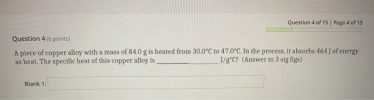 Question 4 of 15 Page 4 of 15 Question 4 (6 points) A piece of copper alloy with a mass of 84.0 g is heated from 30.0°C to 47.0°C. In the process, it absorbs 464 of energy as heat. The specific heat of this copper alloy is J/gºC? (Answer to 3 sig figs) Blank 1:
Question 15 2 Points How much energy is required to heat 44.72 g of H2O from...
Question 15 2 Points How much energy is required to heat 44.72 g of H2O from 10.00 oC to 37.50 oC? (Heat capacity of liquid H2O = 75.37 J mol-1 K-1) (type in the numeric value in Joules - give your answer to 4 significant figures, do not include the units in your answer only the number, do not use scientific notation, do not include comma's) BLANK-1 BLANK-1
The vaporization of compound A is described by the following chemical equation. A(1) A(8) A rap(72.39...
 The vaporization of compound A is described by the following chemical equation. A(1) A(8) A rap(72.39 °C) = 38.21 kJ/mol Calculate the entropy of vaporization, Aswap, for A(l) at 25.0 °C given that the boiling point of A is 72.39 °C, and the molar heat capacity of A(l) is 119.09 J/mol K). Assume that the molar heat capacity of A(R) is 56.5% of that of A(1). ASP J. mol-K Calculate the standard enthalpy of vaporization. A Hap, for A(1) at...
Question 7 of 10 Calculate the energy released as heat when 17.8 g of liquid mercury...
 Question 7 of 10 Calculate the energy released as heat when 17.8 g of liquid mercury at Constants for mercury at 1 atm 25.00 °C is converted to solid mercury at its melting point. heat capacity of Hg() 28.0 J/(mol-K) melting point 234.32 K enthalpy of fusion 2.29 kJ/mol kJ q =
QUESTION How much heating power (in kW) is required to heat a 4.85 kg piece of...
QUESTION How much heating power (in kW) is required to heat a 4.85 kg piece of steel initially at room temperature 21.0 oC to a fully molten state in 3.07 hours? (Data value are correct to 4 sig fig: steel melting point = 1371 oC steel specific heat capacity = 480 J kg-1 K-1 steel specific latent heat of fusion = 4200 kJ kg-1. )
correct sig fig number please! Question 49 (1 point) A student runs the reaction below starting...
 correct sig fig number please!
Question 49 (1 point) A student runs the reaction below starting with 53 grams of ammonia (NH3). How many grams of water should form? 4 NH3 + 5 O2 - 4 NO + 6 H20 NH3 molar mass = 17.04 g/mol H20 molar mass = 18.02 g/mol Report your answer with the correct number of significant figures. Your Answer: I Answer units Question 50 (1 point) When 6.23 grams of an unknown metal is heated...
correct sig fig number please!
Question 49 (1 point) A student runs the reaction below starting with 53 grams of ammonia (NH3). How many grams of water should form? 4 NH3 + 5 O2 - 4 NO + 6 H20 NH3 molar mass = 17.04 g/mol H20 molar mass = 18.02 g/mol Report your answer with the correct number of significant figures. Your Answer: I Answer units Question 50 (1 point) When 6.23 grams of an unknown metal is heated...
A bomb calorimeter, or a constant volume calorimeter, is a device often used to determine the heat of combustion of fue...
 A bomb calorimeter, or a constant volume calorimeter, is a device often used to determine the heat of combustion of fuels and the energy content of foods. In an experiment, a 0.3320 g sample of naphthalene (C10Hg) is burned completely in a bomb calorimeter. The calorimeter is surrounded by 1.092x10³ g of water. During the combustion the temperature increases from 22.54 to 25.04 °C. The heat capacity of water is 4.184 Jg=1°C-1 The heat capacity of the calorimeter was determined...
 The specific heat capacity of silver is 0.24 J/°C .g. (a) Calculate the energy required to raise the temperature of 140.0 g Ag from 273 K to 305 K. (b) Calculate the energy required to raise the temperature of 1.0 mol Ag by 1.0°C (called the molar heat capacity of silver). O J/mol°C (c) It takes 1.35 kJ of energy to heat a sample of pure silver from 12.0°C to 15.3°C. Calculate the mass of the sample of silver. 9
 Heat Evolved During Combustion and Heat Capacity of a
Gas at Constant Pressure
A.
Consider the following reaction:
2 C2H2(g) + 5
O2(g)
4 CO2(g) + 2H2O(l)
Use standard heats of formation from Zumdahl 'Chemical
Principles' 8th ed. Appendix Four pp A19 - A21.
a) How much heat is evolved when
1.440×101 moles of
C2H2(g) is burned in excess oxygen.
Answer to 4 sig figs.
b) How much heat is evolved when
2.250×10² g of CO2(g) is produced
from the...
Heat Evolved During Combustion and Heat Capacity of a
Gas at Constant Pressure
A.
Consider the following reaction:
2 C2H2(g) + 5
O2(g)
4 CO2(g) + 2H2O(l)
Use standard heats of formation from Zumdahl 'Chemical
Principles' 8th ed. Appendix Four pp A19 - A21.
a) How much heat is evolved when
1.440×101 moles of
C2H2(g) is burned in excess oxygen.
Answer to 4 sig figs.
b) How much heat is evolved when
2.250×10² g of CO2(g) is produced
from the...
 Question 4 of 15 Page 4 of 15 Question 4 (6 points) A piece of copper alloy with a mass of 84.0 g is heated from 30.0°C to 47.0°C. In the process, it absorbs 464 of energy as heat. The specific heat of this copper alloy is J/gºC? (Answer to 3 sig figs) Blank 1:
 The vaporization of compound A is described by the following chemical equation. A(1) A(8) A rap(72.39 °C) = 38.21 kJ/mol Calculate the entropy of vaporization, Aswap, for A(l) at 25.0 °C given that the boiling point of A is 72.39 °C, and the molar heat capacity of A(l) is 119.09 J/mol K). Assume that the molar heat capacity of A(R) is 56.5% of that of A(1). ASP J. mol-K Calculate the standard enthalpy of vaporization. A Hap, for A(1) at...
 Question 7 of 10 Calculate the energy released as heat when 17.8 g of liquid mercury at Constants for mercury at 1 atm 25.00 °C is converted to solid mercury at its melting point. heat capacity of Hg() 28.0 J/(mol-K) melting point 234.32 K enthalpy of fusion 2.29 kJ/mol kJ q =
 correct sig fig number please!
Question 49 (1 point) A student runs the reaction below starting with 53 grams of ammonia (NH3). How many grams of water should form? 4 NH3 + 5 O2 - 4 NO + 6 H20 NH3 molar mass = 17.04 g/mol H20 molar mass = 18.02 g/mol Report your answer with the correct number of significant figures. Your Answer: I Answer units Question 50 (1 point) When 6.23 grams of an unknown metal is heated...
correct sig fig number please!
Question 49 (1 point) A student runs the reaction below starting with 53 grams of ammonia (NH3). How many grams of water should form? 4 NH3 + 5 O2 - 4 NO + 6 H20 NH3 molar mass = 17.04 g/mol H20 molar mass = 18.02 g/mol Report your answer with the correct number of significant figures. Your Answer: I Answer units Question 50 (1 point) When 6.23 grams of an unknown metal is heated...
 A bomb calorimeter, or a constant volume calorimeter, is a device often used to determine the heat of combustion of fuels and the energy content of foods. In an experiment, a 0.3320 g sample of naphthalene (C10Hg) is burned completely in a bomb calorimeter. The calorimeter is surrounded by 1.092x10³ g of water. During the combustion the temperature increases from 22.54 to 25.04 °C. The heat capacity of water is 4.184 Jg=1°C-1 The heat capacity of the calorimeter was determined...
Most questions answered within 3 hours.
-
Where is the error in this code sequence?
String s1 = "Hello";
String s2 = "ello";...
asked 10 months ago -
Financial data for Joel de Paris, Inc., for last year
follow:
Joel de Paris, Inc.
Balance...
asked 10 months ago -
Consider this reaction:
Al2(SO4)3 (aq)+ BaCl3
(aq) Al2Cl6 (aq)- +
3BaSO4(s) . What is the...
asked 10 months ago -
Suppose that Savneet is considering increasing her
recent random sample from 20 car rentals to 40...
asked 10 months ago -
Trucks arrive at an unloading terminal at an average rate of 120
per hour.
Trucks arrive...
asked 10 months ago -
Why are methanol and ethanol completely soluble in water while
octanol is not very little soluble....
asked 10 months ago -
A facilities manager at a university reads in a research report
that the mean amount of...
asked 10 months ago -
When the CuSO4 is rehydrated by adding water to the anhydrous
compound, is this an endothermic...
asked 10 months ago -
A ray of sunlight is passing from diamond into crown glass; the
angle of incidence is...
asked 10 months ago -
A block of mass 0.249 kg is placed on top of a light, vertical
spring of...
asked 10 months ago -
how do the kidneys compensate in the presences of acidosis
a) trigger hyperventilate
b) reserve acid...
asked 10 months ago -
Question 501 pts
The rental rate of capital to the firm increases. Which of the
following...
asked 10 months ago