In finance, the acronym VaR does not stand for variance; it means “value at risk.” Imagine...
In finance, the acronym VaR does not stand for variance; it means “value at risk.”
Imagine that you manage the $1 million portfolio of a wealthy investor. The portfolio is expected to average 10% growth over the next year with standard deviation 30%. Let’s convey the risk of this investment using the VaR that excludes the worst 5% of the scenarios. In other words, there is a 5% chance of losing a specific sum of money. What is this sum?
Hint: In this problem X is normal with µ= 0.10 and standard deviation ø= 0.30. You start by writing Pr( X≤ L) = 0.05 and find L. This quantity times the investment amount is the loss.
Homework Answers
The diagram is as shown below:
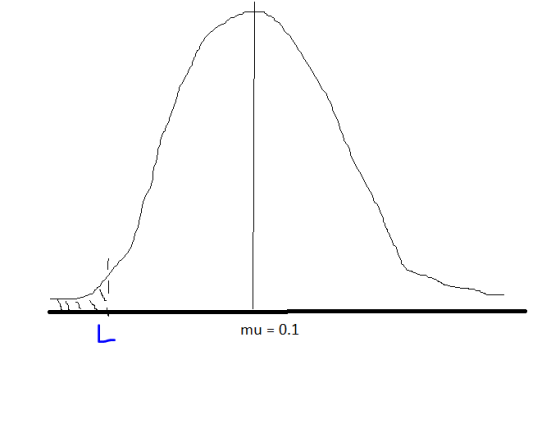
Take cues from the hint, X is normal with mean = 0.10 and standard deviation as 0.30
We need to find L such that Pr(X<=zL) = 0.05
From the z-table, zL = -1.645
-1.645 = (L - 0.10)/0.30
L = 0.10 - 1.645*0.30 = -0.3935
VaR = Value at risk = L*Investment = 0.3935*$1 Million = $393,500
mu = 0.1
Add Answer to:
In finance, the acronym VaR does not stand for variance;
it means “value at risk.”
Imagine...
Dropdown options: 1-risk/return 2-equal to/greater or less than 3-self contained/stand-alone 4-variance/standard deviation 5-variance/beta coefficient 6-diversifiable/non-diversiable 7-is/...
 Dropdown options:
1-risk/return
2-equal to/greater or less than
3-self contained/stand-alone
4-variance/standard deviation
5-variance/beta coefficient
6-diversifiable/non-diversiable
7-is/ is not
8-diversifiable/non-diversifiable
9-random/non random
10-decreasing/increasing
11-2000+/500
12-reduces/increases
13-systematic of market/unsystematic or company-specific
14-diversifiable/non diversifiable
1. Basic concepts - Risk and return Professor Isadore (Izzy) Invest-a-Lot retired two years ago from Exceptional College, a small liberal arts college in North Carolina after teaching corporate finance and investment theory for 35 years. Yesterday, Izzy appear on EC LIVE, a television show produced for the students,...
Dropdown options:
1-risk/return
2-equal to/greater or less than
3-self contained/stand-alone
4-variance/standard deviation
5-variance/beta coefficient
6-diversifiable/non-diversiable
7-is/ is not
8-diversifiable/non-diversifiable
9-random/non random
10-decreasing/increasing
11-2000+/500
12-reduces/increases
13-systematic of market/unsystematic or company-specific
14-diversifiable/non diversifiable
1. Basic concepts - Risk and return Professor Isadore (Izzy) Invest-a-Lot retired two years ago from Exceptional College, a small liberal arts college in North Carolina after teaching corporate finance and investment theory for 35 years. Yesterday, Izzy appear on EC LIVE, a television show produced for the students,...
 Dropdown options:
1-risk/return
2-equal to/greater or less than
3-self contained/stand-alone
4-variance/standard deviation
5-variance/beta coefficient
6-diversifiable/non-diversiable
7-is/ is not
8-diversifiable/non-diversifiable
9-random/non random
10-decreasing/increasing
11-2000+/500
12-reduces/increases
13-systematic of market/unsystematic or company-specific
14-diversifiable/non diversifiable
1. Basic concepts - Risk and return Professor Isadore (Izzy) Invest-a-Lot retired two years ago from Exceptional College, a small liberal arts college in North Carolina after teaching corporate finance and investment theory for 35 years. Yesterday, Izzy appear on EC LIVE, a television show produced for the students,...
Dropdown options:
1-risk/return
2-equal to/greater or less than
3-self contained/stand-alone
4-variance/standard deviation
5-variance/beta coefficient
6-diversifiable/non-diversiable
7-is/ is not
8-diversifiable/non-diversifiable
9-random/non random
10-decreasing/increasing
11-2000+/500
12-reduces/increases
13-systematic of market/unsystematic or company-specific
14-diversifiable/non diversifiable
1. Basic concepts - Risk and return Professor Isadore (Izzy) Invest-a-Lot retired two years ago from Exceptional College, a small liberal arts college in North Carolina after teaching corporate finance and investment theory for 35 years. Yesterday, Izzy appear on EC LIVE, a television show produced for the students,...
Most questions answered within 3 hours.
-
Where is the error in this code sequence?
String s1 = "Hello";
String s2 = "ello";...
asked 10 months ago -
Financial data for Joel de Paris, Inc., for last year
follow:
Joel de Paris, Inc.
Balance...
asked 10 months ago -
Consider this reaction:
Al2(SO4)3 (aq)+ BaCl3
(aq) Al2Cl6 (aq)- +
3BaSO4(s) . What is the...
asked 10 months ago -
Suppose that Savneet is considering increasing her
recent random sample from 20 car rentals to 40...
asked 10 months ago -
Trucks arrive at an unloading terminal at an average rate of 120
per hour.
Trucks arrive...
asked 10 months ago -
Why are methanol and ethanol completely soluble in water while
octanol is not very little soluble....
asked 10 months ago -
A facilities manager at a university reads in a research report
that the mean amount of...
asked 10 months ago -
When the CuSO4 is rehydrated by adding water to the anhydrous
compound, is this an endothermic...
asked 10 months ago -
A ray of sunlight is passing from diamond into crown glass; the
angle of incidence is...
asked 10 months ago -
A block of mass 0.249 kg is placed on top of a light, vertical
spring of...
asked 10 months ago -
how do the kidneys compensate in the presences of acidosis
a) trigger hyperventilate
b) reserve acid...
asked 10 months ago -
Question 501 pts
The rental rate of capital to the firm increases. Which of the
following...
asked 10 months ago