What structural characteristics are desirable for a substrate that can react in both SN1 and SN2...
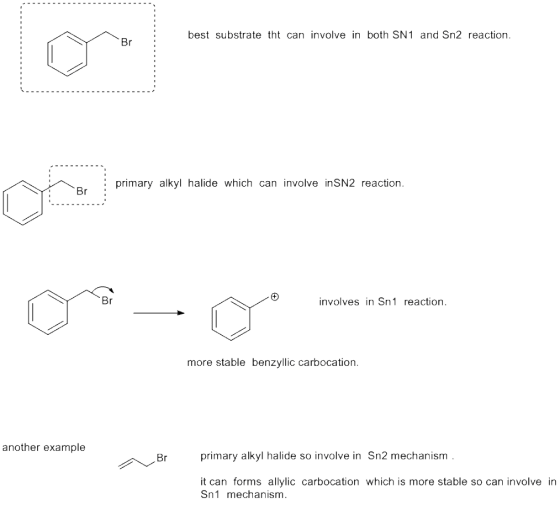
What structural characteristics are desirable for a substrate that can react in both SN1 and SN2 reactions?
Homework Answers
Add Answer to:
What structural characteristics are desirable for a substrate
that can react in both SN1 and SN2...
1. In the SN1 mechanism, the second step is attack of the nucleophile, so increasing the...
1. In the SN1 mechanism, the second step is attack of the nucleophile, so increasing the nucleophile concentration should speed up this step. Why, then, do we say that the rate of an SN1 reaction does not depend on the concentration of the nucleophile? 2. If one wants to select a substrate that will react in both SN1 and SN2 reactions, what substrate structure characteristics are desirable? 3. Iodide is a good nucleophile and also a good leaving group. Yet...
Secondary halides can react via SN1 or SN2 reactions depending on reaction conditions. Draw the starting...
Secondary halides can react via SN1 or SN2 reactions depending on reaction conditions. Draw the starting material and products that would be formed from the reaction of (R)-2- bromobutane with methanol via a SN1 and SN2 reaction.
4. (5 pts) Complete the table comparing SN2 and SN1 reactions. SN2 SN1 rate k[R-XINuc] rate...
 4. (5 pts) Complete the table comparing SN2 and SN1 reactions. SN2 SN1 rate k[R-XINuc] rate rate substrate reactivity methyl 1> 2 >> 3° polar, aprotic fastest stronger nucleophiles react faster solvent nucleophile inversion stereochemistry
22. Both of these reactions have high yields of product. What conclusion can be made about...
 22. Both of these reactions have high yields of product. What conclusion can be made about these results? 2H20 o either A) Both reactions are SN2 B) Both reactions are SN1 C) The substrate cannot undergo either Sn1 or SN2. D) The substrate is equally ideal for both Sn1 and SN2. a moc <240*3 + 2H30 -Br
I'm having trouble understanding when to use SN1 or SN2 (or both) 0 Sn1 - Sn2...
 I'm having trouble understanding when to use SN1 or
SN2 (or both)
0 Sn1 - Sn2 Homework Indicate the mechanism by which each of the reactions occurs. (Snl, Sn2, both Snl and Sn2, or NR) Draw the final Product (s) of the reaction. Draht HI > 7 yet tha 3 Matt Hal > © (27 Xy+HBr > "OH + HBr
I'm having trouble understanding when to use SN1 or
SN2 (or both)
0 Sn1 - Sn2 Homework Indicate the mechanism by which each of the reactions occurs. (Snl, Sn2, both Snl and Sn2, or NR) Draw the final Product (s) of the reaction. Draht HI > 7 yet tha 3 Matt Hal > © (27 Xy+HBr > "OH + HBr
3. Elaborate a comparative table between SN1 and SN2 reactions, based on: trends of substrate reactivity,...
3. Elaborate a comparative table between SN1 and SN2 reactions, based on: trends of substrate reactivity, strength of nucleophile, stereochemistry of product, number of steps.
4. Sn1 reactions are unimolecular and Sn2 reactions are bimolecular. What does this mean? Write the...
 4. Sn1 reactions are unimolecular and Sn2 reactions are bimolecular. What does this mean? Write the generic rate laws for Sn1 and Sn2 reactions. Which reagents do the rates of Sn1 and Sn2 reactions depend on? 5. Consider tert-butylchloride and 2-chloropropane. Which of these compounds is more likely to react via an Sn1 mechanism? Which is more likely to reactive via an Sn2 mechanism? Explain your answer. 6. Rank the following compounds in order of increasing likelihood of undergoing substitution...
1. why does benzyl bromide react under both Sn1 conditions and Sn2 conditions? 2. To promote...
1. why does benzyl bromide react under both Sn1 conditions and Sn2 conditions? 2. To promote the Sn1 mechanism we used AgNO3 in a polar, protic solvent. True or False? Why?
Part A: Structural effects of SUBSTRATE on Srl and SN2 reactivity. RECORD YOUR OBSERVATIONS. Compound Butyl...
 Part A: Structural effects of SUBSTRATE on Srl and SN2 reactivity. RECORD YOUR OBSERVATIONS. Compound Butyl bromide 15 % Nal - acetone crystallization in 55 seconds 1% ethanolic silver nitrate did not crystallize in over 30 minutes Butyl chloride crystallization in 85 seconds Sec-butyl chloride crystallization in 5 minutes 25 seconds did not crystallize in over 30 minutes crystallization in 10 minutes 45 seconds crystallization in 2 minutes 20 seconds Tert-butyl chloride did not crystallize in over 30 minutes Crotyl...
6. Describe the suitability of the following substrate for an Sn1 and SN2 reaction (is it...
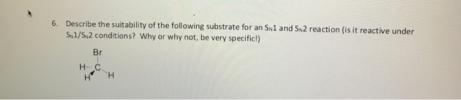 6. Describe the suitability of the following substrate for an Sn1 and SN2 reaction (is it reactive under S,1/S, 2 conditions? Why or why not, be very specific!) HC Η Η
 4. (5 pts) Complete the table comparing SN2 and SN1 reactions. SN2 SN1 rate k[R-XINuc] rate rate substrate reactivity methyl 1> 2 >> 3° polar, aprotic fastest stronger nucleophiles react faster solvent nucleophile inversion stereochemistry
 22. Both of these reactions have high yields of product. What conclusion can be made about these results? 2H20 o either A) Both reactions are SN2 B) Both reactions are SN1 C) The substrate cannot undergo either Sn1 or SN2. D) The substrate is equally ideal for both Sn1 and SN2. a moc <240*3 + 2H30 -Br
 I'm having trouble understanding when to use SN1 or
SN2 (or both)
0 Sn1 - Sn2 Homework Indicate the mechanism by which each of the reactions occurs. (Snl, Sn2, both Snl and Sn2, or NR) Draw the final Product (s) of the reaction. Draht HI > 7 yet tha 3 Matt Hal > © (27 Xy+HBr > "OH + HBr
I'm having trouble understanding when to use SN1 or
SN2 (or both)
0 Sn1 - Sn2 Homework Indicate the mechanism by which each of the reactions occurs. (Snl, Sn2, both Snl and Sn2, or NR) Draw the final Product (s) of the reaction. Draht HI > 7 yet tha 3 Matt Hal > © (27 Xy+HBr > "OH + HBr
 4. Sn1 reactions are unimolecular and Sn2 reactions are bimolecular. What does this mean? Write the generic rate laws for Sn1 and Sn2 reactions. Which reagents do the rates of Sn1 and Sn2 reactions depend on? 5. Consider tert-butylchloride and 2-chloropropane. Which of these compounds is more likely to react via an Sn1 mechanism? Which is more likely to reactive via an Sn2 mechanism? Explain your answer. 6. Rank the following compounds in order of increasing likelihood of undergoing substitution...
 Part A: Structural effects of SUBSTRATE on Srl and SN2 reactivity. RECORD YOUR OBSERVATIONS. Compound Butyl bromide 15 % Nal - acetone crystallization in 55 seconds 1% ethanolic silver nitrate did not crystallize in over 30 minutes Butyl chloride crystallization in 85 seconds Sec-butyl chloride crystallization in 5 minutes 25 seconds did not crystallize in over 30 minutes crystallization in 10 minutes 45 seconds crystallization in 2 minutes 20 seconds Tert-butyl chloride did not crystallize in over 30 minutes Crotyl...
 6. Describe the suitability of the following substrate for an Sn1 and SN2 reaction (is it reactive under S,1/S, 2 conditions? Why or why not, be very specific!) HC Η Η
Most questions answered within 3 hours.
-
Where is the error in this code sequence?
String s1 = "Hello";
String s2 = "ello";...
asked 10 months ago -
Financial data for Joel de Paris, Inc., for last year
follow:
Joel de Paris, Inc.
Balance...
asked 10 months ago -
Consider this reaction:
Al2(SO4)3 (aq)+ BaCl3
(aq) Al2Cl6 (aq)- +
3BaSO4(s) . What is the...
asked 10 months ago -
Suppose that Savneet is considering increasing her
recent random sample from 20 car rentals to 40...
asked 10 months ago -
Trucks arrive at an unloading terminal at an average rate of 120
per hour.
Trucks arrive...
asked 10 months ago -
Why are methanol and ethanol completely soluble in water while
octanol is not very little soluble....
asked 10 months ago -
A facilities manager at a university reads in a research report
that the mean amount of...
asked 10 months ago -
When the CuSO4 is rehydrated by adding water to the anhydrous
compound, is this an endothermic...
asked 10 months ago -
A ray of sunlight is passing from diamond into crown glass; the
angle of incidence is...
asked 10 months ago -
A block of mass 0.249 kg is placed on top of a light, vertical
spring of...
asked 10 months ago -
how do the kidneys compensate in the presences of acidosis
a) trigger hyperventilate
b) reserve acid...
asked 10 months ago -
Question 501 pts
The rental rate of capital to the firm increases. Which of the
following...
asked 10 months ago