
Homework Answers
Add Answer to:
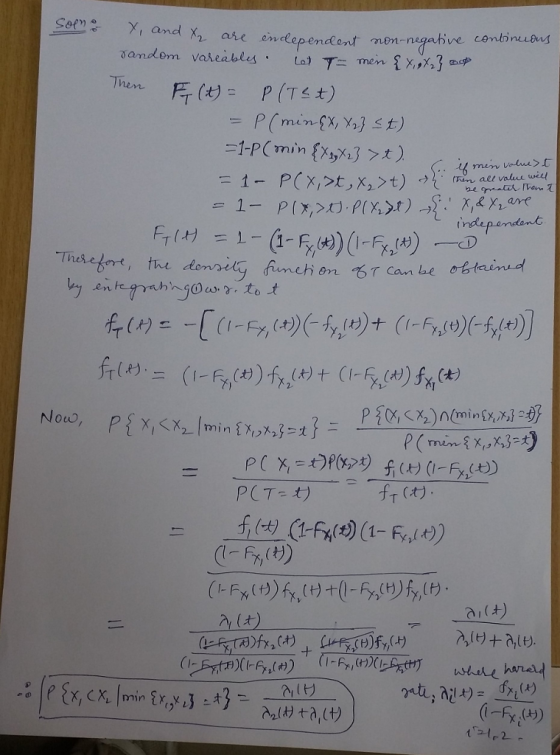
If X, and X2 are independent nonnegative continuous random variables, show that A(t) where λ,(r) is...
et 11, . .. , /n be independent continuous nonnegative random variables with hazard functions λι...
 et 11, . .. , /n be independent continuous nonnegative random variables with hazard functions λι ( .). . . . , λη (. ). Prove that T-man (Tİ , . . . , Tn) has hazard function Σηι λίο.
Let X1 and X2 be two independent continuous random variables. Define and S-Ixpo+2xso) where Ry and...
 Let X1 and X2 be two independent continuous random variables. Define and S-Ixpo+2xso) where Ry and R2 are the Wilcoxon signed ranks of X, and X2, respectively. (a) Assume that X, and X2 have symmetric distributions about 0. Show that Pr(T ) Pr(S-t) for 0,1,2,3 using the properties of symmetry:-Xi ~ x, and Pr(X, > 0)-Pr(X, <0) = 0.5 (b) Suppose that X1 and X2 are identically distributed with common density -05%:- 10.5sx <0 0.5 0sxs1 show that Pr(T+-): Pr(S...
Let X1 and X2 be random variables, not necessarily independent. Show that E [X1 + X2]...
Let X1 and X2 be random variables, not necessarily independent. Show that E [X1 + X2] = E [X1] + E [X2]. You may assume that X1 and X2 are discrete with a joint probability mass function for this problem, while the above inequality is true also for continuous random variables.
2. Suppose X and Y are independent continuous random variables. Show that P(Y < X) =...
 2. Suppose X and Y are independent continuous random variables. Show that P(Y < X) = | Fy(x) · fx (x) dx -oo where Fy is the CDF of Y and fx is the PDF of X [hint: P[Y E A] = S.P(Y E A|X = x) · fx(x) dx]. Rewrite the above equation as an expectation of a function of X, i.e. P(Y < X) = Ex[•]. Use the above relation to compute P[Y < X] if X~Exp (2)...
Let X1, X2, ..., Xr be independent exponential random variables with parameter λ. a. Find the...
Let X1, X2, ..., Xr be independent exponential random variables with parameter λ. a. Find the moment-generating function of Y = X1 + X2 + ... + Xr. b. What is the distribution of the random variable Y?
Consider two independent random variables X1 and X2. (continuous) uniformly distributed over (0,1). Let Y by...
Consider two independent random variables X1 and X2. (continuous) uniformly distributed over (0,1). Let Y by the maximum of the two random variables with cumulative distribution function Fy(y). Find Fy (y) where y=0.9. Show all work solution = 0.81
2 Let X1, X2, ..., X, be independent continuous random variables from the following distribution: (*)...
 2 Let X1, X2, ..., X, be independent continuous random variables from the following distribution: (*) - ar-(-) where I 21 and a > 1 You may use the fact: E[X] = -1 2.1 Show that the maximum likelihood estimator of a is â MLE - Srlos Xi 2.2 Show that the method moment estimator for a is: &mom = 1 2.3 Derive a sufficient statistic for a. What theorem are you using to determine sufficiency?
Random variables are independent of each other, where i=1,2,3 and that Calculate P(X1<X2<X3) X, ~ e.rp(λ.)...
Random variables are independent of each other, where i=1,2,3 and that Calculate P(X1<X2<X3) X, ~ e.rp(λ.) We were unable to transcribe this image
Let X1,X2 be two independent exponential random variables with λ=1, compute the P(X1+X2<t) using the joint...
 Let X1,X2 be two independent
exponential random variables with λ=1, compute the
P(X1+X2<t) using the joint density function. And let Z be gamma
random variable with parameters (2,1). Compute the probability that
P(Z < t). And what you can find by comparing P(X1+X2<t) and
P(Z < t)? And compare P(X1+X2+X3<t) Xi iid
(independent and identically distributed) ~Exp(1) and P(Z < t)
Z~Gamma(3,1) (You don’t have to compute)
(Hint: You can use the fact that Γ(2)=1,
Γ(3)=2)
Problem 2[10 points] Let...
Let X1,X2 be two independent
exponential random variables with λ=1, compute the
P(X1+X2<t) using the joint density function. And let Z be gamma
random variable with parameters (2,1). Compute the probability that
P(Z < t). And what you can find by comparing P(X1+X2<t) and
P(Z < t)? And compare P(X1+X2+X3<t) Xi iid
(independent and identically distributed) ~Exp(1) and P(Z < t)
Z~Gamma(3,1) (You don’t have to compute)
(Hint: You can use the fact that Γ(2)=1,
Γ(3)=2)
Problem 2[10 points] Let...
L.11) Sums of independent random variables a) If X1 , X2 X, , , Xn are...
 L.11) Sums of independent random variables a) If X1 , X2 X, , , Xn are independent random variables all with Exponential μ distribution, then what is the distribution of XII + 2 +X3 + .tX b) If X is a random variable with Exponential[u] distribution, then what is the distribution of x +X1? c) If X1 , X2 , Х, , , X are independent random variables all with Normal 0. I distribution, then what is the distribution of...
 et 11, . .. , /n be independent continuous nonnegative random variables with hazard functions λι ( .). . . . , λη (. ). Prove that T-man (Tİ , . . . , Tn) has hazard function Σηι λίο.
 Let X1 and X2 be two independent continuous random variables. Define and S-Ixpo+2xso) where Ry and R2 are the Wilcoxon signed ranks of X, and X2, respectively. (a) Assume that X, and X2 have symmetric distributions about 0. Show that Pr(T ) Pr(S-t) for 0,1,2,3 using the properties of symmetry:-Xi ~ x, and Pr(X, > 0)-Pr(X, <0) = 0.5 (b) Suppose that X1 and X2 are identically distributed with common density -05%:- 10.5sx <0 0.5 0sxs1 show that Pr(T+-): Pr(S...
 2. Suppose X and Y are independent continuous random variables. Show that P(Y < X) = | Fy(x) · fx (x) dx -oo where Fy is the CDF of Y and fx is the PDF of X [hint: P[Y E A] = S.P(Y E A|X = x) · fx(x) dx]. Rewrite the above equation as an expectation of a function of X, i.e. P(Y < X) = Ex[•]. Use the above relation to compute P[Y < X] if X~Exp (2)...
 2 Let X1, X2, ..., X, be independent continuous random variables from the following distribution: (*) - ar-(-) where I 21 and a > 1 You may use the fact: E[X] = -1 2.1 Show that the maximum likelihood estimator of a is â MLE - Srlos Xi 2.2 Show that the method moment estimator for a is: &mom = 1 2.3 Derive a sufficient statistic for a. What theorem are you using to determine sufficiency?
 Let X1,X2 be two independent
exponential random variables with λ=1, compute the
P(X1+X2<t) using the joint density function. And let Z be gamma
random variable with parameters (2,1). Compute the probability that
P(Z < t). And what you can find by comparing P(X1+X2<t) and
P(Z < t)? And compare P(X1+X2+X3<t) Xi iid
(independent and identically distributed) ~Exp(1) and P(Z < t)
Z~Gamma(3,1) (You don’t have to compute)
(Hint: You can use the fact that Γ(2)=1,
Γ(3)=2)
Problem 2[10 points] Let...
Let X1,X2 be two independent
exponential random variables with λ=1, compute the
P(X1+X2<t) using the joint density function. And let Z be gamma
random variable with parameters (2,1). Compute the probability that
P(Z < t). And what you can find by comparing P(X1+X2<t) and
P(Z < t)? And compare P(X1+X2+X3<t) Xi iid
(independent and identically distributed) ~Exp(1) and P(Z < t)
Z~Gamma(3,1) (You don’t have to compute)
(Hint: You can use the fact that Γ(2)=1,
Γ(3)=2)
Problem 2[10 points] Let...
 L.11) Sums of independent random variables a) If X1 , X2 X, , , Xn are independent random variables all with Exponential μ distribution, then what is the distribution of XII + 2 +X3 + .tX b) If X is a random variable with Exponential[u] distribution, then what is the distribution of x +X1? c) If X1 , X2 , Х, , , X are independent random variables all with Normal 0. I distribution, then what is the distribution of...
Most questions answered within 3 hours.
-
Where is the error in this code sequence?
String s1 = "Hello";
String s2 = "ello";...
asked 10 months ago -
Financial data for Joel de Paris, Inc., for last year
follow:
Joel de Paris, Inc.
Balance...
asked 10 months ago -
Consider this reaction:
Al2(SO4)3 (aq)+ BaCl3
(aq) Al2Cl6 (aq)- +
3BaSO4(s) . What is the...
asked 10 months ago -
Suppose that Savneet is considering increasing her
recent random sample from 20 car rentals to 40...
asked 10 months ago -
Trucks arrive at an unloading terminal at an average rate of 120
per hour.
Trucks arrive...
asked 10 months ago -
Why are methanol and ethanol completely soluble in water while
octanol is not very little soluble....
asked 10 months ago -
A facilities manager at a university reads in a research report
that the mean amount of...
asked 10 months ago -
When the CuSO4 is rehydrated by adding water to the anhydrous
compound, is this an endothermic...
asked 10 months ago -
A ray of sunlight is passing from diamond into crown glass; the
angle of incidence is...
asked 10 months ago -
A block of mass 0.249 kg is placed on top of a light, vertical
spring of...
asked 10 months ago -
how do the kidneys compensate in the presences of acidosis
a) trigger hyperventilate
b) reserve acid...
asked 10 months ago -
Question 501 pts
The rental rate of capital to the firm increases. Which of the
following...
asked 10 months ago