

Homework Answers
Add Answer to:
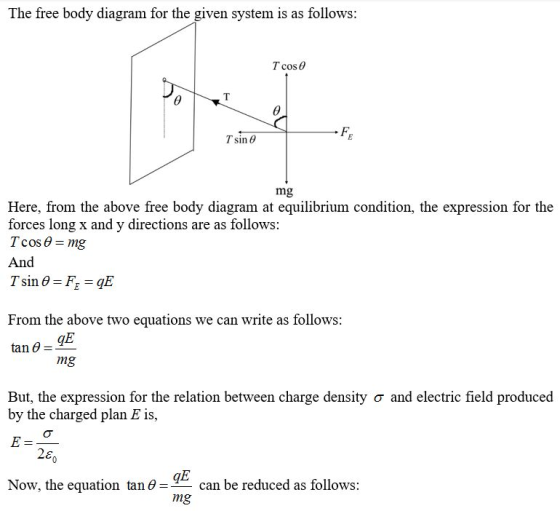
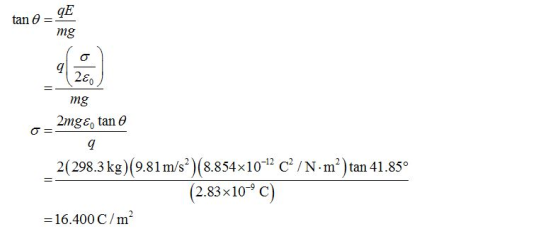
A ball of mass m-298.3 kg and charge q 2.83 nC (10^-9 C) is attached via...
m, q A ball of mass m-371.2 kg and charge q 5.34 nC (104-9 C) is...
 m, q A ball of mass m-371.2 kg and charge q 5.34 nC (104-9 C) is attached via a string to an infinitely large charged plane. The string makes an angle 30.90 degrees with the plane. What is the surface charge density σ of the plane in C/m^2? Use the following constants: 0 8.854 x 10⁻¹² C2/N-m2 9-9.81 N/m Your Answer: Answer
A ball of mass m=622.8 kg and charge q=8.49 nC (10^-9 C) is attached via a...
 A ball of mass m=622.8 kg and charge q=8.49 nC (10^-9 C) is
attached via a string to an infinitely large charged plane. The
string makes an angle 31.70 degrees with the plane. What is the
surface charge density σσ of the plane in C/m^2?
Use the following constants:
ϵ0=8.854×10⁻¹²C2/N⋅m2ϵ0=8.854×10−12C2/N⋅m2
g=9.81N/mg=9.81N/m
m, q
A ball of mass m=622.8 kg and charge q=8.49 nC (10^-9 C) is
attached via a string to an infinitely large charged plane. The
string makes an angle 31.70 degrees with the plane. What is the
surface charge density σσ of the plane in C/m^2?
Use the following constants:
ϵ0=8.854×10⁻¹²C2/N⋅m2ϵ0=8.854×10−12C2/N⋅m2
g=9.81N/mg=9.81N/m
m, q
9 m, q A ball of mass m-423.3 kg and charge q-7.83 nC (10A-9 C) is...
 9 m, q A ball of mass m-423.3 kg and charge q-7.83 nC (10A-9 C) is attached via a string to an infinitely large charged plane. The string makes an angle 28.85 degrees with the plane. What is the surface charge density σ of the plane in C/m^2? Use the following constants: 0 8.854 x 10⁻¹² C2N. m2 g 9.81 N/m Your Answer: Answer
uestion 4 (1 point) 9 m, q A ball of mass m-151.5 kg and charge q-1.22...
 uestion 4 (1 point) 9 m, q A ball of mass m-151.5 kg and charge q-1.22 nC (10A-9 C) is attached via a string to an infinitely large charged plane. The string makes an angle 12.55 degrees with the plane. What is the surface charge density σ of the plane in C/m^2? Use the following constants: 0 - 8.854 x 10¹²/N m2 g 9.81 N/m Your Answer Answer
Hanging ball. A small insulating ball of mass M and positive charge Q hangs down from...
 Hanging ball. A small insulating ball of mass M and positive charge Q hangs down from gravity from a massless thread of length L attached at one end to a charged vertical wall of infinite extent that has surface charge density σ. Calculate the angle θ of the thread to the vertical.
Problem 2. m, q An infinite insulating plane has a uniform surface charge density σ-528 nC/m2....
 Problem 2. m, q An infinite insulating plane has a uniform surface charge density σ-528 nC/m2. A point charge q- 465 nC of mass m 1.14 10-8 kg is released at a distance of 50 cm from the plane. The charge is initially moving toward the plane with a speed of 24.0m/s. What is the closest distance to the plane the charge reaches? (Ignore gravity in this problem.)
9) A ball of mass m is attached to the ceiling via a string of length...
 9) A ball of mass m is attached to the ceiling via a string of length L. The ball is given a push to set it in motion. The ball then travels in a horizontal circle, such that the string makes and angle 0 with the vertical. It is observed that it takes time T for the ball to make one complete revolution. How can this experiment be used to measure the magnitude of the gravitational acceleration g. problem 9...
In the figure a small, nonconducting ball of mass m = 1.1 mg and charge q...
 In the figure a small, nonconducting ball of mass m =
1.1 mg and charge q = 1.8 × 10⁻⁸ C (distributed
uniformly through its volume) hangs from an insulating thread that
makes an angle θ = 45° with a vertical, uniformly charged
nonconducting sheet (shown in cross section). Considering the
gravitational force on the ball and assuming the sheet extends far
vertically and into and out of the page, calculate the surface
charge density σ of the sheet.
In the figure a small, nonconducting ball of mass m =
1.1 mg and charge q = 1.8 × 10⁻⁸ C (distributed
uniformly through its volume) hangs from an insulating thread that
makes an angle θ = 45° with a vertical, uniformly charged
nonconducting sheet (shown in cross section). Considering the
gravitational force on the ball and assuming the sheet extends far
vertically and into and out of the page, calculate the surface
charge density σ of the sheet.
9. A ball of mass m- 30 g that is attached to the ceiling by a...
 9. A ball of mass m- 30 g that is attached to the ceiling by a light string is swinging around in a circle in the xy-plane, as shown. The string makes an angle θ-30° with the vertical. The length of the string is r- 40 cm. What is the magnitude of the torque on the ball about the fixed end of the string due to gravity? a) 0.0402 mN b) 0.0588 m N c) 0.0633 m N 0.0675 mN...
Question 10 of 10> A large positively charged object with charge q+-4.25 μC is brought near...
 Question 10 of 10> A large positively charged object with charge q+-4.25 μC is brought near a negatively charged plastic ball suspended from a string of negligible mass. The suspended ball has a charge of q-47.3 nC and a mass of 12.5 g. What is the angle the string makes with the vertical when the positively charged object is 18.5 cm from the suspended ball? The positively charged object is at the same height as the angle 26
 m, q A ball of mass m-371.2 kg and charge q 5.34 nC (104-9 C) is attached via a string to an infinitely large charged plane. The string makes an angle 30.90 degrees with the plane. What is the surface charge density σ of the plane in C/m^2? Use the following constants: 0 8.854 x 10⁻¹² C2/N-m2 9-9.81 N/m Your Answer: Answer
 A ball of mass m=622.8 kg and charge q=8.49 nC (10^-9 C) is
attached via a string to an infinitely large charged plane. The
string makes an angle 31.70 degrees with the plane. What is the
surface charge density σσ of the plane in C/m^2?
Use the following constants:
ϵ0=8.854×10⁻¹²C2/N⋅m2ϵ0=8.854×10−12C2/N⋅m2
g=9.81N/mg=9.81N/m
m, q
A ball of mass m=622.8 kg and charge q=8.49 nC (10^-9 C) is
attached via a string to an infinitely large charged plane. The
string makes an angle 31.70 degrees with the plane. What is the
surface charge density σσ of the plane in C/m^2?
Use the following constants:
ϵ0=8.854×10⁻¹²C2/N⋅m2ϵ0=8.854×10−12C2/N⋅m2
g=9.81N/mg=9.81N/m
m, q
 9 m, q A ball of mass m-423.3 kg and charge q-7.83 nC (10A-9 C) is attached via a string to an infinitely large charged plane. The string makes an angle 28.85 degrees with the plane. What is the surface charge density σ of the plane in C/m^2? Use the following constants: 0 8.854 x 10⁻¹² C2N. m2 g 9.81 N/m Your Answer: Answer
 uestion 4 (1 point) 9 m, q A ball of mass m-151.5 kg and charge q-1.22 nC (10A-9 C) is attached via a string to an infinitely large charged plane. The string makes an angle 12.55 degrees with the plane. What is the surface charge density σ of the plane in C/m^2? Use the following constants: 0 - 8.854 x 10¹²/N m2 g 9.81 N/m Your Answer Answer
 Hanging ball. A small insulating ball of mass M and positive charge Q hangs down from gravity from a massless thread of length L attached at one end to a charged vertical wall of infinite extent that has surface charge density σ. Calculate the angle θ of the thread to the vertical.
 Problem 2. m, q An infinite insulating plane has a uniform surface charge density σ-528 nC/m2. A point charge q- 465 nC of mass m 1.14 10-8 kg is released at a distance of 50 cm from the plane. The charge is initially moving toward the plane with a speed of 24.0m/s. What is the closest distance to the plane the charge reaches? (Ignore gravity in this problem.)
 9) A ball of mass m is attached to the ceiling via a string of length L. The ball is given a push to set it in motion. The ball then travels in a horizontal circle, such that the string makes and angle 0 with the vertical. It is observed that it takes time T for the ball to make one complete revolution. How can this experiment be used to measure the magnitude of the gravitational acceleration g. problem 9...
 In the figure a small, nonconducting ball of mass m =
1.1 mg and charge q = 1.8 × 10⁻⁸ C (distributed
uniformly through its volume) hangs from an insulating thread that
makes an angle θ = 45° with a vertical, uniformly charged
nonconducting sheet (shown in cross section). Considering the
gravitational force on the ball and assuming the sheet extends far
vertically and into and out of the page, calculate the surface
charge density σ of the sheet.
In the figure a small, nonconducting ball of mass m =
1.1 mg and charge q = 1.8 × 10⁻⁸ C (distributed
uniformly through its volume) hangs from an insulating thread that
makes an angle θ = 45° with a vertical, uniformly charged
nonconducting sheet (shown in cross section). Considering the
gravitational force on the ball and assuming the sheet extends far
vertically and into and out of the page, calculate the surface
charge density σ of the sheet.
 9. A ball of mass m- 30 g that is attached to the ceiling by a light string is swinging around in a circle in the xy-plane, as shown. The string makes an angle θ-30° with the vertical. The length of the string is r- 40 cm. What is the magnitude of the torque on the ball about the fixed end of the string due to gravity? a) 0.0402 mN b) 0.0588 m N c) 0.0633 m N 0.0675 mN...
 Question 10 of 10> A large positively charged object with charge q+-4.25 μC is brought near a negatively charged plastic ball suspended from a string of negligible mass. The suspended ball has a charge of q-47.3 nC and a mass of 12.5 g. What is the angle the string makes with the vertical when the positively charged object is 18.5 cm from the suspended ball? The positively charged object is at the same height as the angle 26
Most questions answered within 3 hours.
-
Where is the error in this code sequence?
String s1 = "Hello";
String s2 = "ello";...
asked 11 months ago -
Financial data for Joel de Paris, Inc., for last year
follow:
Joel de Paris, Inc.
Balance...
asked 11 months ago -
Consider this reaction:
Al2(SO4)3 (aq)+ BaCl3
(aq) Al2Cl6 (aq)- +
3BaSO4(s) . What is the...
asked 11 months ago -
Suppose that Savneet is considering increasing her
recent random sample from 20 car rentals to 40...
asked 11 months ago -
Trucks arrive at an unloading terminal at an average rate of 120
per hour.
Trucks arrive...
asked 11 months ago -
Why are methanol and ethanol completely soluble in water while
octanol is not very little soluble....
asked 11 months ago -
A facilities manager at a university reads in a research report
that the mean amount of...
asked 11 months ago -
When the CuSO4 is rehydrated by adding water to the anhydrous
compound, is this an endothermic...
asked 11 months ago -
A ray of sunlight is passing from diamond into crown glass; the
angle of incidence is...
asked 11 months ago -
A block of mass 0.249 kg is placed on top of a light, vertical
spring of...
asked 11 months ago -
how do the kidneys compensate in the presences of acidosis
a) trigger hyperventilate
b) reserve acid...
asked 11 months ago -
Question 501 pts
The rental rate of capital to the firm increases. Which of the
following...
asked 11 months ago