The electric capacitance of biological tissues serves as the basis for numerous medical technologies. For example, dielectric spectroscopy glucose reading (DSGR) is a noninvasive diagnostic technique that uses the electric capacitance of blood to estimate blood glucose levels.
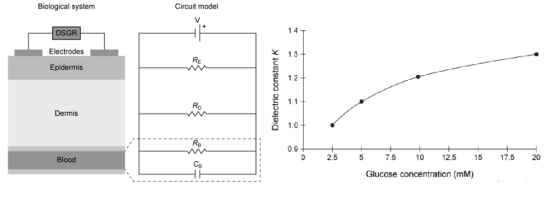
A DSGR device records the electric current that results from applying a voltage source to the skin and underlying blood vessels. DSGR can be modeled by the circuit shown in Figure 1, in which V represents the applied potential, CB represents the capacitance of the blood, and RE, RD, and RB represent the electrical resistances of the epidermis, the dermis, and the blood, respectively.
Figure 1 DSGR circuit model including skin and superficial blood vessel
The capacitance of charged blood may be explained by red blood cell membranes acting as physical barriers that separate electrons introduced into the blood from positively charged ions in the red blood cell cytoplasm. The dielectric constant k of red blood cell membranes varies with glucose concentration (Figure 2) because glucose uptake by red blood cells alters the activity of membrane-bound proteins that regulate the flow of ions into and out of the cell.
Figure 2 Blood dielectric constant vs blood glucose concentration
DSGR readings vary with blood glucose concentration because the time needed to fully charge the blood is related to total blood capacitance. However, interpreting DSGR readings may be complicated by changes in biological variables other than blood capacitance. For example, the resistivity of blood varies in accordance with osmolarity such that changes in diet or hydration status influence the current measured by DSGR devices.
Which of the following statements best describes the behavior of the circuit in Figure 1 when the fully charged capacitor (comprising red blood cells) is discharged?
- The electric currents through RB and RE are equal because the resistors are in series.
- The voltage drops across RB and RE are equal because the resistors are in parallel.
- The electric currents through RB exceeds that through RE because the capacitor is fully charged.
- Both the current and voltage drops across RB and RE are equal because the same power source is used.
Homework Answers
Correct statement is (B).
Here resistance RB and RE are in parallel with battery and the capacitor.
so when we apply kirchoff’s loop law then potential drop across each resistance is equal and its value is V.
Now, current through resistance is given by : i = V/R
so current through RB = iB = V/RB
current through RE = iE = V/RE
potential drop is same but current is different.
Add Answer to:
The electric
capacitance of biological tissues serves as the basis for
numerous medical technologies. For example,...
he electric capacitance of biological tissues serves as the basis for numerous medical technologies. For example,...
 he electric capacitance of biological tissues
serves as the basis for numerous medical technologies. For example,
dielectric spectroscopy glucose reading (DSGR) is
a noninvasive diagnostic technique that uses the electric
capacitance of blood to estimate blood glucose levels.
A DSGR device records the electric current that results from
applying a voltage source to the skin and underlying blood vessels.
DSGR can be modeled by the circuit shown in Figure 1, in which V
represents the applied potential, CB represents the...
he electric capacitance of biological tissues
serves as the basis for numerous medical technologies. For example,
dielectric spectroscopy glucose reading (DSGR) is
a noninvasive diagnostic technique that uses the electric
capacitance of blood to estimate blood glucose levels.
A DSGR device records the electric current that results from
applying a voltage source to the skin and underlying blood vessels.
DSGR can be modeled by the circuit shown in Figure 1, in which V
represents the applied potential, CB represents the...
The electric capacitance of biological tissues serves as the basis for numerous medical technologies. For example,...
 The electric capacitance of biological tissues
serves as the basis for numerous medical technologies. For example,
dielectric spectroscopy glucose reading (DSGR) is
a noninvasive diagnostic technique that uses the electric
capacitance of blood to estimate blood glucose levels.
A DSGR device records the electric current that results from
applying a voltage source to the skin and underlying blood vessels.
DSGR can be modeled by the circuit shown in Figure 1, in which V
represents the applied potential, CB represents the...
The electric capacitance of biological tissues
serves as the basis for numerous medical technologies. For example,
dielectric spectroscopy glucose reading (DSGR) is
a noninvasive diagnostic technique that uses the electric
capacitance of blood to estimate blood glucose levels.
A DSGR device records the electric current that results from
applying a voltage source to the skin and underlying blood vessels.
DSGR can be modeled by the circuit shown in Figure 1, in which V
represents the applied potential, CB represents the...
The electric capacitance of biological tissues serves as the basis for numerous medical technologies. For example,...
 The electric
capacitance of biological tissues serves as the basis for
numerous medical technologies. For example, dielectric
spectroscopy glucose reading (DSGR) is a noninvasive
diagnostic technique that uses the electric capacitance of blood to
estimate blood glucose levels.
A DSGR device records
the electric current that results from applying a voltage source to
the skin and underlying blood vessels. DSGR can be modeled by the
circuit shown in Figure 1, in which V represents the applied
potential, CB represents the...
The electric
capacitance of biological tissues serves as the basis for
numerous medical technologies. For example, dielectric
spectroscopy glucose reading (DSGR) is a noninvasive
diagnostic technique that uses the electric capacitance of blood to
estimate blood glucose levels.
A DSGR device records
the electric current that results from applying a voltage source to
the skin and underlying blood vessels. DSGR can be modeled by the
circuit shown in Figure 1, in which V represents the applied
potential, CB represents the...
he electric capacitance of biological tissues serves as the basis for numerous medical technologies. For example,...
 he electric capacitance of biological tissues
serves as the basis for numerous medical technologies. For example,
dielectric spectroscopy glucose reading (DSGR) is
a noninvasive diagnostic technique that uses the electric
capacitance of blood to estimate blood glucose levels.
A DSGR device records the electric current that results from
applying a voltage source to the skin and underlying blood vessels.
DSGR can be modeled by the circuit shown in Figure 1, in which V
represents the applied potential, CB represents the...
he electric capacitance of biological tissues
serves as the basis for numerous medical technologies. For example,
dielectric spectroscopy glucose reading (DSGR) is
a noninvasive diagnostic technique that uses the electric
capacitance of blood to estimate blood glucose levels.
A DSGR device records the electric current that results from
applying a voltage source to the skin and underlying blood vessels.
DSGR can be modeled by the circuit shown in Figure 1, in which V
represents the applied potential, CB represents the...
he electric capacitance of biological tissues serves as the basis for numerous medical technologies. For example,...
 he electric
capacitance of biological tissues serves as the basis for
numerous medical technologies. For example, dielectric
spectroscopy glucose reading (DSGR) is a noninvasive
diagnostic technique that uses the electric capacitance of blood to
estimate blood glucose levels.
A DSGR device records
the electric current that results from applying a voltage source to
the skin and underlying blood vessels. DSGR can be modeled by the
circuit shown in Figure 1, in which V represents the applied
potential, CB represents the...
he electric
capacitance of biological tissues serves as the basis for
numerous medical technologies. For example, dielectric
spectroscopy glucose reading (DSGR) is a noninvasive
diagnostic technique that uses the electric capacitance of blood to
estimate blood glucose levels.
A DSGR device records
the electric current that results from applying a voltage source to
the skin and underlying blood vessels. DSGR can be modeled by the
circuit shown in Figure 1, in which V represents the applied
potential, CB represents the...
Instructions: Please read each problem and the information carefully. Circle the correct answer choice or fill...
 Instructions: Please read each problem and the information carefully. Circle the correct answer choice or fill in the blanks as asked for in the problem. If no correct answer is shown give your answer in (D) Numbers in the symbols represent the number of points for that problem (6) 1. A 26.5 F capacitor and a 75.8 capacitor are connected in parallel across a 12.0V potential difference. Determine the total energy stored in the capacitors Answer: (a) 5.22 m). (b)...
 he electric capacitance of biological tissues
serves as the basis for numerous medical technologies. For example,
dielectric spectroscopy glucose reading (DSGR) is
a noninvasive diagnostic technique that uses the electric
capacitance of blood to estimate blood glucose levels.
A DSGR device records the electric current that results from
applying a voltage source to the skin and underlying blood vessels.
DSGR can be modeled by the circuit shown in Figure 1, in which V
represents the applied potential, CB represents the...
he electric capacitance of biological tissues
serves as the basis for numerous medical technologies. For example,
dielectric spectroscopy glucose reading (DSGR) is
a noninvasive diagnostic technique that uses the electric
capacitance of blood to estimate blood glucose levels.
A DSGR device records the electric current that results from
applying a voltage source to the skin and underlying blood vessels.
DSGR can be modeled by the circuit shown in Figure 1, in which V
represents the applied potential, CB represents the...
 The electric capacitance of biological tissues
serves as the basis for numerous medical technologies. For example,
dielectric spectroscopy glucose reading (DSGR) is
a noninvasive diagnostic technique that uses the electric
capacitance of blood to estimate blood glucose levels.
A DSGR device records the electric current that results from
applying a voltage source to the skin and underlying blood vessels.
DSGR can be modeled by the circuit shown in Figure 1, in which V
represents the applied potential, CB represents the...
The electric capacitance of biological tissues
serves as the basis for numerous medical technologies. For example,
dielectric spectroscopy glucose reading (DSGR) is
a noninvasive diagnostic technique that uses the electric
capacitance of blood to estimate blood glucose levels.
A DSGR device records the electric current that results from
applying a voltage source to the skin and underlying blood vessels.
DSGR can be modeled by the circuit shown in Figure 1, in which V
represents the applied potential, CB represents the...
 The electric
capacitance of biological tissues serves as the basis for
numerous medical technologies. For example, dielectric
spectroscopy glucose reading (DSGR) is a noninvasive
diagnostic technique that uses the electric capacitance of blood to
estimate blood glucose levels.
A DSGR device records
the electric current that results from applying a voltage source to
the skin and underlying blood vessels. DSGR can be modeled by the
circuit shown in Figure 1, in which V represents the applied
potential, CB represents the...
The electric
capacitance of biological tissues serves as the basis for
numerous medical technologies. For example, dielectric
spectroscopy glucose reading (DSGR) is a noninvasive
diagnostic technique that uses the electric capacitance of blood to
estimate blood glucose levels.
A DSGR device records
the electric current that results from applying a voltage source to
the skin and underlying blood vessels. DSGR can be modeled by the
circuit shown in Figure 1, in which V represents the applied
potential, CB represents the...
 he electric capacitance of biological tissues
serves as the basis for numerous medical technologies. For example,
dielectric spectroscopy glucose reading (DSGR) is
a noninvasive diagnostic technique that uses the electric
capacitance of blood to estimate blood glucose levels.
A DSGR device records the electric current that results from
applying a voltage source to the skin and underlying blood vessels.
DSGR can be modeled by the circuit shown in Figure 1, in which V
represents the applied potential, CB represents the...
he electric capacitance of biological tissues
serves as the basis for numerous medical technologies. For example,
dielectric spectroscopy glucose reading (DSGR) is
a noninvasive diagnostic technique that uses the electric
capacitance of blood to estimate blood glucose levels.
A DSGR device records the electric current that results from
applying a voltage source to the skin and underlying blood vessels.
DSGR can be modeled by the circuit shown in Figure 1, in which V
represents the applied potential, CB represents the...
 he electric
capacitance of biological tissues serves as the basis for
numerous medical technologies. For example, dielectric
spectroscopy glucose reading (DSGR) is a noninvasive
diagnostic technique that uses the electric capacitance of blood to
estimate blood glucose levels.
A DSGR device records
the electric current that results from applying a voltage source to
the skin and underlying blood vessels. DSGR can be modeled by the
circuit shown in Figure 1, in which V represents the applied
potential, CB represents the...
he electric
capacitance of biological tissues serves as the basis for
numerous medical technologies. For example, dielectric
spectroscopy glucose reading (DSGR) is a noninvasive
diagnostic technique that uses the electric capacitance of blood to
estimate blood glucose levels.
A DSGR device records
the electric current that results from applying a voltage source to
the skin and underlying blood vessels. DSGR can be modeled by the
circuit shown in Figure 1, in which V represents the applied
potential, CB represents the...
 Instructions: Please read each problem and the information carefully. Circle the correct answer choice or fill in the blanks as asked for in the problem. If no correct answer is shown give your answer in (D) Numbers in the symbols represent the number of points for that problem (6) 1. A 26.5 F capacitor and a 75.8 capacitor are connected in parallel across a 12.0V potential difference. Determine the total energy stored in the capacitors Answer: (a) 5.22 m). (b)...
Most questions answered within 3 hours.
-
Where is the error in this code sequence?
String s1 = "Hello";
String s2 = "ello";...
asked 10 months ago -
Financial data for Joel de Paris, Inc., for last year
follow:
Joel de Paris, Inc.
Balance...
asked 10 months ago -
Consider this reaction:
Al2(SO4)3 (aq)+ BaCl3
(aq) Al2Cl6 (aq)- +
3BaSO4(s) . What is the...
asked 10 months ago -
Suppose that Savneet is considering increasing her
recent random sample from 20 car rentals to 40...
asked 10 months ago -
Trucks arrive at an unloading terminal at an average rate of 120
per hour.
Trucks arrive...
asked 10 months ago -
Why are methanol and ethanol completely soluble in water while
octanol is not very little soluble....
asked 10 months ago -
A facilities manager at a university reads in a research report
that the mean amount of...
asked 10 months ago -
When the CuSO4 is rehydrated by adding water to the anhydrous
compound, is this an endothermic...
asked 10 months ago -
A ray of sunlight is passing from diamond into crown glass; the
angle of incidence is...
asked 10 months ago -
A block of mass 0.249 kg is placed on top of a light, vertical
spring of...
asked 10 months ago -
how do the kidneys compensate in the presences of acidosis
a) trigger hyperventilate
b) reserve acid...
asked 10 months ago -
Question 501 pts
The rental rate of capital to the firm increases. Which of the
following...
asked 10 months ago