
Homework Answers
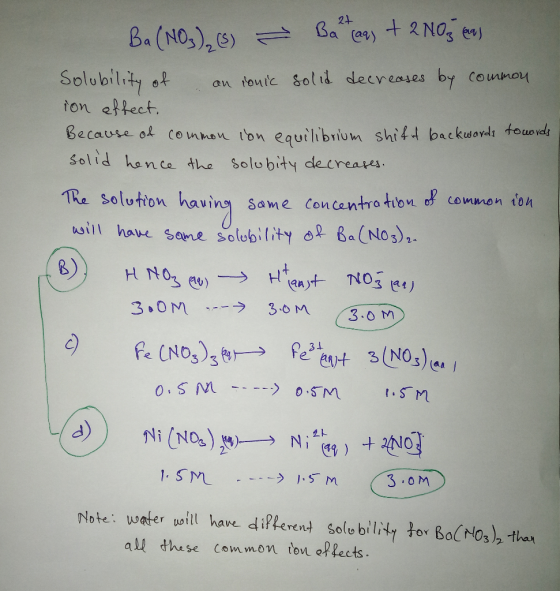
B and D will have same solubility for Ba(NO3)2(s).
Add Answer to:
On the answer line below circle all the solutions with the equal solubility for Ba(NO3)2(s). Solution...
Compare the solubility of barium chromate in each of the following aqueous solutions: 0.10 M Ba(NO3)2...
Compare the solubility of barium chromate in each of the following aqueous solutions: 0.10 M Ba(NO3)2 0.10 M Na2CrO4 0.10 M KNO3 0.10 M NaCH3COO More soluble than in pure water. Similar solubility as in pure water. Less soluble than in pure water.
1) Circle the substance that will be soluble in water: PbSO4, NH4Cl, CuBr2, Ba(NO3)2, Na2CrO4, Fe(ClO4)3 ...
1) Circle the substance that will be soluble in water: PbSO4, NH4Cl, CuBr2, Ba(NO3)2, Na2CrO4, Fe(ClO4)3 (2)
3. (2 pts) Which reaction below illustrates ligand substitution? Circle the one correct answer. a) 2...
 3. (2 pts) Which reaction below illustrates ligand substitution? Circle the one correct answer. a) 2 AgNO3 (aq) + CaCl2 (aq) + 2 AgCl (s) + Ca(NO3)2 (aq) b) AgCl (s) + NaCl (aq) → Na[AgCl2] (aq) c) K3[Fe(SCN)6] (aq) + K4(EDTA) (aq) → K[Fe(EDTA)](aq) + 6 KSCN (aq) d) [Fe(H2O).](NO3)3 (aq) → [Fe(H2O)s(OH)](NO3)2 (aq) + HNO3 (aq) e) 2 K4[Fe(CN)6] + Cl2 → 2 K3[Fe(CN)6] + 2 KCI
3.A classic high school lab experiment involves combining a solution of barium nitrate, Ba(NO3)2, with a...
3.A classic high school lab experiment involves combining a solution of barium nitrate, Ba(NO3)2, with a sodium sulfate solution, Na2SO4, forming a precipitate of barium sulfate. Ba(NO3)2(aq) + Na2SO4(aq) ---> BaSO4(s) + 2NaNO3(aq) a. Identify the hazards associated with the chemicals in this reaction. b. The purpose of this lab is to teach the techniques and principles of quantitative gravimetric analysis. use your knowledge of solubility products to devise a greener set of solutions that would meet the purpose of...
151-Experiment 7-12 2. (2 pts) Which reaction below illustrates complex formation? Circle the one correct answer....
 151-Experiment 7-12 2. (2 pts) Which reaction below illustrates complex formation? Circle the one correct answer. a) 2 AgNO3 (aq) + CaCl2 (aq) + 2 AgCl (s) + Ca(NO3)2 (aq) b) AgCl (s) + NaCl (aq) → Na[AgCl2] (aq) c) K3 [Fe(SCN)6] (aq) + K4(EDTA) (aq) → K[Fe(EDTA)](aq) + 6 KSCN (aq) d) [Fe(H2O)6](NO3)3 (aq) → [Fe(H2O)(OH)](NO3)2 (aq) + HNO3 (aq) e) 2 K4[Fe(CN)6] + Cl2 → 2 K3[Fe(CN)6] + 2 KC1
2) Of the substances below, ________ will decrease the solubility of Pb(NO3)2 in a saturated solution....
2) Of the substances below, ________ will decrease the solubility of Pb(NO3)2 in a saturated solution. a)NaCl b)HCN c)NaCN d)Pb(CN)2 e)H2O2 Can anyone explain briefly explain them with the correct answer?
What happens when you mix equal amounts of two solutions: Na2CO3 (aq) and Ba(NO3)2 (aq) ?...
What happens when you mix equal amounts of two solutions: Na2CO3 (aq) and Ba(NO3)2 (aq) ? a. sodium nitrate precipitates b. barium cation gets reduced to barium metal c. barium carbonate precipitates d. acid base reaction produces CO2
answer all please 1- Calculate the following: A- Number of moles in 10 gram of Cr(NO3)s....
 answer all please
1- Calculate the following: A- Number of moles in 10 gram of Cr(NO3)s. B Number of Atoms in 2.5 gram of Cr(NO3)s C- Number of molecules in 100 gram of Fe(NO3)s. D- Number of grams in 10 20 atoms of Fe(NO3)s. 2- Complete the following table: Element С н % Composition 71 Empirical Formula Element Н % Composition 65.4 5.5 29.1 Empirical Formula 29
answer all please
1- Calculate the following: A- Number of moles in 10 gram of Cr(NO3)s. B Number of Atoms in 2.5 gram of Cr(NO3)s C- Number of molecules in 100 gram of Fe(NO3)s. D- Number of grams in 10 20 atoms of Fe(NO3)s. 2- Complete the following table: Element С н % Composition 71 Empirical Formula Element Н % Composition 65.4 5.5 29.1 Empirical Formula 29
1. Determine the net ionic equations A. Ba(PO4)2(s) + 6HNO3 (aq) → 3Ba(NO3)2(aq) + 2H3PO4(aq) B....
1. Determine the net ionic equations A. Ba(PO4)2(s) + 6HNO3 (aq) → 3Ba(NO3)2(aq) + 2H3PO4(aq) B. Pb3(PO4)2(s) + 6HNO3 (aq) → 3Pb(NO3)2(aq) + 2H3PO4(aq) C. Fe(PO4)(s) + 3HNO3 (aq) → Fe(NO3)3(aq) + H3PO4(aq) D. Ag3PO4(s) + 3HNO3 (aq) → AgNO3(aq) + H3PO4(aq)
Use the solubility table to answer the following. You do not need to mix any chemicals....
 Use the solubility table to answer the following. You do not need to mix any chemicals. 1. Circle the following compounds if they will not dissolve completely or will form ppt in H a CaSO4 (s) Cu(IO3)2(s) AgNO3(s) Baco3 (s) Pb(NO3)2(s) Al(OH)3(s) 2. circle all of the following solutions that will form a precipitate with addition of Mg(IO3)2 aq) Ba (NO3)2(aq) Pb (NO3)2(aq) K2CO3 (aq) CuCl2(aq) NH40H (aq) ZnSO4(aq) 3. Circle all of the following solutions that will not form...
 3. (2 pts) Which reaction below illustrates ligand substitution? Circle the one correct answer. a) 2 AgNO3 (aq) + CaCl2 (aq) + 2 AgCl (s) + Ca(NO3)2 (aq) b) AgCl (s) + NaCl (aq) → Na[AgCl2] (aq) c) K3[Fe(SCN)6] (aq) + K4(EDTA) (aq) → K[Fe(EDTA)](aq) + 6 KSCN (aq) d) [Fe(H2O).](NO3)3 (aq) → [Fe(H2O)s(OH)](NO3)2 (aq) + HNO3 (aq) e) 2 K4[Fe(CN)6] + Cl2 → 2 K3[Fe(CN)6] + 2 KCI
 151-Experiment 7-12 2. (2 pts) Which reaction below illustrates complex formation? Circle the one correct answer. a) 2 AgNO3 (aq) + CaCl2 (aq) + 2 AgCl (s) + Ca(NO3)2 (aq) b) AgCl (s) + NaCl (aq) → Na[AgCl2] (aq) c) K3 [Fe(SCN)6] (aq) + K4(EDTA) (aq) → K[Fe(EDTA)](aq) + 6 KSCN (aq) d) [Fe(H2O)6](NO3)3 (aq) → [Fe(H2O)(OH)](NO3)2 (aq) + HNO3 (aq) e) 2 K4[Fe(CN)6] + Cl2 → 2 K3[Fe(CN)6] + 2 KC1
 answer all please
1- Calculate the following: A- Number of moles in 10 gram of Cr(NO3)s. B Number of Atoms in 2.5 gram of Cr(NO3)s C- Number of molecules in 100 gram of Fe(NO3)s. D- Number of grams in 10 20 atoms of Fe(NO3)s. 2- Complete the following table: Element С н % Composition 71 Empirical Formula Element Н % Composition 65.4 5.5 29.1 Empirical Formula 29
answer all please
1- Calculate the following: A- Number of moles in 10 gram of Cr(NO3)s. B Number of Atoms in 2.5 gram of Cr(NO3)s C- Number of molecules in 100 gram of Fe(NO3)s. D- Number of grams in 10 20 atoms of Fe(NO3)s. 2- Complete the following table: Element С н % Composition 71 Empirical Formula Element Н % Composition 65.4 5.5 29.1 Empirical Formula 29
 Use the solubility table to answer the following. You do not need to mix any chemicals. 1. Circle the following compounds if they will not dissolve completely or will form ppt in H a CaSO4 (s) Cu(IO3)2(s) AgNO3(s) Baco3 (s) Pb(NO3)2(s) Al(OH)3(s) 2. circle all of the following solutions that will form a precipitate with addition of Mg(IO3)2 aq) Ba (NO3)2(aq) Pb (NO3)2(aq) K2CO3 (aq) CuCl2(aq) NH40H (aq) ZnSO4(aq) 3. Circle all of the following solutions that will not form...
Most questions answered within 3 hours.
-
Where is the error in this code sequence?
String s1 = "Hello";
String s2 = "ello";...
asked 10 months ago -
Financial data for Joel de Paris, Inc., for last year
follow:
Joel de Paris, Inc.
Balance...
asked 10 months ago -
Consider this reaction:
Al2(SO4)3 (aq)+ BaCl3
(aq) Al2Cl6 (aq)- +
3BaSO4(s) . What is the...
asked 10 months ago -
Suppose that Savneet is considering increasing her
recent random sample from 20 car rentals to 40...
asked 10 months ago -
Trucks arrive at an unloading terminal at an average rate of 120
per hour.
Trucks arrive...
asked 10 months ago -
Why are methanol and ethanol completely soluble in water while
octanol is not very little soluble....
asked 10 months ago -
A facilities manager at a university reads in a research report
that the mean amount of...
asked 10 months ago -
When the CuSO4 is rehydrated by adding water to the anhydrous
compound, is this an endothermic...
asked 10 months ago -
A ray of sunlight is passing from diamond into crown glass; the
angle of incidence is...
asked 10 months ago -
A block of mass 0.249 kg is placed on top of a light, vertical
spring of...
asked 10 months ago -
how do the kidneys compensate in the presences of acidosis
a) trigger hyperventilate
b) reserve acid...
asked 10 months ago -
Question 501 pts
The rental rate of capital to the firm increases. Which of the
following...
asked 10 months ago