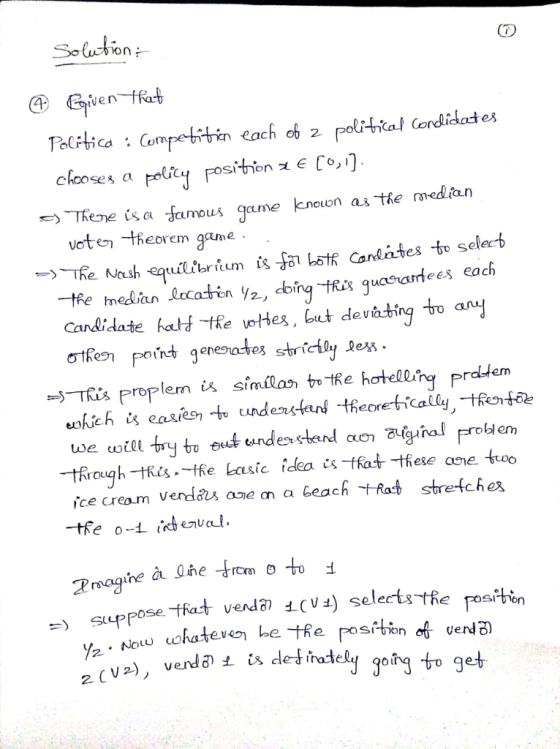
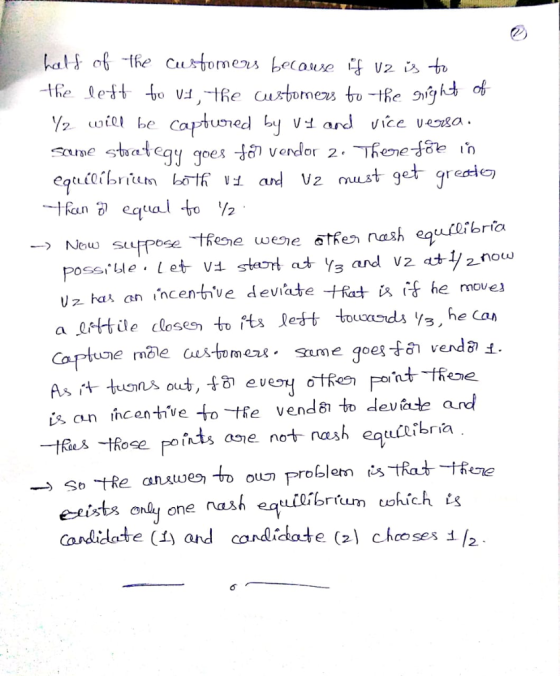
![Political Competition Each of 2 political candidates chooses a policy position x e l0, 1: Voters (there is a continuum of them) are uniformly distributed on [0,1]; each votes for whichever candidate chooses a position closest to him. (So for example, if candidate 1 chooses x and candidate 2 chooses 2,then all voters abovevote for candidate 2, all below vote for candidate 1). The candidate with the most votes wins; in case of a tie, each wins with positive probability. A candidates payoff is 1 if he wins, 0 if he loses. Find all NE of the game. (Note: a NE is a pair (x;x2) such that, given the opponents policy choice, neither candidate wishes to change his position). OW](http://img.homeworklib.com/questions/43dfa9c0-6f11-11ea-97b4-4bb4fc8e3cc1.png?x-oss-process=image/resize,w_560)
Homework Answers
Add Answer to:
Political Competition Each of 2 political candidates chooses a policy position x e l0, 1: Voters...
4. Political Competition Each of 2 political candidates chooses a policy position x e [0,1: Voters...
 4. Political Competition Each of 2 political candidates chooses a policy position x e [0,1: Voters (there is a continuum of them) are uniformly distributed on [0,1]; each votes for whichever candidate chooses a position closest to him. (So for example, if candidate l chooses X1 and candidate 2 chooses x2,then all voters above1 vote for candidate 2, all below with positive probability. A candidate's payoff is 1 if he wins, 0 if he loses. Find all NE of the...
Suppose voters are uniformly distributed along a continuum between 0 and 1. There are two candidates....
Suppose voters are uniformly distributed along a continuum between 0 and 1. There are two candidates. Voters will vote for the candidate who locates closes to them. Candidates only care about receiving more votes than the other candidate (and prefer a tie to losing).What is the rationalizable set of locations for each candidate?
Suppose 2 candidates are vying for election by trying to position themselves along a discrete pol...
Suppose 2 candidates are vying for election by trying to position themselves along a discrete political spectrum 0 1 2 3 4 5 6 7 8 9 . Ten percent of the votes are at each location on the spectrum. Each candidate wants to maximize her share of the votes by choosing her position on the spectrum; voters vote for the candidate closest to their position on the spectrum, and if there is a tie in distance they split their...
4. (Voter Participation): 2 candidates A and B compete in an election. Of the n citizens,...
4. (Voter Participation): 2 candidates A and B compete in an election. Of the n citizens, k support candidate A and the remaining (n − k) support B. Each citizen chooses whether to abstain, or to vote at a cost. A citizen who abstains receives payoff 2 if the candidate she supports wins, 1 if this candidate ties for 1st place, and 0 if the candidate loses. A citizen who votes receives the same payoffs, minus a voting cost 0...
There are N voters. There are 4 candidates. If we were to ask each of the...
There are N voters. There are 4 candidates. If we were to ask each of the N voters, we would learn that 30% would vote for candidate A 25% would vote for candidate B 25% would vote for candidate C 20% would vote for candidate D Since it is unrealistic to ask the whole population, we randomly sample a subset n. Let Yi be the response from the i th sampled voter. Let yi denote the outcome of Yi. yi...
2. Reconsider the model of 2 candidate competition (over school locations) with candidates that face uncertainty...
 2. Reconsider the model of 2 candidate competition (over school locations) with candidates that face uncertainty about the location of the median voter. In particular both candidates believe the median, m is uniformly (a) First assume that the candidates care only about winning (obtain ing a payoff of 1 from a wifro a tie and 0 from losing). Find the Nash equilibria to this game. b) Now assume that the candidates care about policy and winning So candidate 1 obtains...
2. Reconsider the model of 2 candidate competition (over school locations) with candidates that face uncertainty...
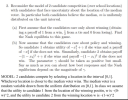 2. Reconsider the model of 2 candidate competition (over school locations) with candidates that face uncertainty about the location of the median voter. In particular both candidates believe the median, m is uniformly distributed on the unit interval a) First assume that the candidates care only about winning (obtain- ing a payoff of 1 from a win, ^ from a tie and 0 from losing). Find the Nash equilibria to this game. (b) Now assume that the candidates care about...
15.1: Tallying Votes Elections are a formal group-decision making process by which a population chooses a...
15.1: Tallying Votes Elections are a formal group-decision making process by which a population chooses a person to hold office, such as the mayor of a city. Another use of elections is to accept or reject a political proposition. Most election results are tallied, or counted, using electronic voting. Most electronic voting machines use a computer to take care of the chore of casting and counting votes. This Tuesday, November 6 (the date your assignment is due) is election day....
Question 1 According to the crash course video on political parties, why do political scientist feel...
Question 1 According to the crash course video on political parties, why do political scientist feel that the primary process can lead to further party polarization (parties becoming less moderate)? a. Low voter turnout leads to partisan voters which leads to partisan candidates b. Primaries are held at different times around the country c. Low voter turnout leads to only elites voting and they pick their favorite candidates d. Only moderate voters vote in primaries Question 2 According to your...
Ranked choice voting is a system of tallying election ballots that is used in many national...
 Ranked choice voting is a system of tallying election
ballots that is used in many national and local elections
throughout the world. Instead of choosing a single candidate,
voters must rank the available candidates in the order of their
choice. For example, if three candidates are available, a
voter might choose #2, #1, and #3 as their choices, with #2 being
their first choice, #1 the second, and #3 the third.
The outcome is determined by a runoff, which follows...
Ranked choice voting is a system of tallying election
ballots that is used in many national and local elections
throughout the world. Instead of choosing a single candidate,
voters must rank the available candidates in the order of their
choice. For example, if three candidates are available, a
voter might choose #2, #1, and #3 as their choices, with #2 being
their first choice, #1 the second, and #3 the third.
The outcome is determined by a runoff, which follows...
 4. Political Competition Each of 2 political candidates chooses a policy position x e [0,1: Voters (there is a continuum of them) are uniformly distributed on [0,1]; each votes for whichever candidate chooses a position closest to him. (So for example, if candidate l chooses X1 and candidate 2 chooses x2,then all voters above1 vote for candidate 2, all below with positive probability. A candidate's payoff is 1 if he wins, 0 if he loses. Find all NE of the...
 2. Reconsider the model of 2 candidate competition (over school locations) with candidates that face uncertainty about the location of the median voter. In particular both candidates believe the median, m is uniformly (a) First assume that the candidates care only about winning (obtain ing a payoff of 1 from a wifro a tie and 0 from losing). Find the Nash equilibria to this game. b) Now assume that the candidates care about policy and winning So candidate 1 obtains...
 2. Reconsider the model of 2 candidate competition (over school locations) with candidates that face uncertainty about the location of the median voter. In particular both candidates believe the median, m is uniformly distributed on the unit interval a) First assume that the candidates care only about winning (obtain- ing a payoff of 1 from a win, ^ from a tie and 0 from losing). Find the Nash equilibria to this game. (b) Now assume that the candidates care about...
 Ranked choice voting is a system of tallying election
ballots that is used in many national and local elections
throughout the world. Instead of choosing a single candidate,
voters must rank the available candidates in the order of their
choice. For example, if three candidates are available, a
voter might choose #2, #1, and #3 as their choices, with #2 being
their first choice, #1 the second, and #3 the third.
The outcome is determined by a runoff, which follows...
Ranked choice voting is a system of tallying election
ballots that is used in many national and local elections
throughout the world. Instead of choosing a single candidate,
voters must rank the available candidates in the order of their
choice. For example, if three candidates are available, a
voter might choose #2, #1, and #3 as their choices, with #2 being
their first choice, #1 the second, and #3 the third.
The outcome is determined by a runoff, which follows...
Most questions answered within 3 hours.
-
Where is the error in this code sequence?
String s1 = "Hello";
String s2 = "ello";...
asked 11 months ago -
Financial data for Joel de Paris, Inc., for last year
follow:
Joel de Paris, Inc.
Balance...
asked 11 months ago -
Consider this reaction:
Al2(SO4)3 (aq)+ BaCl3
(aq) Al2Cl6 (aq)- +
3BaSO4(s) . What is the...
asked 11 months ago -
Suppose that Savneet is considering increasing her
recent random sample from 20 car rentals to 40...
asked 11 months ago -
Trucks arrive at an unloading terminal at an average rate of 120
per hour.
Trucks arrive...
asked 11 months ago -
Why are methanol and ethanol completely soluble in water while
octanol is not very little soluble....
asked 11 months ago -
A facilities manager at a university reads in a research report
that the mean amount of...
asked 11 months ago -
When the CuSO4 is rehydrated by adding water to the anhydrous
compound, is this an endothermic...
asked 11 months ago -
A ray of sunlight is passing from diamond into crown glass; the
angle of incidence is...
asked 11 months ago -
A block of mass 0.249 kg is placed on top of a light, vertical
spring of...
asked 11 months ago -
how do the kidneys compensate in the presences of acidosis
a) trigger hyperventilate
b) reserve acid...
asked 11 months ago -
Question 501 pts
The rental rate of capital to the firm increases. Which of the
following...
asked 11 months ago