
Homework Answers
Answer:
Investors/shareholders
Reason: The purpose of financial audits and reports enable the investors /shareholders to assess the financial performance of the organization.
Add Answer to:
QUESTION 2 The reason for preparing, auditing, and disseminating financial reports is to allow the to...
Question 2 Discuss the sources of criticism of the effectiveness of financial statement auditing and proposals...
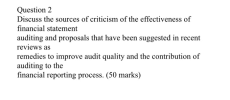 Question 2 Discuss the sources of criticism of the effectiveness of financial statement auditing and proposals that have been suggested in recent reviews as remedies to improve audit quality and the contribution of auditing to the financial reporting process. (50 marks)
Simplified approaches for preparing pro forma statements assume that the firm’s past financial condition is an...
Simplified approaches for preparing pro forma statements assume that the firm’s past financial condition is an accurate indicator of the future. There are several examples from the past where organizations were not accurately reporting their financial information. Discuss the relationship between the external auditor and the organization. What steps have been taken to ensure that the relationship is truly neutral and no bias is shown by the external auditing firm?
principles of auditing chapter 2 QUESTION 11 Audit risk for an individual account consists of business...
 principles of auditing
chapter 2
QUESTION 11 Audit risk for an individual account consists of business risk, detection risk, and control risk. True False QUESTION 12 There is an inverse relationship between the effectiveness of an entity's system of internal control and the A. Reliability of financial statements. B. Fairness of management assertions in the financial statements. C. Degree of staff supervision required in the performance of an audit. D. Extent of detailed audit tests required.
principles of auditing
chapter 2
QUESTION 11 Audit risk for an individual account consists of business risk, detection risk, and control risk. True False QUESTION 12 There is an inverse relationship between the effectiveness of an entity's system of internal control and the A. Reliability of financial statements. B. Fairness of management assertions in the financial statements. C. Degree of staff supervision required in the performance of an audit. D. Extent of detailed audit tests required.
2. Please prepare a response indicating the reason why adjusting entries are required, the potential impact of this...
 2. Please prepare a response indicating the reason why adjusting entries are required, the potential impact of this information on financial statement reports and the importance of these adjustments. 3. Two bookkeepers get into a heated discussion about whether closing entries should be made before or after preparing the financial statements. They have come to you to resolve this issue and have agreed to accept your position. Prepare a written response explaining the purpose of closing entries and whether they...
help with this auditing question Question 4 (a) Explain the relationship between the Financial Statements of...
 help with this auditing question
Question 4 (a) Explain the relationship between the Financial Statements of a company, the shareholders, the directors and the auditors. (8 marks)
help with this auditing question
Question 4 (a) Explain the relationship between the Financial Statements of a company, the shareholders, the directors and the auditors. (8 marks)
principles of auditing chapter 2 QUESTION 9 In a financial statement audit, inherent risk represents A....
 principles of auditing
chapter 2
QUESTION 9 In a financial statement audit, inherent risk represents A. The risk that the auditor fails to modify materially misstated financial statements. B. The risk that misstatements could occur and not be prevented or detected by the system of internal control. C. The susceptibility of an account balance to misstatement that could be material. D. The risk that misstatements could occur and not be detected by the auditor's procedures. QUESTION 10 An auditor strives...
principles of auditing
chapter 2
QUESTION 9 In a financial statement audit, inherent risk represents A. The risk that the auditor fails to modify materially misstated financial statements. B. The risk that misstatements could occur and not be prevented or detected by the system of internal control. C. The susceptibility of an account balance to misstatement that could be material. D. The risk that misstatements could occur and not be detected by the auditor's procedures. QUESTION 10 An auditor strives...
Describe a) what you believe to be the most important COSO component; and b) why. (If for some reason your mind has taken a nap, see question #2 which identifies all 5).
Describe a) what you believe to be the most important COSO component; and b) why. (If for some reason your mind has taken a nap, see question #2 which identifies all 5). Accountants utilize the body of knowledge called GAAP in the performance of their duties partly to ensure comparability and consistency in the preparation of accounting records / financial statements. Auditors on the other hand perform their responsibilities following GAAS as defined within the AICPA SASs or PCAOB Auditing Standards....
Compare (similarities) OR contrast (differences) between the AICPA SASs & the PCAOB Auditing Standards.
Describe a) what you believe to be the most important COSO component; and b)why. (If for some reason your mind has taken a nap, see question #2 which identifies all 5). Accountants utilize the body of knowledge called GAAP in the performance of their duties partly to ensure comparability and consistency in the preparation of accounting records / financial statements. Auditors on the other hand perform their responsibilities following GAAS as defined within the AICPA SASs or PCAOB Auditing Standards. What does this...
principles of auditing ch 2 QUESTION 18 The effect on net income is a qualitative materiality...
 principles of auditing
ch 2
QUESTION 18 The effect on net income is a qualitative materiality criterion. True False
principles of auditing
ch 2
QUESTION 18 The effect on net income is a qualitative materiality criterion. True False
principles of auditing chapter 2 QUESTION 13 The three generally accepted auditing standards classified as general...
 principles of auditing
chapter 2
QUESTION 13 The three generally accepted auditing standards classified as general standards can be described as criteria for the A. Competence, independence, and professional care of individuals performing the audit. B. Planning and supervision of the audit engagement C. Content of the financial statements and related footnote disclosures and the consistency standard. D. Content of the auditor's report, study of internal control, and planning. QUESTION 14 The internal controls of an entity are the policies...
principles of auditing
chapter 2
QUESTION 13 The three generally accepted auditing standards classified as general standards can be described as criteria for the A. Competence, independence, and professional care of individuals performing the audit. B. Planning and supervision of the audit engagement C. Content of the financial statements and related footnote disclosures and the consistency standard. D. Content of the auditor's report, study of internal control, and planning. QUESTION 14 The internal controls of an entity are the policies...
 Question 2 Discuss the sources of criticism of the effectiveness of financial statement auditing and proposals that have been suggested in recent reviews as remedies to improve audit quality and the contribution of auditing to the financial reporting process. (50 marks)
 principles of auditing
chapter 2
QUESTION 11 Audit risk for an individual account consists of business risk, detection risk, and control risk. True False QUESTION 12 There is an inverse relationship between the effectiveness of an entity's system of internal control and the A. Reliability of financial statements. B. Fairness of management assertions in the financial statements. C. Degree of staff supervision required in the performance of an audit. D. Extent of detailed audit tests required.
principles of auditing
chapter 2
QUESTION 11 Audit risk for an individual account consists of business risk, detection risk, and control risk. True False QUESTION 12 There is an inverse relationship between the effectiveness of an entity's system of internal control and the A. Reliability of financial statements. B. Fairness of management assertions in the financial statements. C. Degree of staff supervision required in the performance of an audit. D. Extent of detailed audit tests required.
 2. Please prepare a response indicating the reason why adjusting entries are required, the potential impact of this information on financial statement reports and the importance of these adjustments. 3. Two bookkeepers get into a heated discussion about whether closing entries should be made before or after preparing the financial statements. They have come to you to resolve this issue and have agreed to accept your position. Prepare a written response explaining the purpose of closing entries and whether they...
 help with this auditing question
Question 4 (a) Explain the relationship between the Financial Statements of a company, the shareholders, the directors and the auditors. (8 marks)
help with this auditing question
Question 4 (a) Explain the relationship between the Financial Statements of a company, the shareholders, the directors and the auditors. (8 marks)
 principles of auditing
chapter 2
QUESTION 9 In a financial statement audit, inherent risk represents A. The risk that the auditor fails to modify materially misstated financial statements. B. The risk that misstatements could occur and not be prevented or detected by the system of internal control. C. The susceptibility of an account balance to misstatement that could be material. D. The risk that misstatements could occur and not be detected by the auditor's procedures. QUESTION 10 An auditor strives...
principles of auditing
chapter 2
QUESTION 9 In a financial statement audit, inherent risk represents A. The risk that the auditor fails to modify materially misstated financial statements. B. The risk that misstatements could occur and not be prevented or detected by the system of internal control. C. The susceptibility of an account balance to misstatement that could be material. D. The risk that misstatements could occur and not be detected by the auditor's procedures. QUESTION 10 An auditor strives...
 principles of auditing
ch 2
QUESTION 18 The effect on net income is a qualitative materiality criterion. True False
principles of auditing
ch 2
QUESTION 18 The effect on net income is a qualitative materiality criterion. True False
 principles of auditing
chapter 2
QUESTION 13 The three generally accepted auditing standards classified as general standards can be described as criteria for the A. Competence, independence, and professional care of individuals performing the audit. B. Planning and supervision of the audit engagement C. Content of the financial statements and related footnote disclosures and the consistency standard. D. Content of the auditor's report, study of internal control, and planning. QUESTION 14 The internal controls of an entity are the policies...
principles of auditing
chapter 2
QUESTION 13 The three generally accepted auditing standards classified as general standards can be described as criteria for the A. Competence, independence, and professional care of individuals performing the audit. B. Planning and supervision of the audit engagement C. Content of the financial statements and related footnote disclosures and the consistency standard. D. Content of the auditor's report, study of internal control, and planning. QUESTION 14 The internal controls of an entity are the policies...
Most questions answered within 3 hours.
-
Where is the error in this code sequence?
String s1 = "Hello";
String s2 = "ello";...
asked 10 months ago -
Financial data for Joel de Paris, Inc., for last year
follow:
Joel de Paris, Inc.
Balance...
asked 10 months ago -
Consider this reaction:
Al2(SO4)3 (aq)+ BaCl3
(aq) Al2Cl6 (aq)- +
3BaSO4(s) . What is the...
asked 10 months ago -
Suppose that Savneet is considering increasing her
recent random sample from 20 car rentals to 40...
asked 10 months ago -
Trucks arrive at an unloading terminal at an average rate of 120
per hour.
Trucks arrive...
asked 10 months ago -
Why are methanol and ethanol completely soluble in water while
octanol is not very little soluble....
asked 10 months ago -
A facilities manager at a university reads in a research report
that the mean amount of...
asked 10 months ago -
When the CuSO4 is rehydrated by adding water to the anhydrous
compound, is this an endothermic...
asked 10 months ago -
A ray of sunlight is passing from diamond into crown glass; the
angle of incidence is...
asked 10 months ago -
A block of mass 0.249 kg is placed on top of a light, vertical
spring of...
asked 10 months ago -
how do the kidneys compensate in the presences of acidosis
a) trigger hyperventilate
b) reserve acid...
asked 10 months ago -
Question 501 pts
The rental rate of capital to the firm increases. Which of the
following...
asked 10 months ago