
Homework Answers
After tax cost of debt = 7.5%*(1-40%) = 4.5%
Cost of equity = Rf+beta*(Rm-Rf)
= 4%+1.75*(12%-4%)
= 18%
WACC = cost of debt* debt/(debt plus equity)+ the cost of equity* equity/(the debt plus equity)
= 4.5%*2/5+18%*3/5
= 12.6%
NPV = Initial cost +PV of annuity
= -50+8*(1-1/(1+12.6%)^10)/12.6%
=-50+44.11
= - $5.89 million
The project should not be undertaken since NPV is negative.
Add Answer to:
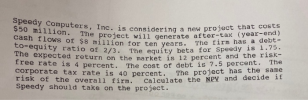
Speedy Computers, Inc. is considering a new project that costs $50 million. The project will generate...
please slove and explain how amswers were obtained Speedy Computers, Inc. is considerin $50 million. The...
 please slove and explain how amswers were obtained
Speedy Computers, Inc. is considerin $50 million. The project will ge cash flows of $8 million for ten years. to-equity ratio of 2/3. "The equity The expected return on the market is 12 percent and free rate is 4 percent. The cost Calcula Speedy should take on the project. is considering a new project that costs e project will generate after-tax (year-end) for ten years. The firm has a debt- 110 of...
please slove and explain how amswers were obtained
Speedy Computers, Inc. is considerin $50 million. The project will ge cash flows of $8 million for ten years. to-equity ratio of 2/3. "The equity The expected return on the market is 12 percent and free rate is 4 percent. The cost Calcula Speedy should take on the project. is considering a new project that costs e project will generate after-tax (year-end) for ten years. The firm has a debt- 110 of...
2) KAYNE Inc. is considering a new project that costs $50 million. The project will generate...
2) KAYNE Inc. is considering a new project that costs $50 million. The project will generate after-tax (year-end) cash flows of $10 million for the first three years (t = 1, 2, 3), $13 million for the following two years (t = 4, 5), and $12.5 million for the last three years (t= 6, 7, 8). The firm has a debt-equity ratio of 0.50. This firm has a beta of 1.8 and its cost of debt is 10 percent. Suppose...
Blue Angel, Inc., a private firm in the holiday gift industry, is considering a new project....
Blue Angel, Inc., a private firm in the holiday gift industry, is considering a new project. The company currently has a target debt–equity ratio of .45, but the industry target debt–equity ratio is .40. The industry average beta is 1.20. The market risk premium is 8 percent, and the risk-free rate is 6 percent. Assume all companies in this industry can issue debt at the risk-free rate. The corporate tax rate is 40 percent. The project requires an initial outlay...
Blue Angel, Inc., a private firm in the holiday gift industry, is considering a new project....
Blue Angel, Inc., a private firm in the holiday gift industry, is considering a new project. The company currently has a target debt–equity ratio of .40, but the industry target debt–equity ratio is .35. The industry average beta is 1.40. The market risk premium is 7 percent, and the risk-free rate is 5 percent. Assume all companies in this industry can issue debt at the risk-free rate. The corporate tax rate is 34 percent. The project requires an initial outlay...
Blue Angel, Inc., a private firm in the holiday gift industry, is considering a new project....
Blue Angel, Inc., a private firm in the holiday gift industry, is considering a new project. The company currently has a target debt-equity ratio of .45, but the industry target debt-equity ratio is .50. The industry average beta is 1.10. The market risk premium is 6.9 percent and the risk-free rate is 4.5 percent. Assume all companies in this industry can issue debt at the risk-free rate. The corporate tax rate is 23 percent. The project requires an initial outlay...
Blue Angel, Inc., a private firm in the holiday gift industry, is considering a new project....
Blue Angel, Inc., a private firm in the holiday gift industry, is considering a new project. The company currently has a target debt-equity ratio of .40, but the industry target debt-equity ratio is .35. The industry average beta is 1.05. The market risk premium is 6.2 percent and the risk-free rate is 4.6 percent. Assume all companies in this industry can issue debt at the risk-free rate. The corporate tax rate is 24 percent. The project requires an initial outlay...
Blue Angel, Inc., a private firm in the holiday gift industry, is considering a new project....
Blue Angel, Inc., a private firm in the holiday gift industry, is considering a new project. The company currently has a target debt–equity ratio of .35, but the industry target debt–equity ratio is .30. The industry average beta is 1.90. The market risk premium is 7 percent, and the risk-free rate is 5 percent. Assume all companies in this industry can issue debt at the risk-free rate. The corporate tax rate is 34 percent. The project requires an initial outlay...
Blue Angel, Inc., a private firm in the holiday gift industry, is considering a new project....
 Blue Angel, Inc., a private firm in the holiday gift industry, is considering a new project. The company currently has a target debt-equity ratio of .35, but the industry target debt-equity ratio is .30. The industry average beta is 1.90. The market risk premium is 6 percent, and the risk-free rate is 4 percent. Assume all companies in this industry can issue debt at the risk-free rate. The corporate tax rate is 34 percent. The project requires an initial outlay...
Blue Angel, Inc., a private firm in the holiday gift industry, is considering a new project....
 Blue Angel, Inc., a private firm in the holiday gift industry, is considering a new project. The company currently has a target debt-equity ratio of 40, but the industry target debt-equity ratio is 35. The industry average beta is 1.40. The market risk premium is 7 percent, and the risk-free rate is 5 percent. Assume all companies in this industry can issue debt at the risk-free rate. The corporate tax rate is 34 percent. The project requires an initial outlay...
Blue Angel, Inc., a private firm in the holiday gift industry, is considering a new project. The company currently has a...
Blue Angel, Inc., a private firm in the holiday gift industry, is considering a new project. The company currently has a target debt–equity ratio of .45, but the industry target debt–equity ratio is .40. The industry average beta is 1.20. The market risk premium is 8 percent, and the risk-free rate is 6 percent. Assume all companies in this industry can issue debt at the risk-free rate. The corporate tax rate is 40 percent. The project requires an initial outlay...
 please slove and explain how amswers were obtained
Speedy Computers, Inc. is considerin $50 million. The project will ge cash flows of $8 million for ten years. to-equity ratio of 2/3. "The equity The expected return on the market is 12 percent and free rate is 4 percent. The cost Calcula Speedy should take on the project. is considering a new project that costs e project will generate after-tax (year-end) for ten years. The firm has a debt- 110 of...
please slove and explain how amswers were obtained
Speedy Computers, Inc. is considerin $50 million. The project will ge cash flows of $8 million for ten years. to-equity ratio of 2/3. "The equity The expected return on the market is 12 percent and free rate is 4 percent. The cost Calcula Speedy should take on the project. is considering a new project that costs e project will generate after-tax (year-end) for ten years. The firm has a debt- 110 of...
 Blue Angel, Inc., a private firm in the holiday gift industry, is considering a new project. The company currently has a target debt-equity ratio of .35, but the industry target debt-equity ratio is .30. The industry average beta is 1.90. The market risk premium is 6 percent, and the risk-free rate is 4 percent. Assume all companies in this industry can issue debt at the risk-free rate. The corporate tax rate is 34 percent. The project requires an initial outlay...
 Blue Angel, Inc., a private firm in the holiday gift industry, is considering a new project. The company currently has a target debt-equity ratio of 40, but the industry target debt-equity ratio is 35. The industry average beta is 1.40. The market risk premium is 7 percent, and the risk-free rate is 5 percent. Assume all companies in this industry can issue debt at the risk-free rate. The corporate tax rate is 34 percent. The project requires an initial outlay...
Most questions answered within 3 hours.
-
Where is the error in this code sequence?
String s1 = "Hello";
String s2 = "ello";...
asked 11 months ago -
Financial data for Joel de Paris, Inc., for last year
follow:
Joel de Paris, Inc.
Balance...
asked 11 months ago -
Consider this reaction:
Al2(SO4)3 (aq)+ BaCl3
(aq) Al2Cl6 (aq)- +
3BaSO4(s) . What is the...
asked 11 months ago -
Suppose that Savneet is considering increasing her
recent random sample from 20 car rentals to 40...
asked 11 months ago -
Trucks arrive at an unloading terminal at an average rate of 120
per hour.
Trucks arrive...
asked 11 months ago -
Why are methanol and ethanol completely soluble in water while
octanol is not very little soluble....
asked 11 months ago -
A facilities manager at a university reads in a research report
that the mean amount of...
asked 11 months ago -
When the CuSO4 is rehydrated by adding water to the anhydrous
compound, is this an endothermic...
asked 11 months ago -
A ray of sunlight is passing from diamond into crown glass; the
angle of incidence is...
asked 11 months ago -
A block of mass 0.249 kg is placed on top of a light, vertical
spring of...
asked 11 months ago -
how do the kidneys compensate in the presences of acidosis
a) trigger hyperventilate
b) reserve acid...
asked 11 months ago -
Question 501 pts
The rental rate of capital to the firm increases. Which of the
following...
asked 11 months ago