
Homework Answers
In a perfectly competitive market, profit maximization is achieved at the output where price is equal to marginal cost.
The profit maximization rule states that profit is maximized when marginal revenue equals marginal cost.
In perfectly competitive market, for profit maximization to take place, Price = Marginal cost = Marginal revenue
Total cost = 3000 + 24Q - 0.045Q2 + 0.00005Q3
Marginal cost = 24 - 0.09Q + 0.00015Q2
Equating Price and Marginal cost
$ 24 = 24 - 0.09Q + 0.00015Q2
0.09 Q - 0.00015Q2 = 0
Q ( 0.09 - 0.00015Q ) = 0
0.00015Q = 0.09
Q = 0.09
0.00015
Q = 600 units
Profit = Revenue - Total cost
Profit = 600 units x $ 24 - [ 3000 + 24 x 600 - 0.045 x (600)2 + 0.00005 x (600)3 ]
Profit = $ 2400
Output = 600 units ; Profit = $ 2400
----------------------------------------------------------------------------------------------
The shutdown price for a perfectly competitive firm is the minimum point on the average variable cost curve.
The total cost = 3000 + 24Q - 0.045Q2 + 0.00005Q3
The variable cost component of the total cost equation = 24Q - 0.045Q2 + 0.00005Q3
Variable cost = 24Q - 0.045Q2 + 0.00005Q3
Dividing the above variable cost equation by Q , we get the average variable cost equation
AVC = 24 - 0.045Q + 0.00005Q2
Taking the first derivative of above equation
dAVC/dq = -0.045 + 0.0001Q
Equating the above equation to zero
-0.045 + 0.0001Q = 0
Q = 0.045
0.0001
Q = 450 units
At Q = 450 units, the average variable cost is minimum
We know that , AVC = 24 - 0.045Q + 0.00005Q2
Substituting the value of Q = 450 in the above, we find the average variable cost at Q = 450
The average variable cost at 450 units = 24 - 0.045 x 450 + 0.00005 x 4502
The average variable cost at 450 units = $ 13.875
-------------------------------------------------------------------------------------------------
Sunnyvale should shutdown if the price of plums falls below $ 13.875 .
Loss = Revenue - total cost
Loss = $ 13.875 x 450 units - [ 3000 + 24 x 450 - 0.045 x (450)2 + 0.00005 x (450)3 ]
----------------------------------------------------------------------------------------------
Shutdown price = $ 13.875
Loss = - $ 3000
Add Answer to:
3. Sunnyvale Orchards is one of many small, perfectly competitive firms growing plums for the U.S....
3. Sunnyvale Orchards is one of many small, perfectly competitive firms growing plums for the U.S. market. The fore...
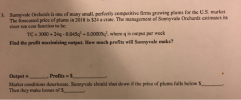 3. Sunnyvale Orchards is one of many small, perfectly competitive firms growing plums for the U.S. market. The forecasted price of plums in 2018 is $24 a crate. The management of Sunnyvale Orchards estimates its short run cost function to be: TC = 3000 + 244 -0.045q? + 0.00005q', where q is output per week Find the profit maximizing output. How much profits will Sunnyvale make? Output = . Profits = $ Market conditions deteriorate. Sunnyvale should shut down if...
The demand curve for a perfectly competitive firm options: is upward sloping. is perfectly horizontal. is...
The demand curve for a perfectly competitive firm options: is upward sloping. is perfectly horizontal. is perfectly vertical. maybe downward or upward sloping, depending upon the type of product offered for sale. In the short run, the best policy for a perfectly competitive firm is to Question 17 options: shut down its operation if the price ever falls below average total cost. produce and sell its product as long as price is greater than average variable cost. shut down its...
For a perfectly competitive market made up of firms represented in the graph below, what is...
 For a perfectly competitive market made up of firms represented in the graph below, what is the long run equilibrium price of the good? Cost ($) MC ATC AVC $16 $14 $12 $10 Quantity $14 $10 $12 $16 For a perfectly competitive market made up of firms represented in the graph below, if the price is $14, Cost ($) MC ATC $16 AVC - $14 $12 $10 Quantity The firm is operating at its minimum long run average total cost....
1) A perfectly competitive firm faces the following Total revenue, Total cost and Marginal cost functions:...
1) A perfectly competitive firm faces the following Total revenue, Total cost and Marginal cost functions: TR = 10Q TC = 2 + 2Q + Q2 MC = 2 + 2Q At the level of output maximizing profit , the above firm's level of economic profit is A) $0 B) $4 C) $6 D) $8 *Additional information after I did the math: The price this firm charges for its product is $10, the level of output maximizing profit is 4...
cardboard boxes are produced in a perfectly competitive market. each identical firm has a short run...
 cardboard boxes are produced in a perfectly
competitive market. each identical firm has a short run total cost
curve of TC= 3Q^3 - 12Q^2 +16Q + 100, where Q is measured in
thousands of boxes per week. calculate the output for the price
below which a firm in the market will not produce any output in the
short run. ( i.e., the output for the shut down price)
a 2^1/2
b. 2
c. 1/2
d. 1/square root of 2
2)...
cardboard boxes are produced in a perfectly
competitive market. each identical firm has a short run total cost
curve of TC= 3Q^3 - 12Q^2 +16Q + 100, where Q is measured in
thousands of boxes per week. calculate the output for the price
below which a firm in the market will not produce any output in the
short run. ( i.e., the output for the shut down price)
a 2^1/2
b. 2
c. 1/2
d. 1/square root of 2
2)...
Suppose a perfectly Competitive firms minimum average variable cost is $1 when it produces 50. If...
Suppose a perfectly Competitive firms minimum average variable cost is $1 when it produces 50. If the price is $2 and the firm's marginal cost is $2 the firm should Continue to produce, but produce less than 50 Continue to operate, but produce more than 50 Shut down Continue to produce 50 To maximize economic profit of perfectly competitive firm: will sell its goods below the market price all of the above will sell its goods above the market price...
When a perfectly competitive market is in long-run equilibrium: O firms have an incentive to enter...
 When a perfectly competitive market is in long-run equilibrium: O firms have an incentive to enter the market. O firms have an incentive to leave the market. O no firm has an incentive to enter or leave the market. When a firm operating in a perfectly competitive market is experiencing losses, it should continue operations if: O P< AVC O P=AVC O P > AVC If, in a perfectly competitive market, P= (a firm's) ATC, then the firm: earns an...
In the long run, all of the firms in a perfectly competitive industry will: exit the...
 In the long run, all of the firms in a perfectly competitive industry will: exit the industry if price is greater than average total cost. produce at an output level at which average total cost equals marginal cost. earn an economic profit greater than zero. O produce an output level at which price is greater than average total cost. Which statement about the differences between monopoly and perfect competition is INCORRECT? A monopoly will charge a higher price and produce...
Which of the following is true about firms exiting a perfectly competitive market? Select the correct...
 Which of the following is true about firms exiting a perfectly competitive market? Select the correct answer below: O The price where firms exit the market shows the price where the firm would lack enough revenue to cover its variable costs. O Firms are only concerned with what quantity to produce and will exit otherwise, even if they are not experiencing losses. Exiting the market occurs in response to a sustained pattern of losses. Exiting the market occurs in response...
Duane breeds canary birds for a living. He operates in a perfectly competitive industry. Production costs...
 Duane breeds canary birds for a living. He operates in a perfectly competitive industry. Production costs for Duane are as follows: Output TVC MC AVC ATC 104 34.7 - maino 27.5 110 130 7 150 196 8 190 236 24 29.5 a. Presently, a canary sells for $37. How many birds should Duane breed per month? What are his profits or losses? b. Due to a change in demand, the price of canaries changes to $24. What is Duane's profit...
 3. Sunnyvale Orchards is one of many small, perfectly competitive firms growing plums for the U.S. market. The forecasted price of plums in 2018 is $24 a crate. The management of Sunnyvale Orchards estimates its short run cost function to be: TC = 3000 + 244 -0.045q? + 0.00005q', where q is output per week Find the profit maximizing output. How much profits will Sunnyvale make? Output = . Profits = $ Market conditions deteriorate. Sunnyvale should shut down if...
 For a perfectly competitive market made up of firms represented in the graph below, what is the long run equilibrium price of the good? Cost ($) MC ATC AVC $16 $14 $12 $10 Quantity $14 $10 $12 $16 For a perfectly competitive market made up of firms represented in the graph below, if the price is $14, Cost ($) MC ATC $16 AVC - $14 $12 $10 Quantity The firm is operating at its minimum long run average total cost....
 cardboard boxes are produced in a perfectly
competitive market. each identical firm has a short run total cost
curve of TC= 3Q^3 - 12Q^2 +16Q + 100, where Q is measured in
thousands of boxes per week. calculate the output for the price
below which a firm in the market will not produce any output in the
short run. ( i.e., the output for the shut down price)
a 2^1/2
b. 2
c. 1/2
d. 1/square root of 2
2)...
cardboard boxes are produced in a perfectly
competitive market. each identical firm has a short run total cost
curve of TC= 3Q^3 - 12Q^2 +16Q + 100, where Q is measured in
thousands of boxes per week. calculate the output for the price
below which a firm in the market will not produce any output in the
short run. ( i.e., the output for the shut down price)
a 2^1/2
b. 2
c. 1/2
d. 1/square root of 2
2)...
 When a perfectly competitive market is in long-run equilibrium: O firms have an incentive to enter the market. O firms have an incentive to leave the market. O no firm has an incentive to enter or leave the market. When a firm operating in a perfectly competitive market is experiencing losses, it should continue operations if: O P< AVC O P=AVC O P > AVC If, in a perfectly competitive market, P= (a firm's) ATC, then the firm: earns an...
 In the long run, all of the firms in a perfectly competitive industry will: exit the industry if price is greater than average total cost. produce at an output level at which average total cost equals marginal cost. earn an economic profit greater than zero. O produce an output level at which price is greater than average total cost. Which statement about the differences between monopoly and perfect competition is INCORRECT? A monopoly will charge a higher price and produce...
 Which of the following is true about firms exiting a perfectly competitive market? Select the correct answer below: O The price where firms exit the market shows the price where the firm would lack enough revenue to cover its variable costs. O Firms are only concerned with what quantity to produce and will exit otherwise, even if they are not experiencing losses. Exiting the market occurs in response to a sustained pattern of losses. Exiting the market occurs in response...
 Duane breeds canary birds for a living. He operates in a perfectly competitive industry. Production costs for Duane are as follows: Output TVC MC AVC ATC 104 34.7 - maino 27.5 110 130 7 150 196 8 190 236 24 29.5 a. Presently, a canary sells for $37. How many birds should Duane breed per month? What are his profits or losses? b. Due to a change in demand, the price of canaries changes to $24. What is Duane's profit...
Most questions answered within 3 hours.
-
Where is the error in this code sequence?
String s1 = "Hello";
String s2 = "ello";...
asked 11 months ago -
Financial data for Joel de Paris, Inc., for last year
follow:
Joel de Paris, Inc.
Balance...
asked 11 months ago -
Consider this reaction:
Al2(SO4)3 (aq)+ BaCl3
(aq) Al2Cl6 (aq)- +
3BaSO4(s) . What is the...
asked 11 months ago -
Suppose that Savneet is considering increasing her
recent random sample from 20 car rentals to 40...
asked 11 months ago -
Trucks arrive at an unloading terminal at an average rate of 120
per hour.
Trucks arrive...
asked 11 months ago -
Why are methanol and ethanol completely soluble in water while
octanol is not very little soluble....
asked 11 months ago -
A facilities manager at a university reads in a research report
that the mean amount of...
asked 11 months ago -
When the CuSO4 is rehydrated by adding water to the anhydrous
compound, is this an endothermic...
asked 11 months ago -
A ray of sunlight is passing from diamond into crown glass; the
angle of incidence is...
asked 11 months ago -
A block of mass 0.249 kg is placed on top of a light, vertical
spring of...
asked 11 months ago -
how do the kidneys compensate in the presences of acidosis
a) trigger hyperventilate
b) reserve acid...
asked 11 months ago -
Question 501 pts
The rental rate of capital to the firm increases. Which of the
following...
asked 11 months ago