

Homework Answers
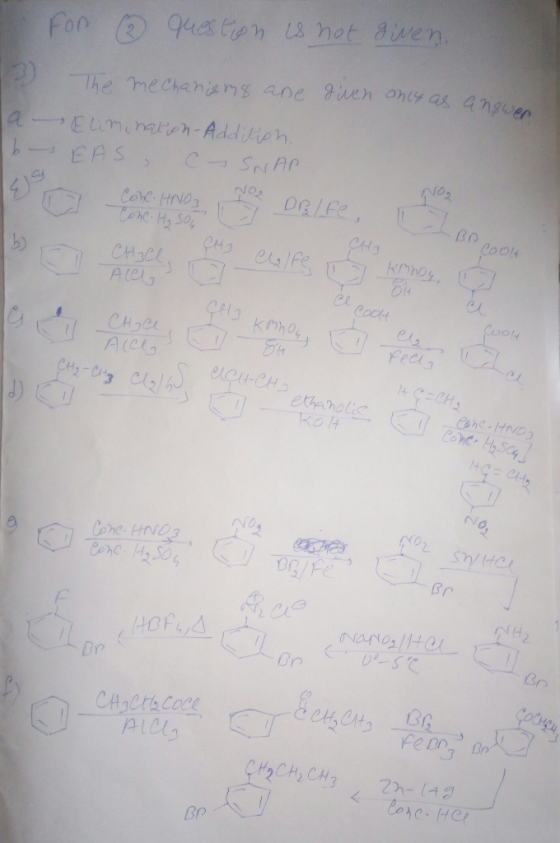
Add Answer to:
aromatic reaction worksheet
2. b IV. fastest > slowest 3. Under each reaction, circle the correct...
organic 2 aromatic reaction worksheet 1.1 h) + 1, Cuci heat -NO, + KOCH, | 1)...
 organic 2
aromatic reaction worksheet
1.1 h) + 1, Cuci heat -NO, + KOCH, | 1) NaNH, NH. -CI 2) H0 Rank the following compounds from fastest to slowest as they react in an EAS with Bry/FeBrz. IL IV. fastest__> slowest
organic 2
aromatic reaction worksheet
1.1 h) + 1, Cuci heat -NO, + KOCH, | 1) NaNH, NH. -CI 2) H0 Rank the following compounds from fastest to slowest as they react in an EAS with Bry/FeBrz. IL IV. fastest__> slowest
che 1. Rank from fastest (1) to slowest (5) the rates of the SN2 reaction of...
 che
1. Rank from fastest (1) to slowest (5) the rates of the SN2 reaction of the compounds shown. Br Br CH3-C-CH3 CH3 CHaCHs CH2 CH-CH21 CH-CH,он CH3CH2Br 2. Rank from fastest (1) to slowest (5) the rates of the solvolysis reaction in HOAC/HOH of the compounds shown. Br Br CH3-с-CHз CH3CH2OH CH2-CH-CH21 CH3-C-CH3 CH3 CH3CH2Br B. Circle the number corresponding to the correct answer. Answer 5. a) What is the principal determinant of reaction order? i. structure of substrate...
che
1. Rank from fastest (1) to slowest (5) the rates of the SN2 reaction of the compounds shown. Br Br CH3-C-CH3 CH3 CHaCHs CH2 CH-CH21 CH-CH,он CH3CH2Br 2. Rank from fastest (1) to slowest (5) the rates of the solvolysis reaction in HOAC/HOH of the compounds shown. Br Br CH3-с-CHз CH3CH2OH CH2-CH-CH21 CH3-C-CH3 CH3 CH3CH2Br B. Circle the number corresponding to the correct answer. Answer 5. a) What is the principal determinant of reaction order? i. structure of substrate...
Please describe how each reaction will be accomplished. Alkyne and Nitrile Synthesis Retrosynthesis CH CH2 OH...
 Please describe how each reaction will be accomplished.
Alkyne and Nitrile Synthesis Retrosynthesis CH CH2 OH ОН Br HCECH + Synthesis CH CH2 0,0 NMO HCOCH Li NH NaNH Benzyl bromide OH OH Retrosynthesis One-on-o EN Br Synthesis Br KCN er blan NH2 H3C 1) LAH 2) H30* NH CH3 Alkyne and Nitrile Synthesis Retrosynthesis CH CH2 OH OH Br H2=CH + Synthesis CH CH2 0.0 NMO Li NH, NaNH, Benzyl bromide HC SCH OH OH The starting material is...
Please describe how each reaction will be accomplished.
Alkyne and Nitrile Synthesis Retrosynthesis CH CH2 OH ОН Br HCECH + Synthesis CH CH2 0,0 NMO HCOCH Li NH NaNH Benzyl bromide OH OH Retrosynthesis One-on-o EN Br Synthesis Br KCN er blan NH2 H3C 1) LAH 2) H30* NH CH3 Alkyne and Nitrile Synthesis Retrosynthesis CH CH2 OH OH Br H2=CH + Synthesis CH CH2 0.0 NMO Li NH, NaNH, Benzyl bromide HC SCH OH OH The starting material is...
1. (18 points; 3 points each] Multiple Choice: Circle the best answer i. Consider the following...
 1. (18 points; 3 points each] Multiple Choice: Circle the best answer i. Consider the following reaction: Xooot THF, A If there are no other changes, what is the effect of doubling the concentration of the starting alcohol on the rate of this reaction? a. No change b. Doubles the rate C. Triples the rate d. Quadruples the rate ii. Which nitrogen compound below would react fastest as a nucleophile in an 5, 2 reaction? NH NH N d. "NH2...
Na 1. Br CH2-Ph 2. Ph 6M HC OH он NH CI NHy CI NH d...
 Na 1. Br CH2-Ph 2. Ph 6M HC OH он NH CI NHy CI NH d -Sy2 Nucleophilic substitution Nucleophilic subs at carbonyl(acyl Xfer) a Electrophilic addition b- E2 Elimination e-Syl Nucleophilic substitution e Electrophilic aromatic substitution h Conjugate (nucleophilic) addn r-Carbonyl nucleophilie addn Identify the mechanism by which each of the reactions above proceeds from among the mechanisms listed. Use the letters a - i for your answers. 2. Submit Answer Ratry Entiro Group 0 1. Cl 0 OMe...
(10 points) Draw the correct product for the reaction below. For step 2, draw the reaction...
 (10 points) Draw the correct product for the reaction below. For step 2, draw the reaction mechanism. Be sure to include important intermediate compounds, electron flow arrows, and formal charges for full credit. ОН 1. SOCl2, pyridine 2. CH3NH2 (10 points) Fill in the boxes with the missing starting material, intermediate products, reagents, and/or products. Then for each reaction draw the reaction mechanism with Correct electron flow arrows if appropriate or intermediates and correct formal charges. -OH -NH2 NH (10...
250 ChemActivity 29 Electrophilic Aromatic Substitution no ChemActivity 29 Part A: Electrophilic Aromatic Substitution (What products...
 250 ChemActivity 29 Electrophilic Aromatic Substitution no ChemActivity 29 Part A: Electrophilic Aromatic Substitution (What products are formed when a strong electrophile is added to benzene?) Model 1: (review) Electrophilic Addition of HCI Rani o g cyclohexene carbocation intermediate Run 2 U X benzene This product carbocation intermediate DOES NOT Critical Thinking Questions 1 For Rxn I (above) draw curved arrows showing the mechanism of electrophilic addition of HCl. Include an appropriate carbocation intermediate in the box above. Figure 1:...
9) Circle the correct answer for each of the questions below. e. Which reacts faster in...
 9) Circle the correct answer for each of the questions below. e. Which reacts faster in an Syl reaction? a. Which reacts faster in an Sy2 reaction? CHs CH, CH,CHCHCH, or CH,CH,CCHy Br Br Br b. Which reacts faster in an El reaction? d. Which reacts faster in an E2 reaction? Br Br 10)2-bromobutane will react with OCH, in the present of dimethylsulfoxide, DMSO, as a solvent to create 1-butene and 2-butene by an elimination reaction A) Write the chemical...
3. Acids and Bases. (15 pts) (a) Circle the weakest acid in each series shown below (9 pts). Seri...
 poease answer and explain all. thank you!
3. Acids and Bases. (15 pts) (a) Circle the weakest acid in each series shown below (9 pts). Series 1 HC CH2 Series 2 OH он OH Series 3 Cl ai pk, 9.38 pk, 10.2 (b) Draw the products of the following acid-base reaction (6 pts). CH3O reactants products 4. Use curved arrow to indieate the flow of electrons for the following elementary steps. Label each step with a proper name such as...
poease answer and explain all. thank you!
3. Acids and Bases. (15 pts) (a) Circle the weakest acid in each series shown below (9 pts). Series 1 HC CH2 Series 2 OH он OH Series 3 Cl ai pk, 9.38 pk, 10.2 (b) Draw the products of the following acid-base reaction (6 pts). CH3O reactants products 4. Use curved arrow to indieate the flow of electrons for the following elementary steps. Label each step with a proper name such as...
4. Provide a plausible mechanism for the reaction shown. (6 pts) 7 NaNH. Hycor ND 5....
 4. Provide a plausible mechanism for the reaction shown. (6 pts) 7 NaNH. Hycor ND 5. Each transformation shown below requires at least two steps. Provide the reagents/conditions for each transformation. (20 pts) Reagents Reagents A! Reagents D-7 Reagents Reagents 6. Predict the products from the Birch reductions shown below. (3 pts) Nz, NHU CH OH Bonus: (6 pts) Provide a synthesis for the target molecule using benzene. CO2H CO2H TM 1. Draw Frost circle diagrams for each compound shown....
 organic 2
aromatic reaction worksheet
1.1 h) + 1, Cuci heat -NO, + KOCH, | 1) NaNH, NH. -CI 2) H0 Rank the following compounds from fastest to slowest as they react in an EAS with Bry/FeBrz. IL IV. fastest__> slowest
organic 2
aromatic reaction worksheet
1.1 h) + 1, Cuci heat -NO, + KOCH, | 1) NaNH, NH. -CI 2) H0 Rank the following compounds from fastest to slowest as they react in an EAS with Bry/FeBrz. IL IV. fastest__> slowest
 che
1. Rank from fastest (1) to slowest (5) the rates of the SN2 reaction of the compounds shown. Br Br CH3-C-CH3 CH3 CHaCHs CH2 CH-CH21 CH-CH,он CH3CH2Br 2. Rank from fastest (1) to slowest (5) the rates of the solvolysis reaction in HOAC/HOH of the compounds shown. Br Br CH3-с-CHз CH3CH2OH CH2-CH-CH21 CH3-C-CH3 CH3 CH3CH2Br B. Circle the number corresponding to the correct answer. Answer 5. a) What is the principal determinant of reaction order? i. structure of substrate...
che
1. Rank from fastest (1) to slowest (5) the rates of the SN2 reaction of the compounds shown. Br Br CH3-C-CH3 CH3 CHaCHs CH2 CH-CH21 CH-CH,он CH3CH2Br 2. Rank from fastest (1) to slowest (5) the rates of the solvolysis reaction in HOAC/HOH of the compounds shown. Br Br CH3-с-CHз CH3CH2OH CH2-CH-CH21 CH3-C-CH3 CH3 CH3CH2Br B. Circle the number corresponding to the correct answer. Answer 5. a) What is the principal determinant of reaction order? i. structure of substrate...
 Please describe how each reaction will be accomplished.
Alkyne and Nitrile Synthesis Retrosynthesis CH CH2 OH ОН Br HCECH + Synthesis CH CH2 0,0 NMO HCOCH Li NH NaNH Benzyl bromide OH OH Retrosynthesis One-on-o EN Br Synthesis Br KCN er blan NH2 H3C 1) LAH 2) H30* NH CH3 Alkyne and Nitrile Synthesis Retrosynthesis CH CH2 OH OH Br H2=CH + Synthesis CH CH2 0.0 NMO Li NH, NaNH, Benzyl bromide HC SCH OH OH The starting material is...
Please describe how each reaction will be accomplished.
Alkyne and Nitrile Synthesis Retrosynthesis CH CH2 OH ОН Br HCECH + Synthesis CH CH2 0,0 NMO HCOCH Li NH NaNH Benzyl bromide OH OH Retrosynthesis One-on-o EN Br Synthesis Br KCN er blan NH2 H3C 1) LAH 2) H30* NH CH3 Alkyne and Nitrile Synthesis Retrosynthesis CH CH2 OH OH Br H2=CH + Synthesis CH CH2 0.0 NMO Li NH, NaNH, Benzyl bromide HC SCH OH OH The starting material is...
 1. (18 points; 3 points each] Multiple Choice: Circle the best answer i. Consider the following reaction: Xooot THF, A If there are no other changes, what is the effect of doubling the concentration of the starting alcohol on the rate of this reaction? a. No change b. Doubles the rate C. Triples the rate d. Quadruples the rate ii. Which nitrogen compound below would react fastest as a nucleophile in an 5, 2 reaction? NH NH N d. "NH2...
 Na 1. Br CH2-Ph 2. Ph 6M HC OH он NH CI NHy CI NH d -Sy2 Nucleophilic substitution Nucleophilic subs at carbonyl(acyl Xfer) a Electrophilic addition b- E2 Elimination e-Syl Nucleophilic substitution e Electrophilic aromatic substitution h Conjugate (nucleophilic) addn r-Carbonyl nucleophilie addn Identify the mechanism by which each of the reactions above proceeds from among the mechanisms listed. Use the letters a - i for your answers. 2. Submit Answer Ratry Entiro Group 0 1. Cl 0 OMe...
 (10 points) Draw the correct product for the reaction below. For step 2, draw the reaction mechanism. Be sure to include important intermediate compounds, electron flow arrows, and formal charges for full credit. ОН 1. SOCl2, pyridine 2. CH3NH2 (10 points) Fill in the boxes with the missing starting material, intermediate products, reagents, and/or products. Then for each reaction draw the reaction mechanism with Correct electron flow arrows if appropriate or intermediates and correct formal charges. -OH -NH2 NH (10...
 250 ChemActivity 29 Electrophilic Aromatic Substitution no ChemActivity 29 Part A: Electrophilic Aromatic Substitution (What products are formed when a strong electrophile is added to benzene?) Model 1: (review) Electrophilic Addition of HCI Rani o g cyclohexene carbocation intermediate Run 2 U X benzene This product carbocation intermediate DOES NOT Critical Thinking Questions 1 For Rxn I (above) draw curved arrows showing the mechanism of electrophilic addition of HCl. Include an appropriate carbocation intermediate in the box above. Figure 1:...
 9) Circle the correct answer for each of the questions below. e. Which reacts faster in an Syl reaction? a. Which reacts faster in an Sy2 reaction? CHs CH, CH,CHCHCH, or CH,CH,CCHy Br Br Br b. Which reacts faster in an El reaction? d. Which reacts faster in an E2 reaction? Br Br 10)2-bromobutane will react with OCH, in the present of dimethylsulfoxide, DMSO, as a solvent to create 1-butene and 2-butene by an elimination reaction A) Write the chemical...
 poease answer and explain all. thank you!
3. Acids and Bases. (15 pts) (a) Circle the weakest acid in each series shown below (9 pts). Series 1 HC CH2 Series 2 OH он OH Series 3 Cl ai pk, 9.38 pk, 10.2 (b) Draw the products of the following acid-base reaction (6 pts). CH3O reactants products 4. Use curved arrow to indieate the flow of electrons for the following elementary steps. Label each step with a proper name such as...
poease answer and explain all. thank you!
3. Acids and Bases. (15 pts) (a) Circle the weakest acid in each series shown below (9 pts). Series 1 HC CH2 Series 2 OH он OH Series 3 Cl ai pk, 9.38 pk, 10.2 (b) Draw the products of the following acid-base reaction (6 pts). CH3O reactants products 4. Use curved arrow to indieate the flow of electrons for the following elementary steps. Label each step with a proper name such as...
 4. Provide a plausible mechanism for the reaction shown. (6 pts) 7 NaNH. Hycor ND 5. Each transformation shown below requires at least two steps. Provide the reagents/conditions for each transformation. (20 pts) Reagents Reagents A! Reagents D-7 Reagents Reagents 6. Predict the products from the Birch reductions shown below. (3 pts) Nz, NHU CH OH Bonus: (6 pts) Provide a synthesis for the target molecule using benzene. CO2H CO2H TM 1. Draw Frost circle diagrams for each compound shown....
Most questions answered within 3 hours.
-
Where is the error in this code sequence?
String s1 = "Hello";
String s2 = "ello";...
asked 10 months ago -
Financial data for Joel de Paris, Inc., for last year
follow:
Joel de Paris, Inc.
Balance...
asked 10 months ago -
Consider this reaction:
Al2(SO4)3 (aq)+ BaCl3
(aq) Al2Cl6 (aq)- +
3BaSO4(s) . What is the...
asked 10 months ago -
Suppose that Savneet is considering increasing her
recent random sample from 20 car rentals to 40...
asked 10 months ago -
Trucks arrive at an unloading terminal at an average rate of 120
per hour.
Trucks arrive...
asked 10 months ago -
Why are methanol and ethanol completely soluble in water while
octanol is not very little soluble....
asked 10 months ago -
A facilities manager at a university reads in a research report
that the mean amount of...
asked 10 months ago -
When the CuSO4 is rehydrated by adding water to the anhydrous
compound, is this an endothermic...
asked 10 months ago -
A ray of sunlight is passing from diamond into crown glass; the
angle of incidence is...
asked 10 months ago -
A block of mass 0.249 kg is placed on top of a light, vertical
spring of...
asked 10 months ago -
how do the kidneys compensate in the presences of acidosis
a) trigger hyperventilate
b) reserve acid...
asked 10 months ago -
Question 501 pts
The rental rate of capital to the firm increases. Which of the
following...
asked 10 months ago