A 55 year-old male presents with progressive history of weakness of both arms and forearms, as well as tingling along the 4th and 5th fingers of the hands, and loss of sensitivity on the medial side of the forearms and back of the hands. There is no history of trauma. There is no diabetes, infection, rheumatism, or alcoholism. The patient cannot hold a card between the thumb and the index finger. Picture of the right hand (on the left) shows the following features, which are actually seen on both hands.

1. Which nerve has been affected in this patient?
2. Discuss the potential sites of compression of this nerve and how to distinguish between them?
Examination finds that the radial pulse is lost during abduction and external rotation of the shoulder.
3. What could be the hypothesis concerning the site of compression?
An X-ray shows the following abnormalities (arrows):

4. What is the name of this syndrome? Describe it (origin and symptoms) and discuss the tests that can be useful for diagnosis and evaluation.
5. Discuss the treatment that could be indicated in the present case?
Homework Answers
1. Compression of ulnar nerve are responsible for this symptom
2.occurs mainly 2 sites elbow ( cubital tunnel syndrome)and wrist (Guyon's canal syndrome )
Symptoms
| Cubital tunnel syndrome | Guyon's canal syndrome |
|
|
3. Compression of bronchial plexus, sites: cervical rib
4.Thoracic outlet syndrome
- Tests- history collection about symptoms and onset, chest X ray, palpitation of ribcage, MRI and CT. Nerve compression studies
5.Treatment
- Anticoagulants- warfarin
- Compression of blood vessels.
- Surgery removal of cervical rib that are affected
- Physiotherapy eg. Stretching exercises
- Drugs : Non steroid Antinflammatory drugs, for relieving symptoms and calcium channel blockers.
Add Answer to:
A 55 year-old male presents with progressive history of weakness
of both arms and forearms, as...
Is this correct? 67 A 25-year-old man comes to the physician because of a 1-month history...
 Is this correct?
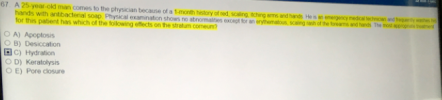
67 A 25-year-old man comes to the physician because of a 1-month history of red scaling, tching arms and hands He is an emergency medical chan and requerywhere hands with antibacterial soap. Physical examination shows no abnormalities except for an erythematous, scaling rash of the forearms and hands The most propter for this patient has which of the following effects on the stratum comeum? OA) Apoptosis B) Desiccation OC) Hydration D) Keratolysis O E) Pore closure
Is this correct?
67 A 25-year-old man comes to the physician because of a 1-month history of red scaling, tching arms and hands He is an emergency medical chan and requerywhere hands with antibacterial soap. Physical examination shows no abnormalities except for an erythematous, scaling rash of the forearms and hands The most propter for this patient has which of the following effects on the stratum comeum? OA) Apoptosis B) Desiccation OC) Hydration D) Keratolysis O E) Pore closure
what is the patient suffering from? Clinical Correlations Clinical Case 4 A 60-year-old woman complains of...
 what is the patient suffering from?
Clinical Correlations Clinical Case 4 A 60-year-old woman complains of falls, imbalance, and numbness and tingling in her hands and legs. There is also some incoordination of hand use and she has difficulty manipulating small items such as buttons. She is unable to play the piano now since she cannot position her fingers correctly on the piano keys. She thinks the strength in her arms and legs is adequate. Symptoms started with very slight...
what is the patient suffering from?
Clinical Correlations Clinical Case 4 A 60-year-old woman complains of falls, imbalance, and numbness and tingling in her hands and legs. There is also some incoordination of hand use and she has difficulty manipulating small items such as buttons. She is unable to play the piano now since she cannot position her fingers correctly on the piano keys. She thinks the strength in her arms and legs is adequate. Symptoms started with very slight...
L.K. s a 26 year old male who has been feeling tired for nearly six months....
L.K. s a 26 year old male who has been feeling tired for nearly six months. Lately he has been having problems talking and some difficulties with concentration and remembering things he had done the previous day. He has also had numbness in both his legs and weakness to the point of having trouble walking. L.K's symptoms started gradually and he also had progressive numbness and intermittent tingling in both of his hands. In his past medical history he has...
A 47-year old male presents in the clinic with a complaint of recurrent low-grade fevers, weight...
A 47-year old male presents in the clinic with a complaint of recurrent low-grade fevers, weight loss (about 20% of his body weight over a 6 month period), muscle and joint pains, episodes of profuse sweating, weakness and extreme fatigue (in spite of sleeping well at night he feels tired during the day). He eats healthy, but lately, he has no appetite. He disregarded all these symptoms and thought he was just getting old, but then a week ago he...
19-year-old non- ambulatory male with pneumonia Chief Complaint: 19-year-old non-ambulatory male with pneumonia. History: James Fenlow,...
 19-year-old non- ambulatory male with pneumonia Chief Complaint: 19-year-old non-ambulatory male with pneumonia. History: James Fenlow, a 19-year old male, is immobile and hospitalized for pneumonia. He has a long history of progressive weakening of his muscles. In the first year of his life, James reached many gross motor skill milestones, such as holding his head up, rolling over, sitting, and standing, at normal times. However, he did not walk until age 16 months, and by age two, started to...
You are the RN caring for Mrs. M.T., a 72 year old female patient who is admitted for a UTI. M.T. has a history of UTIs,...
You are the RN caring for Mrs. M.T., a 72 year old female patient who is admitted for a UTI. M.T. has a history of UTIs, urinary retention, HTN, hyperlipidemia, asthma, glaucoma, and a left femoral-popliteal bypass. (#11-20) 11. Upon admission M.T. opens her eyes only when her name is called out, she states she is in the hospital and that the year is 1975. When asked to hold her arms out in front of her, she is reluctant, but...
Office Note This 78-year-old male returns to the office today to follow-up on diagnostic testing completed...
Office Note This 78-year-old male returns to the office today to follow-up on diagnostic testing completed due to his ongoing muscle aches, myalgia, stiffness, and muscle weakness. Laboratory testing: Urinalysis was positive for hemoglobin. The urine myoglobin test and serum myoglobin test were both positive. The serum CPK value was high. Following these values additional testing was completed that confirmed elevated muscle enzymes in the blood. Because of these findings a diagnosis of rhabdomyolsis was confirmed. Plan: I discussed with...
CASE C: A 61 year old African American male presents to the emergency department with complaints of a productive cough, dyspnea and altered mental status. His past medical history is significant...
 CASE C: A 61 year old African American male presents to the emergency department with complaints of a productive cough, dyspnea and altered mental status. His past medical history is significant for HIV and currently he is non-compliant with his anti-retroviral medications. On arrival, he is found to be hypoglycemic (glucose 49 mg/dL) and tachycardic (heart rate between 160-180 beats/min). He lives in a group home and they report decreased oral intake for several days but he denies fever, chills,...
Neurology Consult Note Admission Date: 9/28/2015 LOS: 0 days Reason for Consult: stroke activation Consult type: Opinio...
Neurology Consult Note Admission Date: 9/28/2015 LOS: 0 days Reason for Consult: stroke activation Consult type: Opinion with orders Assessment/Plan 51 year old male with PMH of DM, HTN, HLD, and CVA 3 months ago presents to the ED with sudden onset of left sided weakness. Last known normal was 23:30 and presented to the ED around 01:15am. NIHSS 12 for left sided weakness, sensory changes and extinction and mild dysarthria. Head CT showed right thalamic and corona radiata hemorrhage....
420. A 42 year old patient is admitted to the emergency department (ED. following being mugged....
420. A 42 year old patient is admitted to the emergency department (ED. following being mugged. The patient received blunt trauma to the face and has clear fluid draining from the right nostril. What does the ED nurse know to assess this fluid for? A. Sodium B. Protein C. Calcium D. Glucose 421. As an asthma educator, you are teaching a patient newly diagnosed with asthma and her family about the use of a peak flow meter. What does a...
 Is this correct?
67 A 25-year-old man comes to the physician because of a 1-month history of red scaling, tching arms and hands He is an emergency medical chan and requerywhere hands with antibacterial soap. Physical examination shows no abnormalities except for an erythematous, scaling rash of the forearms and hands The most propter for this patient has which of the following effects on the stratum comeum? OA) Apoptosis B) Desiccation OC) Hydration D) Keratolysis O E) Pore closure
Is this correct?
67 A 25-year-old man comes to the physician because of a 1-month history of red scaling, tching arms and hands He is an emergency medical chan and requerywhere hands with antibacterial soap. Physical examination shows no abnormalities except for an erythematous, scaling rash of the forearms and hands The most propter for this patient has which of the following effects on the stratum comeum? OA) Apoptosis B) Desiccation OC) Hydration D) Keratolysis O E) Pore closure
 what is the patient suffering from?
Clinical Correlations Clinical Case 4 A 60-year-old woman complains of falls, imbalance, and numbness and tingling in her hands and legs. There is also some incoordination of hand use and she has difficulty manipulating small items such as buttons. She is unable to play the piano now since she cannot position her fingers correctly on the piano keys. She thinks the strength in her arms and legs is adequate. Symptoms started with very slight...
what is the patient suffering from?
Clinical Correlations Clinical Case 4 A 60-year-old woman complains of falls, imbalance, and numbness and tingling in her hands and legs. There is also some incoordination of hand use and she has difficulty manipulating small items such as buttons. She is unable to play the piano now since she cannot position her fingers correctly on the piano keys. She thinks the strength in her arms and legs is adequate. Symptoms started with very slight...
 19-year-old non- ambulatory male with pneumonia Chief Complaint: 19-year-old non-ambulatory male with pneumonia. History: James Fenlow, a 19-year old male, is immobile and hospitalized for pneumonia. He has a long history of progressive weakening of his muscles. In the first year of his life, James reached many gross motor skill milestones, such as holding his head up, rolling over, sitting, and standing, at normal times. However, he did not walk until age 16 months, and by age two, started to...
 CASE C: A 61 year old African American male presents to the emergency department with complaints of a productive cough, dyspnea and altered mental status. His past medical history is significant for HIV and currently he is non-compliant with his anti-retroviral medications. On arrival, he is found to be hypoglycemic (glucose 49 mg/dL) and tachycardic (heart rate between 160-180 beats/min). He lives in a group home and they report decreased oral intake for several days but he denies fever, chills,...
Most questions answered within 3 hours.
-
Where is the error in this code sequence?
String s1 = "Hello";
String s2 = "ello";...
asked 10 months ago -
Financial data for Joel de Paris, Inc., for last year
follow:
Joel de Paris, Inc.
Balance...
asked 10 months ago -
Consider this reaction:
Al2(SO4)3 (aq)+ BaCl3
(aq) Al2Cl6 (aq)- +
3BaSO4(s) . What is the...
asked 10 months ago -
Suppose that Savneet is considering increasing her
recent random sample from 20 car rentals to 40...
asked 10 months ago -
Trucks arrive at an unloading terminal at an average rate of 120
per hour.
Trucks arrive...
asked 10 months ago -
Why are methanol and ethanol completely soluble in water while
octanol is not very little soluble....
asked 10 months ago -
A facilities manager at a university reads in a research report
that the mean amount of...
asked 10 months ago -
When the CuSO4 is rehydrated by adding water to the anhydrous
compound, is this an endothermic...
asked 10 months ago -
A ray of sunlight is passing from diamond into crown glass; the
angle of incidence is...
asked 10 months ago -
A block of mass 0.249 kg is placed on top of a light, vertical
spring of...
asked 10 months ago -
how do the kidneys compensate in the presences of acidosis
a) trigger hyperventilate
b) reserve acid...
asked 10 months ago -
Question 501 pts
The rental rate of capital to the firm increases. Which of the
following...
asked 10 months ago