
Homework Answers
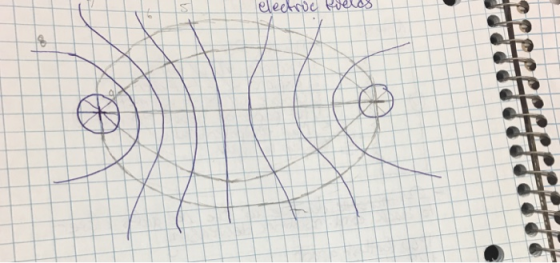
A) Field lines never cross each other.If the lines cross each other at a given location, then there must be two distinctly different values of electric field with their own individual direction at that given location. This could never be the case. Every single location in space has its own electric field strength and direction associated with it. Consequently, the lines representing the field cannot cross each other at any given location in space.
B)Electric field lines cannot cross. If they did, they would be telling you that the force on a charge at that location would point in two different directions, which does not make any sense at all. Equipotential lines at different potentials can never cross either. This is because they are, by definition, a line of constant potential. The equipotential at a given point in space can only have a single value. If lines for two different values of the potential were to cross, then they would no longer represent equipotential lines. Note: It is possible for two lines representing the same potential to cross.
C)90 degree ,This is because,when the potential becomes constant,the negative potential gradient also becomes zero,hence necessitating the need for Electric field to be always normal with surface.
D)The field is strongest where no of electric field lines in a small area is maximum. By gauss law.
Add Answer to:
Electric fields and potentials a-d.
Questions: a. Do any field lines cross one another? Why, or...
1) Do the electric field lines cross? Can two equipotential 2) Explain why the equipotential surfaces...
 1) Do the electric field lines cross? Can two equipotential 2) Explain why the equipotential surfaces should be always 3) A uniform electric field is parallel to the y-axis. What lines ever cross? Explain. perpendicular to the electric field lines? direction can a charge be displaced in this field without any external work being done on the charge?
Electric Fields and Potentials What do you think the electrie field lines look like in the...
 Electric Fields and Potentials What do you think the electrie field lines look like in the region of space between a single positive charge and a single negative ch 6. arge? What do you think the equipotential lines look like in the region of space between a single positive charge and a single negative charge? 7. What is the shape of the electric field if there are two positive charges near each other? 8. 850 0 q What is the...
Advance Seudy Assignment: Fields & Equipotentials Name QUESTIONS 1. Explain the term electric field. What is...
 Advance Seudy Assignment: Fields & Equipotentials Name QUESTIONS 1. Explain the term electric field. What is its definition? Explain with an example what the Sec size and direction of an electric field at a given point means. 2. What is meant by electric potential? What is an equipotential surface? Explain the relationship between equipotential lines and electric field lines. Why is this so? 3. Explain how you will map the electric field of a dipole in this exercise. 4. Using...
(c) How are the Electric Field lines related to the equipotential lines? How do they cross...
 (c) How are the Electric Field lines related to the equipotential lines? How do they cross each other? What does Eq. 11.2 indicate? Use a sketch to illustrate the relation of the Electric Field lines to the equipotential lines. (d) The Electric Field gives the direction in which a positive test charge would move from a given point in space. Explain why different lines of force can never cross each other.
3.1 Pre-lab In the lab on electric potential and electric field lines, you noted that charged...
 3.1 Pre-lab In the lab on electric potential and electric field lines, you noted that charged par- ticles produce electric fields and these electric fields, in turn, act on charged par- ticles. However, you then proceeded to produce an electric field geometry using conductors held at a particular electric potential. What happened to the electric charges? Electric charge and electric potential are closely related to each other. Putting charge on a conductor raises its electric potential. It is usually much...
Which of the following statements about electric field lines are true? (choose all that are true)...
Which of the following statements about electric field lines are true? (choose all that are true) a) They are only defined for positive charges. b) They are always tangent to electric field vectors. c) They are always perpendicular to charged surfaces. d) They are a simple way to visualize the electric field vectors. e) None of the above. If a negative charge is placed in an electric field, what direction will it be accelerated? a) In the direction of the...
A-How does the electric field vary as one moves away from a point charge? –the outside...
A-How does the electric field vary as one moves away from a point charge? –the outside of a spherical distribution of charge? -- the inside hollow space of a spherical distribution of charge? –a line of charge? -- far away from a dipole along the perpendicular bisector? -- an infinite sheet of charge? -- inside a capacitor? B-Describe electric field lines from a sphere? –from a flat surface? -- from a pointed object? C- What is the geometric relationship between...
How to solve Part 4c? Sketches of electric field lines and equipotentials Sketch and answer 4...
 How to solve Part 4c?
Sketches of electric field lines and equipotentials Sketch and answer 4 - A through 4 - D in your answer book. Consider different charge configurations as shown: 4 - A : Suppose you are a test charge and you start at some distance from the charge q = +1 below, such as at the point X. Starting at point X, what path could you move along without doing any work? i.e. which Ē. ds is...
How to solve Part 4c?
Sketches of electric field lines and equipotentials Sketch and answer 4 - A through 4 - D in your answer book. Consider different charge configurations as shown: 4 - A : Suppose you are a test charge and you start at some distance from the charge q = +1 below, such as at the point X. Starting at point X, what path could you move along without doing any work? i.e. which Ē. ds is...
Question F 2. Optional (mo poines): On the diagram of two eginal and orpposine charges below,...
 Question F
2. Optional (mo poines): On the diagram of two eginal and orpposine charges below, neatly draw electric field lines (roughly & to 16 lines per charge). Indicate direction on ALL field lines with arrow heads. tmo poinns): With a different color pen/pencil or with dashed lines, draw roughly 6 to 12 equipetential equipotentials for the entire area benween and surrounding the charges . Shape smmetry, and relative spacing of the lines DO matter, bat you do not need...
Question F
2. Optional (mo poines): On the diagram of two eginal and orpposine charges below, neatly draw electric field lines (roughly & to 16 lines per charge). Indicate direction on ALL field lines with arrow heads. tmo poinns): With a different color pen/pencil or with dashed lines, draw roughly 6 to 12 equipetential equipotentials for the entire area benween and surrounding the charges . Shape smmetry, and relative spacing of the lines DO matter, bat you do not need...
24. Which of the following physical principles is/are not contained in PATA a) Electric charge creates...
 24. Which of the following physical principles is/are not contained in PATA a) Electric charge creates electric fields that radiate outwards or inwards. b) Electric current creates magnetic fields that loop c) Changing magnetic fields create electric fields that loop d) A changing electric field acts like an electric current. e) Magnetic fields cause charged particles to curve, but not to speed up or slow down. f) Magnetic monopoles do not exist. Maxwell's equations? 25. Which of the following is/are...
 1) Do the electric field lines cross? Can two equipotential 2) Explain why the equipotential surfaces should be always 3) A uniform electric field is parallel to the y-axis. What lines ever cross? Explain. perpendicular to the electric field lines? direction can a charge be displaced in this field without any external work being done on the charge?
 Electric Fields and Potentials What do you think the electrie field lines look like in the region of space between a single positive charge and a single negative ch 6. arge? What do you think the equipotential lines look like in the region of space between a single positive charge and a single negative charge? 7. What is the shape of the electric field if there are two positive charges near each other? 8. 850 0 q What is the...
 Advance Seudy Assignment: Fields & Equipotentials Name QUESTIONS 1. Explain the term electric field. What is its definition? Explain with an example what the Sec size and direction of an electric field at a given point means. 2. What is meant by electric potential? What is an equipotential surface? Explain the relationship between equipotential lines and electric field lines. Why is this so? 3. Explain how you will map the electric field of a dipole in this exercise. 4. Using...
 (c) How are the Electric Field lines related to the equipotential lines? How do they cross each other? What does Eq. 11.2 indicate? Use a sketch to illustrate the relation of the Electric Field lines to the equipotential lines. (d) The Electric Field gives the direction in which a positive test charge would move from a given point in space. Explain why different lines of force can never cross each other.
 3.1 Pre-lab In the lab on electric potential and electric field lines, you noted that charged par- ticles produce electric fields and these electric fields, in turn, act on charged par- ticles. However, you then proceeded to produce an electric field geometry using conductors held at a particular electric potential. What happened to the electric charges? Electric charge and electric potential are closely related to each other. Putting charge on a conductor raises its electric potential. It is usually much...
 How to solve Part 4c?
Sketches of electric field lines and equipotentials Sketch and answer 4 - A through 4 - D in your answer book. Consider different charge configurations as shown: 4 - A : Suppose you are a test charge and you start at some distance from the charge q = +1 below, such as at the point X. Starting at point X, what path could you move along without doing any work? i.e. which Ē. ds is...
How to solve Part 4c?
Sketches of electric field lines and equipotentials Sketch and answer 4 - A through 4 - D in your answer book. Consider different charge configurations as shown: 4 - A : Suppose you are a test charge and you start at some distance from the charge q = +1 below, such as at the point X. Starting at point X, what path could you move along without doing any work? i.e. which Ē. ds is...
 Question F
2. Optional (mo poines): On the diagram of two eginal and orpposine charges below, neatly draw electric field lines (roughly & to 16 lines per charge). Indicate direction on ALL field lines with arrow heads. tmo poinns): With a different color pen/pencil or with dashed lines, draw roughly 6 to 12 equipetential equipotentials for the entire area benween and surrounding the charges . Shape smmetry, and relative spacing of the lines DO matter, bat you do not need...
Question F
2. Optional (mo poines): On the diagram of two eginal and orpposine charges below, neatly draw electric field lines (roughly & to 16 lines per charge). Indicate direction on ALL field lines with arrow heads. tmo poinns): With a different color pen/pencil or with dashed lines, draw roughly 6 to 12 equipetential equipotentials for the entire area benween and surrounding the charges . Shape smmetry, and relative spacing of the lines DO matter, bat you do not need...
 24. Which of the following physical principles is/are not contained in PATA a) Electric charge creates electric fields that radiate outwards or inwards. b) Electric current creates magnetic fields that loop c) Changing magnetic fields create electric fields that loop d) A changing electric field acts like an electric current. e) Magnetic fields cause charged particles to curve, but not to speed up or slow down. f) Magnetic monopoles do not exist. Maxwell's equations? 25. Which of the following is/are...
Most questions answered within 3 hours.
-
Where is the error in this code sequence?
String s1 = "Hello";
String s2 = "ello";...
asked 10 months ago -
Financial data for Joel de Paris, Inc., for last year
follow:
Joel de Paris, Inc.
Balance...
asked 10 months ago -
Consider this reaction:
Al2(SO4)3 (aq)+ BaCl3
(aq) Al2Cl6 (aq)- +
3BaSO4(s) . What is the...
asked 10 months ago -
Suppose that Savneet is considering increasing her
recent random sample from 20 car rentals to 40...
asked 10 months ago -
Trucks arrive at an unloading terminal at an average rate of 120
per hour.
Trucks arrive...
asked 10 months ago -
Why are methanol and ethanol completely soluble in water while
octanol is not very little soluble....
asked 10 months ago -
A facilities manager at a university reads in a research report
that the mean amount of...
asked 10 months ago -
When the CuSO4 is rehydrated by adding water to the anhydrous
compound, is this an endothermic...
asked 10 months ago -
A ray of sunlight is passing from diamond into crown glass; the
angle of incidence is...
asked 10 months ago -
A block of mass 0.249 kg is placed on top of a light, vertical
spring of...
asked 10 months ago -
how do the kidneys compensate in the presences of acidosis
a) trigger hyperventilate
b) reserve acid...
asked 10 months ago -
Question 501 pts
The rental rate of capital to the firm increases. Which of the
following...
asked 10 months ago