

Homework Answers
Answer 2) In Grignard reagents, RMgX, the carbon bonded to Mg atom carries δ-charge and hence it has significant carbanion character. Since carbanions are among the strongest bases, they can abstract H+ ion from traces of water i.e, they can react with even trace amount of water to give the corresponding hydrocarbon, RH.
RMgX + H2O = RH + Mg(OH)X
Hence when dealing with Grignard reagents, all glasswares must be free of traces of water.
And magnesium too reacts with water to give magnesium hydroxide which would become useless for the preparation of RMgX.
Mg + 2 H2O = Mg(OH)2 + H2
Answer 3) Anhydrous calcium chloride is a hygroscopic substance i.e, it absorbs moisture from its immediate surroundings and forms CaCl2.2H2O
Hence Anhydrous calcium chloride is employed in the preparation of Grignard reagents to keep the reaction environment moisture free and avoid their accidental reaction with water.
Answer4)
 Hence theoretical yield of
diphenylmethanol is 2.70 g.
Hence theoretical yield of
diphenylmethanol is 2.70 g.
Add Answer to:
2. Why should all of the glassware and the magnesium used for the preparation of the...
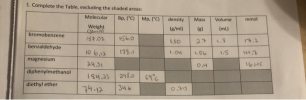
posted by accident mmol density (g/ml) Mass () Volume (mL) 17.2 1. Complete the Table, excluding...
 posted by accident
mmol density (g/ml) Mass () Volume (mL) 17.2 1. Complete the Table, excluding the shaded areas: Molecular Bp. (°C) Mp. (°C) Weight Colima bromobenzene 157.02 156,0 benzaldehyde 106,12 178.1 magnesium 24.31 diphenylmethanol 184.23 | 298, 0 69°C diethyl ether 74.12 34.6 1.SO 1.04 27 1.56 0.4 1.5 14.7 16.us 0.713
posted by accident
mmol density (g/ml) Mass () Volume (mL) 17.2 1. Complete the Table, excluding the shaded areas: Molecular Bp. (°C) Mp. (°C) Weight Colima bromobenzene 157.02 156,0 benzaldehyde 106,12 178.1 magnesium 24.31 diphenylmethanol 184.23 | 298, 0 69°C diethyl ether 74.12 34.6 1.SO 1.04 27 1.56 0.4 1.5 14.7 16.us 0.713
Grignard reagent THE GRIGNARD REAGENT-PREPARATION AND REACTION In this experiment, you will prepa...
 i need help with the prelab questions please
Grignard reagent THE GRIGNARD REAGENT-PREPARATION AND REACTION In this experiment, you will prepare a Grignard reagent, phenyl magnesium bromide, from bromobenzene and magnesium metal. The Grignard reagent will then react with methyl benzoate to form triphenylmethanol. Introduction Grignard reagents, such as organomagnesium halides, were discovered in 1910 by French chemist Victor Grignard. The Grignard reaction is one of the most general methods for carbon- carbon bond formation in all of organic chemistry....
i need help with the prelab questions please
Grignard reagent THE GRIGNARD REAGENT-PREPARATION AND REACTION In this experiment, you will prepare a Grignard reagent, phenyl magnesium bromide, from bromobenzene and magnesium metal. The Grignard reagent will then react with methyl benzoate to form triphenylmethanol. Introduction Grignard reagents, such as organomagnesium halides, were discovered in 1910 by French chemist Victor Grignard. The Grignard reaction is one of the most general methods for carbon- carbon bond formation in all of organic chemistry....
Grignard reagent THE GRIGNARD REAGENT-PREPARATION AND REACTION In this experiment, you will prepa...
 i need help with the postlab questions please
Grignard reagent THE GRIGNARD REAGENT-PREPARATION AND REACTION In this experiment, you will prepare a Grignard reagent, phenyl magnesium bromide, from bromobenzene and magnesium metal. The Grignard reagent will then react with methyl benzoate to form triphenylmethanol. Introduction Grignard reagents, such as organomagnesium halides, were discovered in 1910 by French chemist Victor Grignard. The Grignard reaction is one of the most general methods for carbon- carbon bond formation in all of organic chemistry....
i need help with the postlab questions please
Grignard reagent THE GRIGNARD REAGENT-PREPARATION AND REACTION In this experiment, you will prepare a Grignard reagent, phenyl magnesium bromide, from bromobenzene and magnesium metal. The Grignard reagent will then react with methyl benzoate to form triphenylmethanol. Introduction Grignard reagents, such as organomagnesium halides, were discovered in 1910 by French chemist Victor Grignard. The Grignard reaction is one of the most general methods for carbon- carbon bond formation in all of organic chemistry....
EXPERIMENT S: THE GRIGNARD REACTION Pre-lab assignments are found at the end of the lab manual...
 EXPERIMENT S: THE GRIGNARD REACTION Pre-lab assignments are found at the end of the lab manual Review the sections in Chapter 10 in the textbook dealing with organometalic reagents. As will be evident in this and chapters, Grignard reagents play a commanding role in organic synthesis, adaptable to the preparation of a large ater variety of functional systems, and comprise one of the major uses of alkyl halides. This experiment involves a synthesis diphenylmethanol using phenylmagnesium bromide and benzaldehyde Reaction...
Preparation of Benzoic Acid using a Grignard Reagent URGENT 1. During your Grignard formation, a small...
Preparation of Benzoic Acid using a Grignard Reagent URGENT 1. During your Grignard formation, a small amount of benzene is formed. Provide a brief explanation and mechanism to explain this observation. 2. During your Grignard formation, a small amount of biphenyl is formed. Provide a brief explanation and mechanism to explain this observation. 3. What mass of water would be required to destroy the phenylmagnesium bromide that you prepared in this experiment? What volume does this represent? 4. Why is...
I did an experiment where I synthesized 2-phenyl-2-propanol using the grignard reaction. please help me answer these lab questions Reagents Moles of Reagent 0.00142 moles (0.224 g)bromoben...
 I did an experiment where I synthesized
2-phenyl-2-propanol using the grignard reaction. please help me
answer these lab questions
Reagents Moles of Reagent 0.00142 moles (0.224 g)bromobenzene 0.00712 mol (0.173 g) 2 mL of THF (n/a moles) tetrahydrofuran 0.00142 mol (0.083g, 0.11mL) acetone, HPLC grade, anh Reagent Name FW 157.75 24.31 n/a 58 Comments Mg powder grind before using must be anhydrous must be anhydrous Pre-Lab Assignment: 1. Determine the volume (mL) of bromobenzene needed for the experiment. Obtain the...
I did an experiment where I synthesized
2-phenyl-2-propanol using the grignard reaction. please help me
answer these lab questions
Reagents Moles of Reagent 0.00142 moles (0.224 g)bromobenzene 0.00712 mol (0.173 g) 2 mL of THF (n/a moles) tetrahydrofuran 0.00142 mol (0.083g, 0.11mL) acetone, HPLC grade, anh Reagent Name FW 157.75 24.31 n/a 58 Comments Mg powder grind before using must be anhydrous must be anhydrous Pre-Lab Assignment: 1. Determine the volume (mL) of bromobenzene needed for the experiment. Obtain the...
. Grignard Reagents and As (Addition, Nucleophil ic) Additions Magnesium metal spontaneously reduces organohalides via...
 .
Grignard Reagents and As (Addition, Nucleophil ic) Additions Magnesium metal spontaneously reduces organohalides via a succession transfers. This results in the Grignard 'insertion reaction, as proposed in the 1920s single electron Procedure t was only Part A: Preparation of the Glassyware and Magnesium successful in ether solvents, and failed utterly n hydrocarbons such as benzene. 1. The Grignard reagent camot form in the presence of water, and any water that it comes Mg (solid) into contact with immed iately...
.
Grignard Reagents and As (Addition, Nucleophil ic) Additions Magnesium metal spontaneously reduces organohalides via a succession transfers. This results in the Grignard 'insertion reaction, as proposed in the 1920s single electron Procedure t was only Part A: Preparation of the Glassyware and Magnesium successful in ether solvents, and failed utterly n hydrocarbons such as benzene. 1. The Grignard reagent camot form in the presence of water, and any water that it comes Mg (solid) into contact with immed iately...
Organic chemistry post-lab question: "Why is important to add the alkyl halide dropwise in your reaction?...
 Organic chemistry post-lab question: "Why is important
to add the alkyl halide dropwise in your reaction? (Hint: your
reaction is not heated, but you still need a water-cooled
condenser!)" Please answer in detail!
Here is a copy of the experiment, thank you!
The Grignard reaction is an important synthetic process by which a carbon-carbon bond is formed. Magnesium metal is first reacted with an organic halide. The resultant organo-magnesium halide (Grignard reagent) is then combined with a carbonyl compound, ultimately...
Organic chemistry post-lab question: "Why is important
to add the alkyl halide dropwise in your reaction? (Hint: your
reaction is not heated, but you still need a water-cooled
condenser!)" Please answer in detail!
Here is a copy of the experiment, thank you!
The Grignard reaction is an important synthetic process by which a carbon-carbon bond is formed. Magnesium metal is first reacted with an organic halide. The resultant organo-magnesium halide (Grignard reagent) is then combined with a carbonyl compound, ultimately...
please answer the prelab excercise:) I tried doing it but I did not get very far Experiment 7: Grignard Reactio...
 please answer the prelab excercise:) I tried doing it but I did not
get very far
Experiment 7: Grignard Reaction. Introduction Discovered by French chemist Victor Grignard, the reaction that now bears his name is an example of the preparation of an organometallic reagent. In this lab, phenylmagnesium bromide is the Grignard of interest, and it will be added to an aldehyde to produce an alcohol. Lab Objectives 1. To study organometallic reagents in general. benzophenone. 2. To prepare phenylmagnesium...
please answer the prelab excercise:) I tried doing it but I did not
get very far
Experiment 7: Grignard Reaction. Introduction Discovered by French chemist Victor Grignard, the reaction that now bears his name is an example of the preparation of an organometallic reagent. In this lab, phenylmagnesium bromide is the Grignard of interest, and it will be added to an aldehyde to produce an alcohol. Lab Objectives 1. To study organometallic reagents in general. benzophenone. 2. To prepare phenylmagnesium...
using pictures and a maximum of 10 words, explain why an oven-dried 5-ml conical vial and...
 using pictures and a maximum of 10 words, explain why an oven-dried
5-ml conical vial and drying tube(step 1 and 2 of part 1) are used
in the reaction. do both please! also the notebook pages are the
procedure
(1) Using pictures and a maximum of 10 words, explain why an oven-dried 5-ml conical vial and drying tube (step 1 and 2 of Part 1) are used in the reaction. (2) After the addition of benzophenone to the mixture of...
using pictures and a maximum of 10 words, explain why an oven-dried
5-ml conical vial and drying tube(step 1 and 2 of part 1) are used
in the reaction. do both please! also the notebook pages are the
procedure
(1) Using pictures and a maximum of 10 words, explain why an oven-dried 5-ml conical vial and drying tube (step 1 and 2 of Part 1) are used in the reaction. (2) After the addition of benzophenone to the mixture of...
 posted by accident
mmol density (g/ml) Mass () Volume (mL) 17.2 1. Complete the Table, excluding the shaded areas: Molecular Bp. (°C) Mp. (°C) Weight Colima bromobenzene 157.02 156,0 benzaldehyde 106,12 178.1 magnesium 24.31 diphenylmethanol 184.23 | 298, 0 69°C diethyl ether 74.12 34.6 1.SO 1.04 27 1.56 0.4 1.5 14.7 16.us 0.713
posted by accident
mmol density (g/ml) Mass () Volume (mL) 17.2 1. Complete the Table, excluding the shaded areas: Molecular Bp. (°C) Mp. (°C) Weight Colima bromobenzene 157.02 156,0 benzaldehyde 106,12 178.1 magnesium 24.31 diphenylmethanol 184.23 | 298, 0 69°C diethyl ether 74.12 34.6 1.SO 1.04 27 1.56 0.4 1.5 14.7 16.us 0.713
 i need help with the prelab questions please
Grignard reagent THE GRIGNARD REAGENT-PREPARATION AND REACTION In this experiment, you will prepare a Grignard reagent, phenyl magnesium bromide, from bromobenzene and magnesium metal. The Grignard reagent will then react with methyl benzoate to form triphenylmethanol. Introduction Grignard reagents, such as organomagnesium halides, were discovered in 1910 by French chemist Victor Grignard. The Grignard reaction is one of the most general methods for carbon- carbon bond formation in all of organic chemistry....
i need help with the prelab questions please
Grignard reagent THE GRIGNARD REAGENT-PREPARATION AND REACTION In this experiment, you will prepare a Grignard reagent, phenyl magnesium bromide, from bromobenzene and magnesium metal. The Grignard reagent will then react with methyl benzoate to form triphenylmethanol. Introduction Grignard reagents, such as organomagnesium halides, were discovered in 1910 by French chemist Victor Grignard. The Grignard reaction is one of the most general methods for carbon- carbon bond formation in all of organic chemistry....
 i need help with the postlab questions please
Grignard reagent THE GRIGNARD REAGENT-PREPARATION AND REACTION In this experiment, you will prepare a Grignard reagent, phenyl magnesium bromide, from bromobenzene and magnesium metal. The Grignard reagent will then react with methyl benzoate to form triphenylmethanol. Introduction Grignard reagents, such as organomagnesium halides, were discovered in 1910 by French chemist Victor Grignard. The Grignard reaction is one of the most general methods for carbon- carbon bond formation in all of organic chemistry....
i need help with the postlab questions please
Grignard reagent THE GRIGNARD REAGENT-PREPARATION AND REACTION In this experiment, you will prepare a Grignard reagent, phenyl magnesium bromide, from bromobenzene and magnesium metal. The Grignard reagent will then react with methyl benzoate to form triphenylmethanol. Introduction Grignard reagents, such as organomagnesium halides, were discovered in 1910 by French chemist Victor Grignard. The Grignard reaction is one of the most general methods for carbon- carbon bond formation in all of organic chemistry....
 EXPERIMENT S: THE GRIGNARD REACTION Pre-lab assignments are found at the end of the lab manual Review the sections in Chapter 10 in the textbook dealing with organometalic reagents. As will be evident in this and chapters, Grignard reagents play a commanding role in organic synthesis, adaptable to the preparation of a large ater variety of functional systems, and comprise one of the major uses of alkyl halides. This experiment involves a synthesis diphenylmethanol using phenylmagnesium bromide and benzaldehyde Reaction...
 I did an experiment where I synthesized
2-phenyl-2-propanol using the grignard reaction. please help me
answer these lab questions
Reagents Moles of Reagent 0.00142 moles (0.224 g)bromobenzene 0.00712 mol (0.173 g) 2 mL of THF (n/a moles) tetrahydrofuran 0.00142 mol (0.083g, 0.11mL) acetone, HPLC grade, anh Reagent Name FW 157.75 24.31 n/a 58 Comments Mg powder grind before using must be anhydrous must be anhydrous Pre-Lab Assignment: 1. Determine the volume (mL) of bromobenzene needed for the experiment. Obtain the...
I did an experiment where I synthesized
2-phenyl-2-propanol using the grignard reaction. please help me
answer these lab questions
Reagents Moles of Reagent 0.00142 moles (0.224 g)bromobenzene 0.00712 mol (0.173 g) 2 mL of THF (n/a moles) tetrahydrofuran 0.00142 mol (0.083g, 0.11mL) acetone, HPLC grade, anh Reagent Name FW 157.75 24.31 n/a 58 Comments Mg powder grind before using must be anhydrous must be anhydrous Pre-Lab Assignment: 1. Determine the volume (mL) of bromobenzene needed for the experiment. Obtain the...
 .
Grignard Reagents and As (Addition, Nucleophil ic) Additions Magnesium metal spontaneously reduces organohalides via a succession transfers. This results in the Grignard 'insertion reaction, as proposed in the 1920s single electron Procedure t was only Part A: Preparation of the Glassyware and Magnesium successful in ether solvents, and failed utterly n hydrocarbons such as benzene. 1. The Grignard reagent camot form in the presence of water, and any water that it comes Mg (solid) into contact with immed iately...
.
Grignard Reagents and As (Addition, Nucleophil ic) Additions Magnesium metal spontaneously reduces organohalides via a succession transfers. This results in the Grignard 'insertion reaction, as proposed in the 1920s single electron Procedure t was only Part A: Preparation of the Glassyware and Magnesium successful in ether solvents, and failed utterly n hydrocarbons such as benzene. 1. The Grignard reagent camot form in the presence of water, and any water that it comes Mg (solid) into contact with immed iately...
 Organic chemistry post-lab question: "Why is important
to add the alkyl halide dropwise in your reaction? (Hint: your
reaction is not heated, but you still need a water-cooled
condenser!)" Please answer in detail!
Here is a copy of the experiment, thank you!
The Grignard reaction is an important synthetic process by which a carbon-carbon bond is formed. Magnesium metal is first reacted with an organic halide. The resultant organo-magnesium halide (Grignard reagent) is then combined with a carbonyl compound, ultimately...
Organic chemistry post-lab question: "Why is important
to add the alkyl halide dropwise in your reaction? (Hint: your
reaction is not heated, but you still need a water-cooled
condenser!)" Please answer in detail!
Here is a copy of the experiment, thank you!
The Grignard reaction is an important synthetic process by which a carbon-carbon bond is formed. Magnesium metal is first reacted with an organic halide. The resultant organo-magnesium halide (Grignard reagent) is then combined with a carbonyl compound, ultimately...
 please answer the prelab excercise:) I tried doing it but I did not
get very far
Experiment 7: Grignard Reaction. Introduction Discovered by French chemist Victor Grignard, the reaction that now bears his name is an example of the preparation of an organometallic reagent. In this lab, phenylmagnesium bromide is the Grignard of interest, and it will be added to an aldehyde to produce an alcohol. Lab Objectives 1. To study organometallic reagents in general. benzophenone. 2. To prepare phenylmagnesium...
please answer the prelab excercise:) I tried doing it but I did not
get very far
Experiment 7: Grignard Reaction. Introduction Discovered by French chemist Victor Grignard, the reaction that now bears his name is an example of the preparation of an organometallic reagent. In this lab, phenylmagnesium bromide is the Grignard of interest, and it will be added to an aldehyde to produce an alcohol. Lab Objectives 1. To study organometallic reagents in general. benzophenone. 2. To prepare phenylmagnesium...
 using pictures and a maximum of 10 words, explain why an oven-dried
5-ml conical vial and drying tube(step 1 and 2 of part 1) are used
in the reaction. do both please! also the notebook pages are the
procedure
(1) Using pictures and a maximum of 10 words, explain why an oven-dried 5-ml conical vial and drying tube (step 1 and 2 of Part 1) are used in the reaction. (2) After the addition of benzophenone to the mixture of...
using pictures and a maximum of 10 words, explain why an oven-dried
5-ml conical vial and drying tube(step 1 and 2 of part 1) are used
in the reaction. do both please! also the notebook pages are the
procedure
(1) Using pictures and a maximum of 10 words, explain why an oven-dried 5-ml conical vial and drying tube (step 1 and 2 of Part 1) are used in the reaction. (2) After the addition of benzophenone to the mixture of...
Most questions answered within 3 hours.
-
Where is the error in this code sequence?
String s1 = "Hello";
String s2 = "ello";...
asked 11 months ago -
Financial data for Joel de Paris, Inc., for last year
follow:
Joel de Paris, Inc.
Balance...
asked 11 months ago -
Consider this reaction:
Al2(SO4)3 (aq)+ BaCl3
(aq) Al2Cl6 (aq)- +
3BaSO4(s) . What is the...
asked 11 months ago -
Suppose that Savneet is considering increasing her
recent random sample from 20 car rentals to 40...
asked 11 months ago -
Trucks arrive at an unloading terminal at an average rate of 120
per hour.
Trucks arrive...
asked 11 months ago -
Why are methanol and ethanol completely soluble in water while
octanol is not very little soluble....
asked 11 months ago -
A facilities manager at a university reads in a research report
that the mean amount of...
asked 11 months ago -
When the CuSO4 is rehydrated by adding water to the anhydrous
compound, is this an endothermic...
asked 11 months ago -
A ray of sunlight is passing from diamond into crown glass; the
angle of incidence is...
asked 11 months ago -
A block of mass 0.249 kg is placed on top of a light, vertical
spring of...
asked 11 months ago -
how do the kidneys compensate in the presences of acidosis
a) trigger hyperventilate
b) reserve acid...
asked 11 months ago -
Question 501 pts
The rental rate of capital to the firm increases. Which of the
following...
asked 11 months ago