
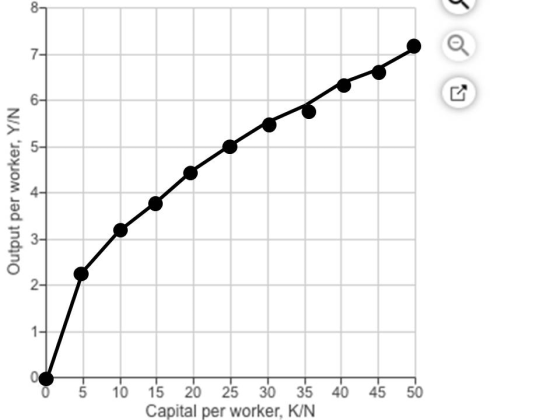
Use the function above to show how much output per worker can be produced from the following amounts of capital per worker:
K/N
= {0, 5, 10, 15, 20, 25, 30, 35, 40, 45, 50}
1.) Using the multipoint curve drawing
tool,
draw a curve showing the relationship between
Y/N and K/N
by using the above function and the values for
K/N.
Homework Answers
Data table
| K/N | Y/N = (K/N)^0.5 |
| 0 | 0 |
| 5 | 2.24 |
| 10 | 3.16 |
| 15 | 3.87 |
| 20 | 4.47 |
| 25 | 5 |
| 30 | 5.48 |
| 35 | 5.92 |
| 40 | 6.32 |
| 45 | 6.71 |
| 50 | 7.07 |
Graph
Add Answer to:
Use the function above to show how much output per worker can be
produced from the...
Q#04 (10 Marks) YIN = F(KIN, 1) Output per worker, YIN A B с Capital per...
 Q#04 (10 Marks) YIN = F(KIN, 1) Output per worker, YIN A B с Capital per worker, KIN a. According to the above diagram, explain the relationship between Output per Worker and Capital per Worker b. Explain the sources of growth in the above production function
The demand function for a monopoly shown in the graph at right is: Demand and Marginal...
 The demand function for a monopoly shown in the graph at right is: Demand and Marginal Revenue 120 110 100 p 80-2Q. Use the line drawing tool to draw the marginal revenue curve associated with the monopoly's demand curve. Label this line 'MR'. 90- 80 70- Carefully follow the instructions above, and only draw the required object. 60 50- 40 30- 20- 10- 0- 0 5 10 15 20 25 30 35 40 45 50 55 60 Quantity
Demand and Marginal Revenue The demand function for a monopoly shown in the graph at right...
 Demand and Marginal Revenue The demand function for a monopoly shown in the graph at right is: p = 120 - 20. Use the line drawing tool to draw the marginal revenue curve associated with the monopoly's demand curve. Label this line 'MR'. Carefully follow the instructions above, and only draw the required object. Price 0 5 10 15 20 25 30 35 40 45 50 55 60 Quantity Here Selected: none Delete Clear are com a
Assume fixed costs are $200/day and labor costs are $80 per day per worker (assume labor...
Assume fixed costs are $200/day and labor costs are $80 per day per worker (assume labor costs are the only variable costs). If the company could sell cases of snack cakes for $14 per case, how many cases of snack cakes should the company produce in order achieve the highest profit possible? # of Workers Q of Snack Cakes TVC TFC TC MC 0 0 1 5 1.6 10 2 15 2.35 20 2.75 25 3.22 30 3.75 35 4.35...
1. Assume that an economy described by a Solow model has a per-worker production function given...
 1. Assume that an economy described by a Solow model has a per-worker production function given by y- k05, where y is output per worker and k is capital stock per worker (capital-labor ratio). Assume also that the depreciation rate δ is 5%. This economy has no technological progress and no population growth (n 0). Both capital and labor are paid for their marginal products and the economy has been in a steady state with capital stock per worker at...
3. (15 pts). Assume that the per-worker production function is yr = 20 k'. Further, assume...
 3. (15 pts). Assume that the per-worker production function is yr = 20 k'. Further, assume that the saving rate, s = 0.1, the depreciation rate, = 0.125, and the population growth rate, n= 0. Calculate the following: (a) The steady-state values of the capital-labor ratio, k", output per worker, y, and consumption, c. (b) The new steady-state values of the capital-labor ratio, output, and consumption (ki. Yi, and ci) if there is a technological progress and A increases from...
An individual sets aside a certain amount of his income per month to spend on his...
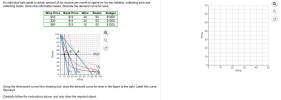 An individual sets aside a certain amount of his income per month to spend on his two hobbies, collecting wine and collecting books. Given the information below, illustrate the demand curve for wine Wine Price Book Price Wine Books Bud $15 $30 $60 40 20 10 50 50 50 $1200 $1200 1200 $12 PCC 10 20 30 40 50 Wine 0 10 20 30 40 50 60 70 80 90 1 Wine Using the three-point curved line drawing tool, draw...
Using the 3-point curved line drawing tool, draw a second isoquant that doubles output using a production function tha...
 Using the 3-point curved line drawing tool, draw a second
isoquant that doubles output using a production function that
exhibits
increasing increasing
returns to scale. Label your curve 'q = 200.'
Carefully follow the instructions above, and only draw the
required object.
wyd wath Pe... Kropbox - Japane... Desmos Graphin..._ Meaning of teebu... first academy lees... U Irvine - MYA.. mathxl.com/Student/Playe ionid=15&flushed=false&cd=57335268.centerwin=yes 3 Hi, Econ 100 A Fall 2019 mics Feifan Zhang S1 11/5/19 12:22 PM Do Homework Homework: Chapter...
Using the 3-point curved line drawing tool, draw a second
isoquant that doubles output using a production function that
exhibits
increasing increasing
returns to scale. Label your curve 'q = 200.'
Carefully follow the instructions above, and only draw the
required object.
wyd wath Pe... Kropbox - Japane... Desmos Graphin..._ Meaning of teebu... first academy lees... U Irvine - MYA.. mathxl.com/Student/Playe ionid=15&flushed=false&cd=57335268.centerwin=yes 3 Hi, Econ 100 A Fall 2019 mics Feifan Zhang S1 11/5/19 12:22 PM Do Homework Homework: Chapter...
Refer to the per worker production function presented in Figure 1 on the next page. Explain what a movement from point...
 Refer to the per worker production function presented in Figure
1 on the next page. Explain what a movement from point A to B
represents, and explain what a movement from point B to D
represents. Which change would be the best for sustained (long run)
economic growth?
Real GDP per hour worked Y/L Production functions 17 000 Production 16 400 function2 16 000 Production function 15 000 0 Capital per hour worked, K/L $50 000 $60 000 $70 000...
Refer to the per worker production function presented in Figure
1 on the next page. Explain what a movement from point A to B
represents, and explain what a movement from point B to D
represents. Which change would be the best for sustained (long run)
economic growth?
Real GDP per hour worked Y/L Production functions 17 000 Production 16 400 function2 16 000 Production function 15 000 0 Capital per hour worked, K/L $50 000 $60 000 $70 000...
2. (15 pts). Assume that the per-worker production function is y, 5.k Further, assume that the...
 2. (15 pts). Assume that the per-worker production function is y, 5.k Further, assume that the saving rate, s = 0.2, the depreciation rate, 8 0.04, and the population growth rate, n- 0. Calculate the following: (a) The steady-state values of the capital-labor ratio, k", output per worker, y, and consumption, c'. (b) The new steady-state values of the capital-labor ratio, output, and consumption (k, yi, and ci), if there is population growth so that n: 0.06. (c) Show your...
 Q#04 (10 Marks) YIN = F(KIN, 1) Output per worker, YIN A B с Capital per worker, KIN a. According to the above diagram, explain the relationship between Output per Worker and Capital per Worker b. Explain the sources of growth in the above production function
 The demand function for a monopoly shown in the graph at right is: Demand and Marginal Revenue 120 110 100 p 80-2Q. Use the line drawing tool to draw the marginal revenue curve associated with the monopoly's demand curve. Label this line 'MR'. 90- 80 70- Carefully follow the instructions above, and only draw the required object. 60 50- 40 30- 20- 10- 0- 0 5 10 15 20 25 30 35 40 45 50 55 60 Quantity
 Demand and Marginal Revenue The demand function for a monopoly shown in the graph at right is: p = 120 - 20. Use the line drawing tool to draw the marginal revenue curve associated with the monopoly's demand curve. Label this line 'MR'. Carefully follow the instructions above, and only draw the required object. Price 0 5 10 15 20 25 30 35 40 45 50 55 60 Quantity Here Selected: none Delete Clear are com a
 1. Assume that an economy described by a Solow model has a per-worker production function given by y- k05, where y is output per worker and k is capital stock per worker (capital-labor ratio). Assume also that the depreciation rate δ is 5%. This economy has no technological progress and no population growth (n 0). Both capital and labor are paid for their marginal products and the economy has been in a steady state with capital stock per worker at...
 3. (15 pts). Assume that the per-worker production function is yr = 20 k'. Further, assume that the saving rate, s = 0.1, the depreciation rate, = 0.125, and the population growth rate, n= 0. Calculate the following: (a) The steady-state values of the capital-labor ratio, k", output per worker, y, and consumption, c. (b) The new steady-state values of the capital-labor ratio, output, and consumption (ki. Yi, and ci) if there is a technological progress and A increases from...
 An individual sets aside a certain amount of his income per month to spend on his two hobbies, collecting wine and collecting books. Given the information below, illustrate the demand curve for wine Wine Price Book Price Wine Books Bud $15 $30 $60 40 20 10 50 50 50 $1200 $1200 1200 $12 PCC 10 20 30 40 50 Wine 0 10 20 30 40 50 60 70 80 90 1 Wine Using the three-point curved line drawing tool, draw...
 Using the 3-point curved line drawing tool, draw a second
isoquant that doubles output using a production function that
exhibits
increasing increasing
returns to scale. Label your curve 'q = 200.'
Carefully follow the instructions above, and only draw the
required object.
wyd wath Pe... Kropbox - Japane... Desmos Graphin..._ Meaning of teebu... first academy lees... U Irvine - MYA.. mathxl.com/Student/Playe ionid=15&flushed=false&cd=57335268.centerwin=yes 3 Hi, Econ 100 A Fall 2019 mics Feifan Zhang S1 11/5/19 12:22 PM Do Homework Homework: Chapter...
Using the 3-point curved line drawing tool, draw a second
isoquant that doubles output using a production function that
exhibits
increasing increasing
returns to scale. Label your curve 'q = 200.'
Carefully follow the instructions above, and only draw the
required object.
wyd wath Pe... Kropbox - Japane... Desmos Graphin..._ Meaning of teebu... first academy lees... U Irvine - MYA.. mathxl.com/Student/Playe ionid=15&flushed=false&cd=57335268.centerwin=yes 3 Hi, Econ 100 A Fall 2019 mics Feifan Zhang S1 11/5/19 12:22 PM Do Homework Homework: Chapter...
 Refer to the per worker production function presented in Figure
1 on the next page. Explain what a movement from point A to B
represents, and explain what a movement from point B to D
represents. Which change would be the best for sustained (long run)
economic growth?
Real GDP per hour worked Y/L Production functions 17 000 Production 16 400 function2 16 000 Production function 15 000 0 Capital per hour worked, K/L $50 000 $60 000 $70 000...
Refer to the per worker production function presented in Figure
1 on the next page. Explain what a movement from point A to B
represents, and explain what a movement from point B to D
represents. Which change would be the best for sustained (long run)
economic growth?
Real GDP per hour worked Y/L Production functions 17 000 Production 16 400 function2 16 000 Production function 15 000 0 Capital per hour worked, K/L $50 000 $60 000 $70 000...
 2. (15 pts). Assume that the per-worker production function is y, 5.k Further, assume that the saving rate, s = 0.2, the depreciation rate, 8 0.04, and the population growth rate, n- 0. Calculate the following: (a) The steady-state values of the capital-labor ratio, k", output per worker, y, and consumption, c'. (b) The new steady-state values of the capital-labor ratio, output, and consumption (k, yi, and ci), if there is population growth so that n: 0.06. (c) Show your...
Most questions answered within 3 hours.
-
Where is the error in this code sequence?
String s1 = "Hello";
String s2 = "ello";...
asked 10 months ago -
Financial data for Joel de Paris, Inc., for last year
follow:
Joel de Paris, Inc.
Balance...
asked 10 months ago -
Consider this reaction:
Al2(SO4)3 (aq)+ BaCl3
(aq) Al2Cl6 (aq)- +
3BaSO4(s) . What is the...
asked 10 months ago -
Suppose that Savneet is considering increasing her
recent random sample from 20 car rentals to 40...
asked 10 months ago -
Trucks arrive at an unloading terminal at an average rate of 120
per hour.
Trucks arrive...
asked 10 months ago -
Why are methanol and ethanol completely soluble in water while
octanol is not very little soluble....
asked 10 months ago -
A facilities manager at a university reads in a research report
that the mean amount of...
asked 10 months ago -
When the CuSO4 is rehydrated by adding water to the anhydrous
compound, is this an endothermic...
asked 10 months ago -
A ray of sunlight is passing from diamond into crown glass; the
angle of incidence is...
asked 10 months ago -
A block of mass 0.249 kg is placed on top of a light, vertical
spring of...
asked 10 months ago -
how do the kidneys compensate in the presences of acidosis
a) trigger hyperventilate
b) reserve acid...
asked 10 months ago -
Question 501 pts
The rental rate of capital to the firm increases. Which of the
following...
asked 10 months ago