

Homework Answers
Y = 30K + 10L
(1)
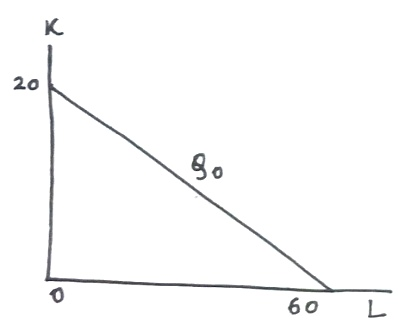
When Y = 600,
600 = 30K + 10L,or
60 = 3K + L
When L = 0, K = 60/3 = 20 (Vertical intercept) and when K = 0, L = 60 (Horizontal intercept).
In following graph, Q0 is above isoquant. For a linear production function, isoquants are straight lines touching both axes.
(2)
Since production function are linear, K and L are perfect substitutes. The production process requires 10 units of labor or 30 units of capital for Q level of output produced. So,
30 units of K can replace 10 units of L.
1 unit of K can replace (10/30) = (1/3) unit of L. This is the substitution ration between K and L.
(3)
Since the isoquant is a straight line, it is not convex. A convex isoquant requires a non-constant MRTS but for a linear isoquant, MRTS is constant where MRTS is the slope of isoquant.
(4)
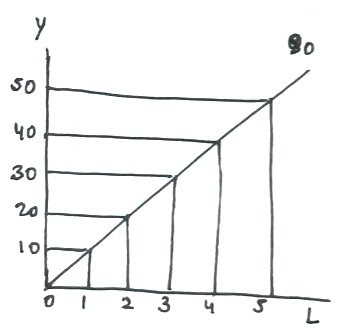
When K = 0,
Y = 10L
When L = 0, Y = 10 x 0 = 0
When L = 1, Y = 10 x 1 = 10
When L = 2, Y = 10 x 2 = 20
When L = 3, Y = 10 x 3 = 30
When L = 4, Y = 10 x 4 = 40
When L = 5, Y = 10 x 5 = 50
The following graph plots the isoquant Q0 which is a straight line from origin.
NOTE: As per Answering Policy, 1st 4 parts are answered.
Add Answer to:
Please show all work.
Problem #3: Long-Run Labor Demand and Factor Substitutability Suppose there are two...
Please show all work. Problem #3: Long-Run Labor Demand and Factor Substitutability Suppose there are two...
 Please show all work.
Problem #3: Long-Run Labor Demand and Factor Substitutability Suppose there are two inputs in the production function, labor (L) and capital (K), which carn be combined to produce Y units of output according to the following production function: Y = 30K + 10L The firm wants to produce 600 units of output. 1. Draw the isoquant that corresponds to that level of production (600 units) in a graph that has L on the horizontal axis and...
Please show all work.
Problem #3: Long-Run Labor Demand and Factor Substitutability Suppose there are two inputs in the production function, labor (L) and capital (K), which carn be combined to produce Y units of output according to the following production function: Y = 30K + 10L The firm wants to produce 600 units of output. 1. Draw the isoquant that corresponds to that level of production (600 units) in a graph that has L on the horizontal axis and...
Problem #3: Long-Run Labor Demand and Factor Substitutability Suppose there are two inputs in the production...
 Problem #3: Long-Run Labor Demand and Factor Substitutability Suppose there are two inputs in the production function, labor (L) and capital (K), which carn be combined to produce Y units of out put according to the following production function: Y-30K+10L The firm wants to produce 600 units of out put 1. Draw the isoquant that corresponds to that level of production (600 units) in a graph that has L on the horizontal axis and K on the vertical axis 2....
Problem #3: Long-Run Labor Dernand and Factor Substitutability Suppose there are two inputs in the production...
 Problem #3: Long-Run Labor Dernand and Factor Substitutability Suppose there are two inputs in the production function, labor (L) and capital (K), which can be combined to produe Y units of output according to the following production function Y = 30K + 10L The firm wants to produce 600 units of output 1. Draw the ot that corresponds to that level of production (600 units) in a graph that has L on the horizontal axis and K on the vertical...
Problem #3: Long-Run Labor Demand and Factor Substitutability Suppose there are two inputs in the production...
 Problem #3: Long-Run Labor Demand and Factor Substitutability Suppose there are two inputs in the production function, labor (L) and capital (K), which can be combined to produce Y units of output according to the following production function: 7. Suppose the firm can choose whatever combination of capital (K) and labor (L) it wants to produce 600 units. Suppose the price of capital is S1,000 per machine per week. What combination of inputs (K and L) will the firm use...
Consider a competitive firm that produces bots. Labor (L) and capital (K) are the only two...
 Consider a competitive firm that produces bots. Labor (L) and capital (K) are the only two inputs of production; each unit of labor is paid the market wage (w), and each unit of capital is rented at the rental price of capital (r). Output (Y) is therefore a function of labor and capital, or Y = f (K, L), and is sold at the market price (P). The goal of this firm is to maximize profit given the price of...
1. Suppose the production of digital cameras is characterized by the production function q F(K, L)- KL (MPL = K, MPK = L), where q represents the number of digital cameras produced. Suppose that...
 1. Suppose the production of digital cameras is characterized by the production function q F(K, L)- KL (MPL = K, MPK = L), where q represents the number of digital cameras produced. Suppose that the price of labor is $10 per unit and the price of capital is S1 per unit. (a) Graph the isoquant for q-121 000. (b) On the graph you drew for part a), draw several isocost lines including one that is tangent to the isoquant you...
Suppose a firm produces an output level according to the simple production function: Q = 5...
Suppose a firm produces an output level according to the simple production function: Q = 5 L K, which implies M P L = 5 K and M P K = 5 L. Further suppose a firm must pay labor (L) a wage rate (w) of $5 per unit, and the rental rate (r) on capital (K) is $25 per unit. A. Find the marginal rate of technical substitution. B. Write the equation for the isocost line. What is the...
Please help! Show all work and label answers clearly please! Thank you! 2. (12 total points,...
 Please help! Show all work and label answers clearly please!
Thank you!
2. (12 total points, Suppose a firm can use either Capital (K) or Labor (L) in a production process. The firm's production function is given by Q = 5L + 15K. The price of Capital is $20 per unit and the price of Labor is $8 per unit. a) (4 points) What is the firm's Total Cost function? TC(Q) = b) (8 points) Suppose the firm is producing...
Please help! Show all work and label answers clearly please!
Thank you!
2. (12 total points, Suppose a firm can use either Capital (K) or Labor (L) in a production process. The firm's production function is given by Q = 5L + 15K. The price of Capital is $20 per unit and the price of Labor is $8 per unit. a) (4 points) What is the firm's Total Cost function? TC(Q) = b) (8 points) Suppose the firm is producing...
Suppose a firm can use either Capital (K) or Labor (L) in a production process. The...
Suppose a firm can use either Capital (K) or Labor (L) in a production process. The firms Production function is given by Q = 5L + 15K. The price of Capital is $20 per unit and the price of Labor is $8 per unit. a) (4 points) What is the firm’s Total Cost function? TC(Q) = ____________________________ b) (8 points) Suppose the firm is producing 30 units of output (Q = 30). Using a graph, draw the firm’s isoquant for...
Please help! Please show all work! 2. (21 points. Suppose a firm's production function is given...
 Please help! Please show all work!
2. (21 points. Suppose a firm's production function is given by Q = L 1/2*K12. The Marginal Product of Labor and the Marginal Product of Capital are given by: MPL = 72 L 1/2K1/2and MPK = 12L12K-1/2 a) Suppose the price of labor is w=18, and the price of capital is r=2. Derive the firm's total cost function. b) What is the firm's marginal cost? c) For this problem, you will sketch the graph...
Please help! Please show all work!
2. (21 points. Suppose a firm's production function is given by Q = L 1/2*K12. The Marginal Product of Labor and the Marginal Product of Capital are given by: MPL = 72 L 1/2K1/2and MPK = 12L12K-1/2 a) Suppose the price of labor is w=18, and the price of capital is r=2. Derive the firm's total cost function. b) What is the firm's marginal cost? c) For this problem, you will sketch the graph...
 Please show all work.
Problem #3: Long-Run Labor Demand and Factor Substitutability Suppose there are two inputs in the production function, labor (L) and capital (K), which carn be combined to produce Y units of output according to the following production function: Y = 30K + 10L The firm wants to produce 600 units of output. 1. Draw the isoquant that corresponds to that level of production (600 units) in a graph that has L on the horizontal axis and...
Please show all work.
Problem #3: Long-Run Labor Demand and Factor Substitutability Suppose there are two inputs in the production function, labor (L) and capital (K), which carn be combined to produce Y units of output according to the following production function: Y = 30K + 10L The firm wants to produce 600 units of output. 1. Draw the isoquant that corresponds to that level of production (600 units) in a graph that has L on the horizontal axis and...
 Problem #3: Long-Run Labor Demand and Factor Substitutability Suppose there are two inputs in the production function, labor (L) and capital (K), which carn be combined to produce Y units of out put according to the following production function: Y-30K+10L The firm wants to produce 600 units of out put 1. Draw the isoquant that corresponds to that level of production (600 units) in a graph that has L on the horizontal axis and K on the vertical axis 2....
 Problem #3: Long-Run Labor Dernand and Factor Substitutability Suppose there are two inputs in the production function, labor (L) and capital (K), which can be combined to produe Y units of output according to the following production function Y = 30K + 10L The firm wants to produce 600 units of output 1. Draw the ot that corresponds to that level of production (600 units) in a graph that has L on the horizontal axis and K on the vertical...
 Problem #3: Long-Run Labor Demand and Factor Substitutability Suppose there are two inputs in the production function, labor (L) and capital (K), which can be combined to produce Y units of output according to the following production function: 7. Suppose the firm can choose whatever combination of capital (K) and labor (L) it wants to produce 600 units. Suppose the price of capital is S1,000 per machine per week. What combination of inputs (K and L) will the firm use...
 Consider a competitive firm that produces bots. Labor (L) and capital (K) are the only two inputs of production; each unit of labor is paid the market wage (w), and each unit of capital is rented at the rental price of capital (r). Output (Y) is therefore a function of labor and capital, or Y = f (K, L), and is sold at the market price (P). The goal of this firm is to maximize profit given the price of...
 1. Suppose the production of digital cameras is characterized by the production function q F(K, L)- KL (MPL = K, MPK = L), where q represents the number of digital cameras produced. Suppose that the price of labor is $10 per unit and the price of capital is S1 per unit. (a) Graph the isoquant for q-121 000. (b) On the graph you drew for part a), draw several isocost lines including one that is tangent to the isoquant you...
 Please help! Show all work and label answers clearly please!
Thank you!
2. (12 total points, Suppose a firm can use either Capital (K) or Labor (L) in a production process. The firm's production function is given by Q = 5L + 15K. The price of Capital is $20 per unit and the price of Labor is $8 per unit. a) (4 points) What is the firm's Total Cost function? TC(Q) = b) (8 points) Suppose the firm is producing...
Please help! Show all work and label answers clearly please!
Thank you!
2. (12 total points, Suppose a firm can use either Capital (K) or Labor (L) in a production process. The firm's production function is given by Q = 5L + 15K. The price of Capital is $20 per unit and the price of Labor is $8 per unit. a) (4 points) What is the firm's Total Cost function? TC(Q) = b) (8 points) Suppose the firm is producing...
 Please help! Please show all work!
2. (21 points. Suppose a firm's production function is given by Q = L 1/2*K12. The Marginal Product of Labor and the Marginal Product of Capital are given by: MPL = 72 L 1/2K1/2and MPK = 12L12K-1/2 a) Suppose the price of labor is w=18, and the price of capital is r=2. Derive the firm's total cost function. b) What is the firm's marginal cost? c) For this problem, you will sketch the graph...
Please help! Please show all work!
2. (21 points. Suppose a firm's production function is given by Q = L 1/2*K12. The Marginal Product of Labor and the Marginal Product of Capital are given by: MPL = 72 L 1/2K1/2and MPK = 12L12K-1/2 a) Suppose the price of labor is w=18, and the price of capital is r=2. Derive the firm's total cost function. b) What is the firm's marginal cost? c) For this problem, you will sketch the graph...
Most questions answered within 3 hours.
-
Where is the error in this code sequence?
String s1 = "Hello";
String s2 = "ello";...
asked 11 months ago -
Financial data for Joel de Paris, Inc., for last year
follow:
Joel de Paris, Inc.
Balance...
asked 11 months ago -
Consider this reaction:
Al2(SO4)3 (aq)+ BaCl3
(aq) Al2Cl6 (aq)- +
3BaSO4(s) . What is the...
asked 11 months ago -
Suppose that Savneet is considering increasing her
recent random sample from 20 car rentals to 40...
asked 11 months ago -
Trucks arrive at an unloading terminal at an average rate of 120
per hour.
Trucks arrive...
asked 11 months ago -
Why are methanol and ethanol completely soluble in water while
octanol is not very little soluble....
asked 11 months ago -
A facilities manager at a university reads in a research report
that the mean amount of...
asked 11 months ago -
When the CuSO4 is rehydrated by adding water to the anhydrous
compound, is this an endothermic...
asked 11 months ago -
A ray of sunlight is passing from diamond into crown glass; the
angle of incidence is...
asked 11 months ago -
A block of mass 0.249 kg is placed on top of a light, vertical
spring of...
asked 11 months ago -
how do the kidneys compensate in the presences of acidosis
a) trigger hyperventilate
b) reserve acid...
asked 11 months ago -
Question 501 pts
The rental rate of capital to the firm increases. Which of the
following...
asked 11 months ago