Which material would cause a more severe burn if equal masses of two distinct metals are...
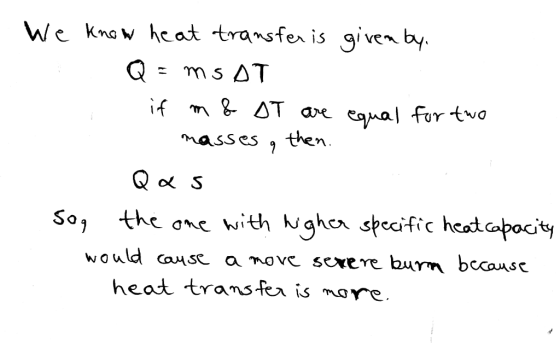
Which material would cause a more severe burn if equal masses of two distinct metals are heated to a temperature of 100 °C: the one with the higher specific heat capacity or the one with the lower specific heat capacity? Explain your answer using the definition of specific heat.
Homework Answers
Add Answer to:
Which material would cause a more severe burn if equal masses of
two distinct metals are...
Equal masses of aluminum and copper are heated to 100°C and placed in water. Which would...
 Equal masses of aluminum and copper are heated to 100°C and placed in water. Which would cause the water to reach the higher temperature? Explain.
Questions: 1. Which of the following metals is a better conductor of heat; Al with a...
 Questions: 1. Which of the following metals is a better conductor of heat; Al with a specific heat of 0.91 J/gºC or cast iron with a specific heat of 0.46 Jlg°C? 2. The specific heat of acetone is 2.18 J/gºC and the specific heat of water is 4.18 J/gºC. Two pieces of iron of equal mass were heated to 100°C. One was plunged into water at room temperature and one was plunged into acetone at room temperature. Which liquid would...
1. If equal masses of aluminum and copper are heated with same amount of heat, which...
 1. If equal masses of aluminum and copper are heated with same amount of heat, which would reach the higher temperature? Explain your answer.
When equal masses of each of the metals in the answers below absorb equal amounts of...
When equal masses of each of the metals in the answers below absorb equal amounts of heat, which undergoes the smallest temperature change? Group of answer choices Fe(s) Specific heat (J/g °C): 0.45 Mo(s) Specific heat (J/g °C): 0.25 Al(s) Specific heat (J/g °C): 0.90 Hg(l) Specific heat (J/g °C): 0.14
1a. Identify which will be hotter (have a higher final temperature) if you heat equal masses...
1a. Identify which will be hotter (have a higher final temperature) if you heat equal masses of water and aluminum, each starting at room temperature with 1.0 kJ of electrical energy. Explain your groups answer. 1b. You are holding an Al rod in one hand and an Fe rod in another. The rods have the same mass and temperature (273 K). Assuming the rate of heat transfer is the same for both, identify which one will come to your body...
in general which group of metals, nonmetals, organic compounds and aqueous solutions has the lowest specific...
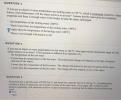 in general which group of metals, nonmetals, organic compounds
and aqueous solutions has the lowest specific heat
QUESTION 3 If you put an object at room temperature into boiling water at 100.°C, which is continually heated by a Buns burner, what temperature will the object achieve in an hour? Assume that the water does not completely evaporate and there is enough water in the beaker to keep the object submerged. the temperature of the boiling water (100°C) Much lower than...
in general which group of metals, nonmetals, organic compounds
and aqueous solutions has the lowest specific heat
QUESTION 3 If you put an object at room temperature into boiling water at 100.°C, which is continually heated by a Buns burner, what temperature will the object achieve in an hour? Assume that the water does not completely evaporate and there is enough water in the beaker to keep the object submerged. the temperature of the boiling water (100°C) Much lower than...
The 3. If two substances having different specific heat capacities have the same amount of heat...
 The 3. If two substances having different specific heat capacities have the same amount of heat energy added to them, which one will have a higher resulting temperature - the one with a lower specific heat capacity or the one with the higher specific heat capacity? Explain. 4. If the calculated specific heat is 0.125 J/g.°C, what metals from Table 1 could be the unknown? What additional measurable criteria could be used to differentiate between the metals? pen Cond Table...
please explain is details this thought Experiment: A composite material is composed of two mixed materials....
please explain is details this thought Experiment: A composite material is composed of two mixed materials. Composites can take many forms, like mixed metals, mixed polymers, mixed liquids, mixed gases, liquids dispersed in polymers, solids suspended in liquids, etc. Essentially, any singular system in which two or more distinct phases can be identified can loosely be called a composite (for example, we might define an immiscible mixture of water and oil as a composite, but we would not define saline...
subject: calorimetry Post Laboratory Questions 1. A student places 138 g of an unknown metal at...
 subject: calorimetry
Post Laboratory Questions 1. A student places 138 g of an unknown metal at 99.9°C into 60.00 g of water at 22.2 °C. The entire system reaches a uniform temperature of 31.5 °C. Calculate the specific heat capacity of the metal. 2. If the correct specific heat of the metal in problem 1 is 0.25 J/gºC, calculate the percent crror. 3. While transferring the piece of unknown metal to the calorimeter, the student dropped the metal into the...
subject: calorimetry
Post Laboratory Questions 1. A student places 138 g of an unknown metal at 99.9°C into 60.00 g of water at 22.2 °C. The entire system reaches a uniform temperature of 31.5 °C. Calculate the specific heat capacity of the metal. 2. If the correct specific heat of the metal in problem 1 is 0.25 J/gºC, calculate the percent crror. 3. While transferring the piece of unknown metal to the calorimeter, the student dropped the metal into the...
Thought Experiment: A composite material is composed of two mixed materials. Composites can take many forms,...
Thought Experiment: A composite material is composed of two mixed materials. Composites can take many forms, like mixed metals, mixed polymers, mixed liquids, mixed gases, liquids dispersed in polymers, solids suspended in liquids, etc. Essentially, any singular system in which two or more distinct phases can be identified can loosely be called a composite (for example, we might define an immiscible mixture of water and oil as a composite, but we would not define saline solution – salt dissolved in...
 Equal masses of aluminum and copper are heated to 100°C and placed in water. Which would cause the water to reach the higher temperature? Explain.
 Questions: 1. Which of the following metals is a better conductor of heat; Al with a specific heat of 0.91 J/gºC or cast iron with a specific heat of 0.46 Jlg°C? 2. The specific heat of acetone is 2.18 J/gºC and the specific heat of water is 4.18 J/gºC. Two pieces of iron of equal mass were heated to 100°C. One was plunged into water at room temperature and one was plunged into acetone at room temperature. Which liquid would...
 1. If equal masses of aluminum and copper are heated with same amount of heat, which would reach the higher temperature? Explain your answer.
 in general which group of metals, nonmetals, organic compounds
and aqueous solutions has the lowest specific heat
QUESTION 3 If you put an object at room temperature into boiling water at 100.°C, which is continually heated by a Buns burner, what temperature will the object achieve in an hour? Assume that the water does not completely evaporate and there is enough water in the beaker to keep the object submerged. the temperature of the boiling water (100°C) Much lower than...
in general which group of metals, nonmetals, organic compounds
and aqueous solutions has the lowest specific heat
QUESTION 3 If you put an object at room temperature into boiling water at 100.°C, which is continually heated by a Buns burner, what temperature will the object achieve in an hour? Assume that the water does not completely evaporate and there is enough water in the beaker to keep the object submerged. the temperature of the boiling water (100°C) Much lower than...
 The 3. If two substances having different specific heat capacities have the same amount of heat energy added to them, which one will have a higher resulting temperature - the one with a lower specific heat capacity or the one with the higher specific heat capacity? Explain. 4. If the calculated specific heat is 0.125 J/g.°C, what metals from Table 1 could be the unknown? What additional measurable criteria could be used to differentiate between the metals? pen Cond Table...
 subject: calorimetry
Post Laboratory Questions 1. A student places 138 g of an unknown metal at 99.9°C into 60.00 g of water at 22.2 °C. The entire system reaches a uniform temperature of 31.5 °C. Calculate the specific heat capacity of the metal. 2. If the correct specific heat of the metal in problem 1 is 0.25 J/gºC, calculate the percent crror. 3. While transferring the piece of unknown metal to the calorimeter, the student dropped the metal into the...
subject: calorimetry
Post Laboratory Questions 1. A student places 138 g of an unknown metal at 99.9°C into 60.00 g of water at 22.2 °C. The entire system reaches a uniform temperature of 31.5 °C. Calculate the specific heat capacity of the metal. 2. If the correct specific heat of the metal in problem 1 is 0.25 J/gºC, calculate the percent crror. 3. While transferring the piece of unknown metal to the calorimeter, the student dropped the metal into the...
Most questions answered within 3 hours.
-
Where is the error in this code sequence?
String s1 = "Hello";
String s2 = "ello";...
asked 10 months ago -
Financial data for Joel de Paris, Inc., for last year
follow:
Joel de Paris, Inc.
Balance...
asked 10 months ago -
Consider this reaction:
Al2(SO4)3 (aq)+ BaCl3
(aq) Al2Cl6 (aq)- +
3BaSO4(s) . What is the...
asked 10 months ago -
Suppose that Savneet is considering increasing her
recent random sample from 20 car rentals to 40...
asked 10 months ago -
Trucks arrive at an unloading terminal at an average rate of 120
per hour.
Trucks arrive...
asked 10 months ago -
Why are methanol and ethanol completely soluble in water while
octanol is not very little soluble....
asked 10 months ago -
A facilities manager at a university reads in a research report
that the mean amount of...
asked 10 months ago -
When the CuSO4 is rehydrated by adding water to the anhydrous
compound, is this an endothermic...
asked 10 months ago -
A ray of sunlight is passing from diamond into crown glass; the
angle of incidence is...
asked 10 months ago -
A block of mass 0.249 kg is placed on top of a light, vertical
spring of...
asked 10 months ago -
how do the kidneys compensate in the presences of acidosis
a) trigger hyperventilate
b) reserve acid...
asked 10 months ago -
Question 501 pts
The rental rate of capital to the firm increases. Which of the
following...
asked 10 months ago