


Homework Answers
Add Answer to:
Suppose we had a large, positively charged plate in an upright (vertical) position and a point...
Please explain how you approach this so I can emulate your problem solving strategies on like...
 Please explain how you approach this so I can emulate your
problem solving strategies on like problems
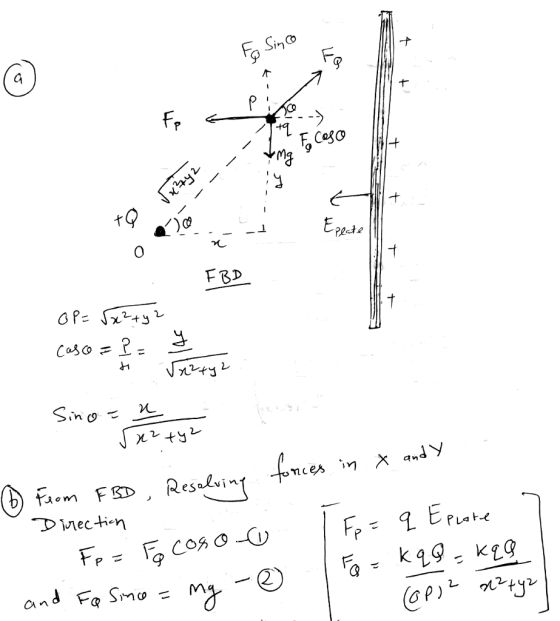
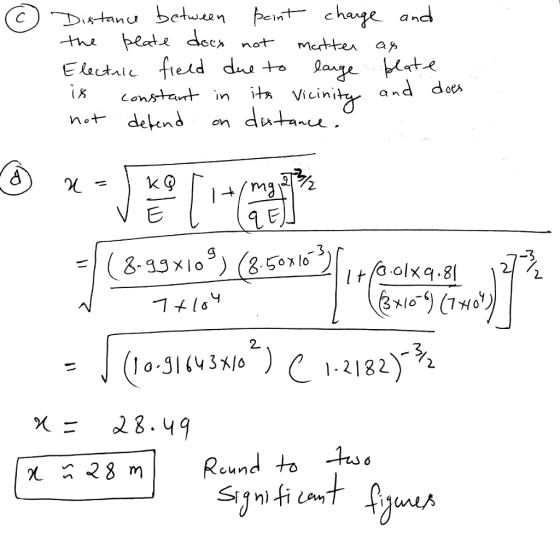
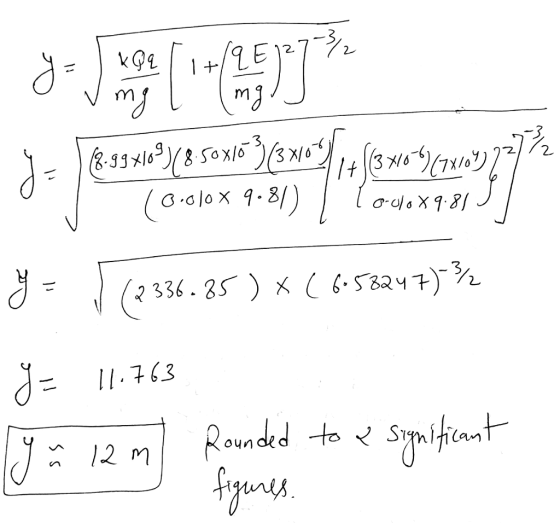
Suppose we had a large, positively charged plate in an upright (vertical) position and a point charge with positive charge +Q. In lecture, you saw that a large charged plate gives rise to an electric field which is constant in space: we will call this electric field Eplate. Let us suppose also that we had a s bl with positive charge +q and...
Please explain how you approach this so I can emulate your
problem solving strategies on like problems
Suppose we had a large, positively charged plate in an upright (vertical) position and a point charge with positive charge +Q. In lecture, you saw that a large charged plate gives rise to an electric field which is constant in space: we will call this electric field Eplate. Let us suppose also that we had a s bl with positive charge +q and...
In the figure is shown a distribution of three charges: A positively charged ring of charge...
In the figure is shown a distribution of three charges: A positively charged ring of charge +Q and radius R, lying in the x-y-plane centered on the origin. A small positively charged sphere with the same charge as the ring, +Q, and sitting on the y-axis at x = 0, y = R, z = 0. A negatively charge point charge, -q, sitting on the z-axis a distance d from the origin. Calculate the magnitude of the total force on...
Nine different charged balls, which we treat as point charges, are arranged in a highly symmetric...
 Nine different charged balls, which we treat as point charges, are arranged in a highly symmetric pattern around a square. Note that the value of Q is 7.00 x 10⁻⁶ C, and L = 60.0 cm. +30 to 30 2L 20 so 50 21 (a) What is the agitude of the net force experienced by the ball with the +Q charge at the center of the square, due to the other 8 charged balls? For the rest of this problem,...
Nine different charged balls, which we treat as point charges, are arranged in a highly symmetric...
 Nine different charged balls, which we treat as point charges, are arranged in a highly symmetric pattern around a square. Note that the value of Q is 6.00 x 10⁻⁶ C, and L = 60.0 cm. 2050 2L 50 50 2L (a) What is the magnitude of the net force experienced by the ball with the + charge at the center of the square, due to the other 8 charged balls? For the rest of this problem, we will consider...
Infinite sheet carrying surface charge density sigma = - 1 MuC/m^2 is in y-z plane. A...
 Infinite sheet carrying surface charge density sigma = - 1 MuC/m^2 is in y-z plane. A point charge q= +8pie MuC is located on x-axis at point (1,0) one meter from the origin. Find the forces acting on the charge q and on the charged plate. Find a coordinate or coordinates on the x-axis for which the net electric field zeroes.
Nine different charged balls, which we treat as point charges, are arranged in a highly symmetric...
 Nine different charged balls, which we treat as point charges, are arranged in a highly symmetric pattern around a square. Note that the value or 2 is 2.00 × 10⁻⁶ c, and L-60.0 cm. 20 5g 30 2I. +20 s Ca) what is the magnitude of the net force experienced by the ball with the +Q charge at the center af the square, due to the other g charged balls? For the rest of this problem, we will consider the...
Three very large charged metal plates are arranged as shown. The radius of each plate is...
 Three very large charged metal plates are arranged as shown. The
radius of each plate is 4 meters, and each plate is w = 0.05 mm
thick. The separation d1 is 8 mm, and the separation d2 is 3 mm.
Each plate has a tiny hole in it, so it is possible for a small
charged particle to pass through all the plates.
You are able to adjust the apparatus by varying the electric field
in the region between location...
Three very large charged metal plates are arranged as shown. The
radius of each plate is 4 meters, and each plate is w = 0.05 mm
thick. The separation d1 is 8 mm, and the separation d2 is 3 mm.
Each plate has a tiny hole in it, so it is possible for a small
charged particle to pass through all the plates.
You are able to adjust the apparatus by varying the electric field
in the region between location...
Nine different charged balls, which we treat as point charges, are arranged in a highly symmetric...
 Nine different charged balls, which we treat as point charges, are arranged in a highly symmetric pattern around a square. Note that the value of Q is 3.00 × 10⁻⁶ C, and -30.0 cm 5Q 20 50 30 2L +20 50 -50 2L (a) What is the magnitude of the net force experienced by the ball with the +Q charge at the center of the square, due to the other 8 charged balls? For the rest of this problem, we...
Can you explain your steps? Positively and negatively charged plates are shown. They are separated a...
 Can you explain your steps?
Positively and negatively charged plates are shown. They are separated a distance d- 0.580 m and the positive plates has a potential of +1600 V relative to the negative plate. Relative to the axis shown: What is the electric potential and electric field at different locations between 0 and d? 0.145 0,290 0.435 N/C A charge of #550 nC is moved along the axis. Relative to the negative plate, how much energy does the +350...
Can you explain your steps?
Positively and negatively charged plates are shown. They are separated a distance d- 0.580 m and the positive plates has a potential of +1600 V relative to the negative plate. Relative to the axis shown: What is the electric potential and electric field at different locations between 0 and d? 0.145 0,290 0.435 N/C A charge of #550 nC is moved along the axis. Relative to the negative plate, how much energy does the +350...
Question 4: Sphere in Fields Phenomenon: A positively charged sphere with charge q-2.00 x 10⁻¹⁹ C and mass m- 3.25 x 10⁻²⁷ kg is traveling in a straight line in the (-) direction. The sphere interact...
 Question 4: Sphere in Fields Phenomenon: A positively charged sphere with charge q-2.00 x 10⁻¹⁹ C and mass m- 3.25 x 10⁻²⁷ kg is traveling in a straight line in the (-) direction. The sphere interacts with an external electric field EExt--,4001 블, and an external magnetic field BExt-1.7n Ext out of page The Big Question we are trying to answer is how fast is the sphere moving? We will answer in steps Ext (a) What is/are the relative magnitude(s)...
 Please explain how you approach this so I can emulate your
problem solving strategies on like problems
Suppose we had a large, positively charged plate in an upright (vertical) position and a point charge with positive charge +Q. In lecture, you saw that a large charged plate gives rise to an electric field which is constant in space: we will call this electric field Eplate. Let us suppose also that we had a s bl with positive charge +q and...
Please explain how you approach this so I can emulate your
problem solving strategies on like problems
Suppose we had a large, positively charged plate in an upright (vertical) position and a point charge with positive charge +Q. In lecture, you saw that a large charged plate gives rise to an electric field which is constant in space: we will call this electric field Eplate. Let us suppose also that we had a s bl with positive charge +q and...
 Nine different charged balls, which we treat as point charges, are arranged in a highly symmetric pattern around a square. Note that the value of Q is 7.00 x 10⁻⁶ C, and L = 60.0 cm. +30 to 30 2L 20 so 50 21 (a) What is the agitude of the net force experienced by the ball with the +Q charge at the center of the square, due to the other 8 charged balls? For the rest of this problem,...
 Nine different charged balls, which we treat as point charges, are arranged in a highly symmetric pattern around a square. Note that the value of Q is 6.00 x 10⁻⁶ C, and L = 60.0 cm. 2050 2L 50 50 2L (a) What is the magnitude of the net force experienced by the ball with the + charge at the center of the square, due to the other 8 charged balls? For the rest of this problem, we will consider...
 Infinite sheet carrying surface charge density sigma = - 1 MuC/m^2 is in y-z plane. A point charge q= +8pie MuC is located on x-axis at point (1,0) one meter from the origin. Find the forces acting on the charge q and on the charged plate. Find a coordinate or coordinates on the x-axis for which the net electric field zeroes.
 Nine different charged balls, which we treat as point charges, are arranged in a highly symmetric pattern around a square. Note that the value or 2 is 2.00 × 10⁻⁶ c, and L-60.0 cm. 20 5g 30 2I. +20 s Ca) what is the magnitude of the net force experienced by the ball with the +Q charge at the center af the square, due to the other g charged balls? For the rest of this problem, we will consider the...
 Three very large charged metal plates are arranged as shown. The
radius of each plate is 4 meters, and each plate is w = 0.05 mm
thick. The separation d1 is 8 mm, and the separation d2 is 3 mm.
Each plate has a tiny hole in it, so it is possible for a small
charged particle to pass through all the plates.
You are able to adjust the apparatus by varying the electric field
in the region between location...
Three very large charged metal plates are arranged as shown. The
radius of each plate is 4 meters, and each plate is w = 0.05 mm
thick. The separation d1 is 8 mm, and the separation d2 is 3 mm.
Each plate has a tiny hole in it, so it is possible for a small
charged particle to pass through all the plates.
You are able to adjust the apparatus by varying the electric field
in the region between location...
 Nine different charged balls, which we treat as point charges, are arranged in a highly symmetric pattern around a square. Note that the value of Q is 3.00 × 10⁻⁶ C, and -30.0 cm 5Q 20 50 30 2L +20 50 -50 2L (a) What is the magnitude of the net force experienced by the ball with the +Q charge at the center of the square, due to the other 8 charged balls? For the rest of this problem, we...
 Can you explain your steps?
Positively and negatively charged plates are shown. They are separated a distance d- 0.580 m and the positive plates has a potential of +1600 V relative to the negative plate. Relative to the axis shown: What is the electric potential and electric field at different locations between 0 and d? 0.145 0,290 0.435 N/C A charge of #550 nC is moved along the axis. Relative to the negative plate, how much energy does the +350...
Can you explain your steps?
Positively and negatively charged plates are shown. They are separated a distance d- 0.580 m and the positive plates has a potential of +1600 V relative to the negative plate. Relative to the axis shown: What is the electric potential and electric field at different locations between 0 and d? 0.145 0,290 0.435 N/C A charge of #550 nC is moved along the axis. Relative to the negative plate, how much energy does the +350...
 Question 4: Sphere in Fields Phenomenon: A positively charged sphere with charge q-2.00 x 10⁻¹⁹ C and mass m- 3.25 x 10⁻²⁷ kg is traveling in a straight line in the (-) direction. The sphere interacts with an external electric field EExt--,4001 블, and an external magnetic field BExt-1.7n Ext out of page The Big Question we are trying to answer is how fast is the sphere moving? We will answer in steps Ext (a) What is/are the relative magnitude(s)...
Most questions answered within 3 hours.
-
Where is the error in this code sequence?
String s1 = "Hello";
String s2 = "ello";...
asked 11 months ago -
Financial data for Joel de Paris, Inc., for last year
follow:
Joel de Paris, Inc.
Balance...
asked 11 months ago -
Consider this reaction:
Al2(SO4)3 (aq)+ BaCl3
(aq) Al2Cl6 (aq)- +
3BaSO4(s) . What is the...
asked 11 months ago -
Suppose that Savneet is considering increasing her
recent random sample from 20 car rentals to 40...
asked 11 months ago -
Trucks arrive at an unloading terminal at an average rate of 120
per hour.
Trucks arrive...
asked 11 months ago -
Why are methanol and ethanol completely soluble in water while
octanol is not very little soluble....
asked 11 months ago -
A facilities manager at a university reads in a research report
that the mean amount of...
asked 11 months ago -
When the CuSO4 is rehydrated by adding water to the anhydrous
compound, is this an endothermic...
asked 11 months ago -
A ray of sunlight is passing from diamond into crown glass; the
angle of incidence is...
asked 11 months ago -
A block of mass 0.249 kg is placed on top of a light, vertical
spring of...
asked 11 months ago -
how do the kidneys compensate in the presences of acidosis
a) trigger hyperventilate
b) reserve acid...
asked 11 months ago -
Question 501 pts
The rental rate of capital to the firm increases. Which of the
following...
asked 11 months ago